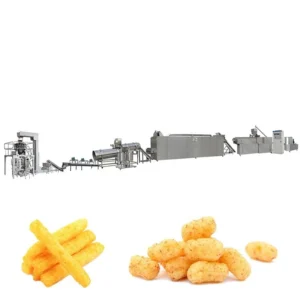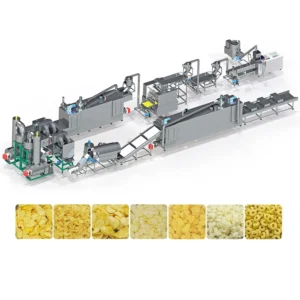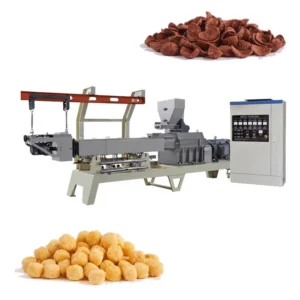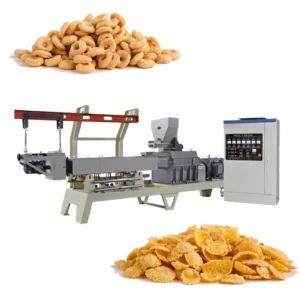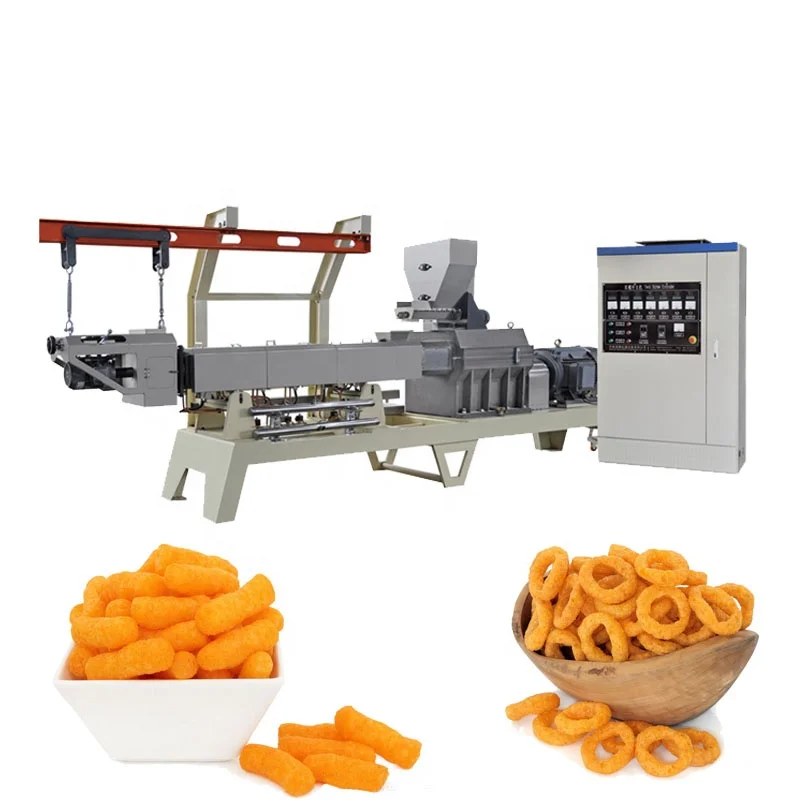
Engineered Screw Builds — every MT75 barrel and screw element sequence is matched to the buyer’s cereal formulation and verified with in-house trial runs before shipment.
Technical Specifications
| Parameter | Value |
|---|---|
| Model | MT75 |
| Product Type | Twin Screw Corn Flakes Extrusion Production Line |
| Screw Type | Twin-screw |
| Installed Power | 210 kW |
| Power Consumption | 150 kW |
| Capacity | 300–500 kg/h (basis not stated in source — confirm raw material, moisture content, and target flake thickness) |
| Overall Dimensions (L×W×H) | 45 × 1.5 × 3.5 m |
| Control System | PLC and MCC |
| Flaking Roller Drive | Double motors, separate roller driving |
| Hydraulic System | Hydraulic system for double rollers |
| Temperature Control | Infrared sensor for even temperature pipe control |
| Dryer Heating Source | Gas or Electric (source value — verify against manufacturer catalog) |
| Roasting Oven | Hot air roasting with conciliation burner, two circulating fans, cyclone dust removal |
| Coating System | Double tumble for sugar melting, elevator, coating drum, spraying nozzle |
| Lubrication | Automatic lubricating and cooling system |
| Raw Materials | Corn, rice, wheat, oat, barley powder |
| Die Configuration | Adjustable mould for ball, tube, stick, ring, fruit loop, star, wheel, flower, heart |
Application Suitability
| Application | Material or Output |
|---|---|
| Natural corn flakes from whole corn grits | Corn powder, multi-grain cereal blends |
| Sugar-coated breakfast cereals | Corn, rice, and oat-based pellets with glaze coating |
| Shaped cereal snacks | Fruit loops, stars, wheels, rings from rice or wheat flour blends |
| Pilot and mid-scale cereal lines | Multi-grain formulations requiring die and screw reconfiguration |
Why a Generic Screw Build Fails Your Corn Flake Line
The extrusion parameters must follow the raw material, not the other way around.
I spent years on installation sites watching lines that ran perfectly during factory acceptance collapse the moment the buyer’s actual grain blend hit the hopper. A twin screw corn flakes extruder extrusion technology setup copied from a catalog default will produce pellets with the wrong density — too soft to flake evenly, or too dense to crisp after roasting. The fat content in the buyer’s corn source, the protein level in a multi-grain blend, even the ambient humidity in the production hall all shift the gelatinisation window. [NEED_CITE: starch gelatinisation behaviour varies with lipid and protein content in cereal formulations] When the screw compression ratio and barrel temperature profile are not adjusted for these variables, the line produces flakes that break in the bowl or sink when milk is poured.
Screw Element Arrangement and Starch Gelatinisation
The twin screw corn flakes extruder extrusion technology on the MT75 relies on a specific sequence of conveying, kneading, and reverse-screw elements to control how completely the starch granules break down inside the barrel. Corn flour demands a different compression profile than an oat-heavy blend because the lipid content alters how moisture penetrates the starch matrix. Engineers configure the element stack so that the dough reaches the target gelatinisation degree at the metering section, producing a consistent rheology that the flaking rollers can handle without tearing.
Barrel Zone Temperature Ramps and Moisture Migration
Each barrel zone on the MT75 is independently heated, creating a controlled temperature ramp from the feed section through compression to the die face. This gradient governs how moisture migrates through the dough mass and how rapidly expansion occurs at the die exit. A flat temperature profile causes uneven cooking — the core of the pellet remains under-gelatinised while the surface over-expands. [NEED_CITE: barrel temperature profiling in twin-screw food extrusion for cereal applications] The infrared sensor on the flaking station monitors pipe temperature to maintain uniformity downstream, but the critical thermal work happens inside the barrel zones before the dough ever reaches the rollers.
Interpreting the Core Parameters
The 210 kW installed power on the MT75 reflects the torque demand of driving twin screws through a high-moisture cereal dough at the compression ratios required for corn flake gelatinisation. Power consumption rated at 150 kW indicates the typical running load once the barrel is thermally stabilised. The PLC and MCC control system allows operators to set and lock each barrel zone temperature, screw speed, and feed rate — parameters that directly determine whether the starch reaches the gelatinisation percentage needed for proper flaking. The hydraulic double-roller flaking station applies even pressure across the pellet width, which matters because uneven roller gap produces flakes that roast at different rates. The automatic lubricating and cooling system keeps the screw shaft bearings within tolerance during extended production runs, preventing thermal drift that would otherwise shift the shear profile inside the barrel over the course of a shift.
What Happens When Die Geometry Is Wrong
A die insert specified for tube-shaped cereal will not produce acceptable fruit loops without reconfiguration — the wall thickness, land length, and orifice diameter each govern expansion behaviour at the cut-off point. When a line is supplied with a generic die plate, the buyer discovers on commissioning day that shaped cereals emerge with collapsed walls or uneven density. [NEED_CITE: die land length and orifice geometry effects on extrudate expansion in twin-screw systems] Reworking the die after installation means weeks of lost production while replacement inserts are manufactured and shipped. The MT75 ships with die configuration records documenting the orifice specification and the formulation it was designed for, so the buyer’s process team knows exactly which insert to load for each product format.
Why This Line Is Configured Differently
The screw build is specified to the buyer’s raw material formulation, not pulled from a standard library. An in-house testing workshop runs trial batches on the buyer’s actual cereal blend before the line ships, generating data on pellet density, gelatinisation degree, and flake crispness after roasting. The complete line — from mixing through extrusion, flaking, drying, hot air roasting, and packing — is supplied under one configuration so throughput is matched at every station. Barrel temperature profiles and moisture range data are documented per zone, giving the buyer’s process engineers a validated starting point for commissioning. Electrical schematics and voltage specifications are confirmed against the buyer’s site supply before production begins, eliminating the most common cause of delayed start-ups.
Documentation & Verification
- Screw and die configuration record matched to your cereal blend formulation
- Trial run report on your raw material covering pellet density and flake crispness
- Barrel temperature profile sheet with zone set-points and acceptable deviation windows
- Electrical schematic with confirmed voltage, frequency, and control language
- Line layout showing throughput matching across every station from mixer to packer
- Operation and maintenance manual with wear parts list for screws, dies, and roller surfaces
Installation, Commissioning & Support
- Foundation plan accounts for the MT75 line length of 45 metres and flaker vibration isolation
- Electrical hookup requires dedicated circuit rated for 210 kW installed load at confirmed site voltage
- Barrel zone temperature calibration and screw speed ramp performed on your raw material during commissioning
- Operator training covers die changeover procedure for switching between natural flake and shaped cereal formats
- Wear parts inventory includes screw elements, die inserts, and flaking roller sleeves matched to your production schedule
- Lubrication system intervals set based on your daily run hours and ambient workshop conditions
What We Need to Configure Your Line
Provide the specific cereal blend you plan to run — corn variety, percentage of rice or oat, and any added protein or fibre ingredients — along with your target flake thickness and bowl-life expectation. Share your site voltage, frequency, and preferred control language so the electrical package is built to match. If you are developing a new shaped cereal format, send the target geometry and dimensions so the die insert can be designed before the trial run.
Frequently Asked Questions
Q: How is screw configuration selected for different cereal blends?
A: Corn, rice, wheat, and oat each have different starch and lipid profiles that change how the dough behaves under shear. Engineers adjust the screw element sequence — the ratio of conveying to kneading blocks and the compression ratio — to match the specific formulation. The MT75 screw build is documented per your recipe, not copied from a generic template.
Q: What barrel temperature profile produces correct starch gelatinisation for corn flakes?
A: The barrel zones follow a defined ramp from the feed section through compression to metering, with each zone set-point calibrated to the residence time and moisture level of your blend. Too low a temperature leaves the starch under-cooked and the flake crumbly; too high causes surface burning before the core is done. The profile is validated during the in-house trial run.
Q: How does die design affect pellet shape and post-flake density?
A: The die orifice diameter, land length, and cut-off timing determine the pellet geometry and how much it expands at the exit. A ball-shaped die requires a different land length than a ring die to achieve even wall thickness. The MT75 ships with interchangeable die inserts, each documented for the target shape and the expansion rate of your formulation.
Q: Can the extruder handle different moisture levels for natural versus sugar-coated lines?
A: Natural corn flakes and sugar-coated variants require different feed moisture targets and expansion rates at the die face. The screw speed and barrel zone temperatures are adjusted to produce a denser pellet for sugar-coated workflows, where the coating drum adds moisture that the flake must absorb without losing structural integrity. Both configurations are tested during the trial run.
Q: Is a trial run performed before shipment and what data does it produce?
A: The testing workshop runs your actual cereal blend through the MT75, measuring pellet density, starch gelatinisation degree, and flake crispness after roasting. The trial run report documents every parameter — barrel temperatures, screw speed, feed moisture, die insert used — so your process team has a validated baseline for commissioning.