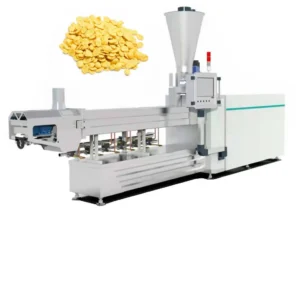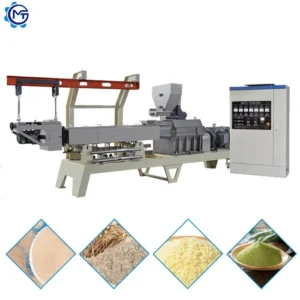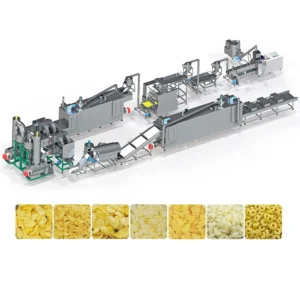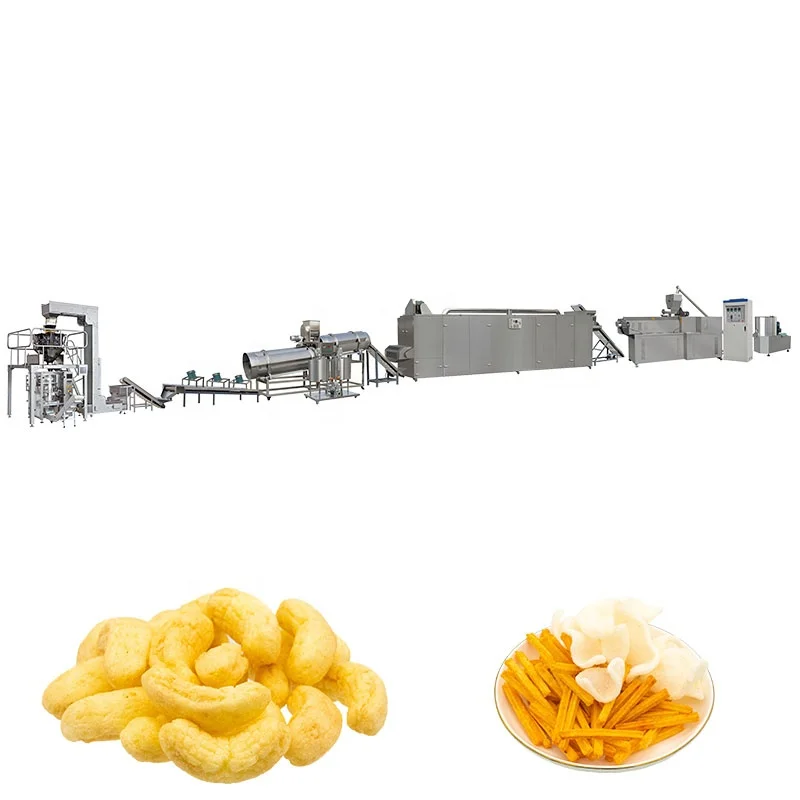
Customized Extrusion Parameters — screw pitch, barrel zones and die geometry configured to your corn blend and target flake density rather than a generic build.
Technical Specifications
| Parameter | Value |
|---|---|
| Model | MT75 |
| Product Type | Corn Flakes Production Line |
| Extruder Type | Twin Screw |
| Installed Power | 210 kW |
| Power Consumption | 150 kW |
| Output Capacity | 300–500 kg/h (basis not stated in source — confirm raw material / moisture) |
| Overall Dimensions | 45 × 1.5 × 3.5 m |
| Raw Materials | Corn, rice, wheat, oat, barley powder |
| Control System | PLC and MCC available for line |
| Dryer Heating Source | Gas / Electric |
| Final Product Shapes | Natural corn flakes, sugar-coated flakes, ball, tube, stick, ring, fruit loop, star, wheel, flower, heart |
| Standards | CE, ISO |
Application Suitability
| Application | Material or Output |
|---|---|
| Natural breakfast cereal production | Corn grits and maize flour extruded into thin, crispy flakes for retail packaging |
| Sugar-coated cereal lines | Extruded corn or rice flakes passed through sugar spraying and coating drums |
| Multi-grain flake formats | Blends of wheat, oat and barley powder processed through twin-screw gelatinisation |
| Shaped cereal variants | Rings, balls, stars and fruit loops produced by adjusting extruder die plates |
What Your Corn Grits Specification Has to Do with Barrel Temperature
Corn flakes extrusion line specifications mean nothing until they are locked to the exact grain blend you will actually run.
I once stood on a factory floor in the Gulf region watching an operator try to push whole-grain corn through a barrel profile that had been set for standard degerminated grits. The flakes came out thick, dense and chewy — the exact opposite of what the supermarket buyer expected. The extruder was not faulty; the screw configuration and temperature zones had simply been specified to a different raw material. Every corn flakes extrusion line specifications sheet must start with the buyer’s flour analysis, not the builder’s default template [NEED_CITE: starch gelatinisation temperature thresholds across corn varieties].
Screw Configuration and Starch Gelatinisation Control
Twin-screw extrusion in corn flake production centres on achieving consistent starch gelatinisation across every particle in the barrel. The corn flakes extrusion line specifications define screw element sequencing — conveying sections, kneading blocks and reverse-flight zones — each chosen to manage residence time and shear against the specific starch content of your grain. A high-fibre whole grain blend demands different kneading intensity than degerminated corn, and getting this wrong produces uneven flake texture downstream.
Barrel Temperature Profiling Across Heating Zones
Each barrel zone operates at an independent temperature, and the profile from feed inlet to die face determines how completely the starch matrix opens. Too aggressive a ramp causes premature expansion before the dough reaches the flaking rolls; too flat a profile leaves hard, under-cooked centres that shatter during roasting. PLC control across the barrel zones holds these setpoints within tight margins, which matters when ambient workshop temperatures in the Middle East can push past 50°C during summer shifts [NEED_CITE: ambient temperature effects on extrusion barrel thermal management].
Die Geometry and Its Influence on Flake Thickness
The die plate at the extruder discharge determines the cross-section of the extrudate rope before it enters the flaking machine. For traditional flat corn flakes, a slot die produces a wide ribbon that the hydraulic double-roller system compresses to target thickness. For shaped cereals — rings, stars, balls — interchangeable die inserts redirect the flow into the required geometry. Die land length and opening dimensions directly affect back-pressure inside the barrel, which in turn influences expansion ratio and final flake density in the bowl.
How Flaking and Roasting Parameters Complete the Texture
The flaking machine uses a hydraulic system with separate motors driving each roller, and infrared sensors monitor surface temperature to maintain uniform compression. After flaking, the hot air roasting oven uses a vibrating pan with high-temperature spraying tubes and two separate circulating fans to drive surface bubbling — that characteristic blistered look consumers associate with quality corn flakes. Cyclone dust removal keeps the roasting chamber clear of fines that would otherwise scorch and taint subsequent batches.
The Hidden Cost of Unspecified Line Configurations
When extruder throughput is not matched to flaking capacity and roaster dwell time, the bottleneck simply migrates. I have seen lines where the twin-screw extruder produced steadily, but the roasting oven could not keep pace, forcing operators to throttle back the entire line and lose hours of output every shift. A capacity calculation that ignores the slowest station is not a specification — it is a wish. Buyers who skip the throughput-matching step end up paying for installed capacity they can never reach [NEED_CITE: production line bottleneck analysis in food extrusion systems].
Why Engineers Specify This Configuration Here
Screw and die configurations are documented to your raw material and target flake density, not pulled from a generic library. Every line undergoes a trial run in the testing workshop using the buyer’s own grain blend before dispatch, so barrel temperatures and moisture levels are validated in advance. PLC and MCC control panels are wired to the voltage and frequency standard of the destination facility, eliminating commissioning delays. The line layout matches throughput across mixing, extruding, flaking, drying and roasting so no single station constrains output. Complete documentation — from screw configuration records to CE declarations — ships with every delivery.
Documentation & Verification
- Screw and die configuration record matched to your corn or multi-grain blend specification
- Trial run report on customer-supplied raw material completed before shipment
- Line layout with capacity calculation showing throughput balance across all stations
- Electrical schematic confirming voltage, frequency and control language to your facility
- CE declaration of conformity and ISO certificate included in shipping documentation
Installation, Commissioning & Support
- Overall footprint of 45 × 1.5 × 3.5 m requires level concrete floor with anchor points for extruder and flaking units
- 210 kW installed power demands dedicated three-phase supply; confirm local voltage before panel build
- Line ships in modular sections for container loading; on-site assembly includes barrel alignment and roller calibration
- First-run commissioning covers PLC parameter upload, barrel zone tuning and flaking pressure adjustment
- Operator training addresses screw wear inspection, die changeover and infrared sensor calibration
- Wear parts list covers screws, die inserts and flaking roller surfaces with recommended replacement intervals
Preparing Your Technical Inquiry
To move from concept to line configuration, share your raw material specification including grain type, particle size and moisture content. Confirm the target flake density, bowl-life requirement and whether you plan to run sugar-coated variants. Provide your workshop voltage, frequency and preferred control language so the electrical schematics align with local standards from day one.
Frequently Asked Questions
Q: How is screw configuration specified to my corn blend and target flake density?
A: The screw element sequence — conveying flights, kneading blocks and reverse elements — is designed around your grain’s starch content, fat level and particle size. Die geometry is selected to match the required extrudate cross-section, and the full configuration is recorded in documentation that ships with the line.
Q: How is output capacity confirmed on my actual grain before the line ships?
A: A trial run is conducted in the testing workshop using your raw material. Barrel temperatures, moisture addition and screw speed are adjusted until the extrudate meets your flake density and texture targets, and the results are documented in a trial report provided before dispatch.
Q: What barrel temperature and moisture settings differ between natural and sugar-coated flakes?
A: Natural flakes typically run with lower barrel moisture to achieve a crisp, dry texture straight from the roasting oven. Sugar-coated variants may use slightly higher moisture during extrusion to support the additional coating and drying stages without compromising structural integrity.
Q: Can I run a trial on my raw material in your testing workshop?
A: Yes. The in-house testing workshop is equipped to process your specific corn, wheat, oat or barley blend through the twin-screw extruder. You receive a full trial report covering extrusion parameters, flake thickness measurements and roasting results before committing to shipment.
Q: How are extruder, flaking and roasting capacities matched across the line?
A: Throughput at every station — mixing, extruding, flaking, drying and roasting — is calculated together during the layout phase. The line specification shows matched capacities so no single machine creates a bottleneck, and the calculation is included in the project documentation for your review.