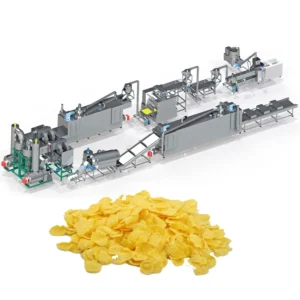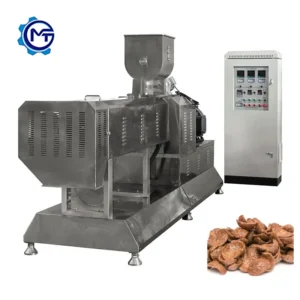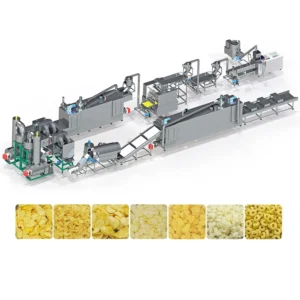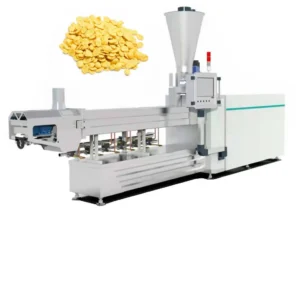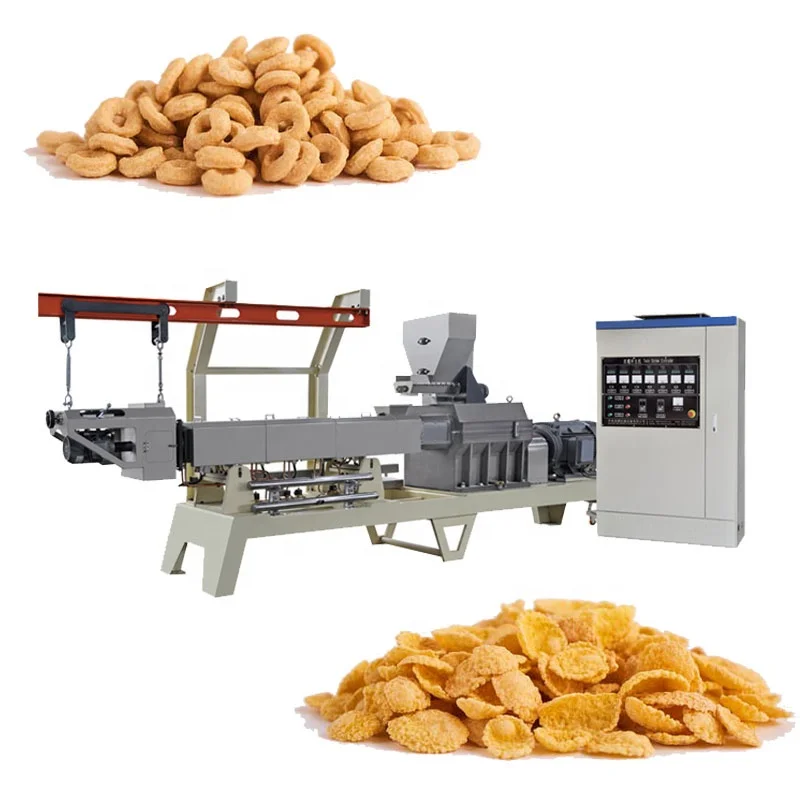
Custom screw and die configuration — Every MT75 build starts with your specific corn, oat, or barley formulation, with trial runs on your actual raw material in our testing workshop before shipment.
Technical Specifications
| Parameter | Value |
|---|---|
| Product Type | Twin Screw Corn Flakes Extrusion Line |
| Available Models | MT70 / MT85 / MT75 |
| Screw Type | Twin Screw |
| Installed Power | MT70 — 160 kW; MT85 — 190 kW; MT75 — 210 kW |
| Power Consumption | MT70 — 120 kW; MT85 — 140 kW; MT75 — 150 kW |
| Output Capacity | MT70 — 150–200 kg/h (basis not stated in source — confirm raw material / moisture); MT85 — 300–400 kg/h (basis not stated in source — confirm raw material / moisture); MT75 — 300–500 kg/h (basis not stated in source — confirm raw material / moisture) |
| Overall Dimensions | MT70 — 41 × 1.5 × 2.2 m; MT85 — 43 × 1.5 × 3.2 m; MT75 — 45 × 1.5 × 3.5 m |
| Control System | PLC and MCC available |
| Flaking Machinery | Hydraulic double-roller system with separate motor driving; infrared temperature control |
| Dryer Heating Source | Gas or Electric (configurable) |
| Hot Air Roasting Oven | Conciliation burner; dual circulating fans; cyclone dust removal; vibrating pan with high-temperature spraying tubes |
| Coating System | Double tumble sugar melting, elevator, coating drum, spraying nozzle |
| Basic Materials Processed | Corn, rice, wheat, oat, barley powder |
| Production Procedure | Mixing → Extruding → Flaking → Drying → Hot Air Roasting → Sugar Coating (optional) → Cooling → Packing |
| Certifications | CE (certified since 2014); ISO |
Application Suitability
| Application | Material or Output |
|---|---|
| Natural corn flakes production | Corn grits or corn flour at controlled moisture |
| Sugar-coated breakfast cereals | Corn, wheat, or oat base with sugar syrup coating |
| Oatmeal and multigrain flakes | Oat, barley, or blended grain formulations |
| 2D shaped cereal snacks | Rings, loops, stars, wheels via extruder die change |
| Fortified cereal lines | Grain blends with added nutritional premix |
What Your Raw Material Actually Does to Corn Flakes Extrusion Line Specifications
Nominal throughput means nothing when your local corn has different starch and protein ratios than the test standard.
I spent eleven days on-site in South Asia watching a corn flakes line fail to produce intact flakes. The factory trial back in Jinan ran perfectly on standard corn grits, but the locally sourced grain had lower starch content and higher protein. The flakes cracked under roller pressure, blistered unevenly in the roasting oven, and came out of the dryer too dense. We rebuilt the entire barrel temperature profile and screw speed curve from scratch. The corn flakes extrusion line specifications you receive on paper must account for the grain you will actually feed into the hopper, not a generic reference material [NEED_CITE: grain composition variability by region and harvest season].
Barrel Temperature Zones and Starch Gelatinisation Control
The twin screw extruder processes cereal dough through multiple heating zones where starch gelatinisation must occur uniformly. If the barrel temperature profile is too aggressive, the dough skins over before the core cooks through, producing flakes with a hard shell and a raw centre. If it is too gentle, the dough exits under-gelatinised and the flaking rollers cannot compress it into a coherent sheet. The MT75 configuration includes a dedicated heating system with independent zone control, allowing the operator to match the thermal curve to the specific gelatinisation onset temperature of corn, oat, or barley starch.
Screw Configuration and Die Design for Different Grain Formulations
Corn, wheat, oat, and barley each behave differently under shear and pressure inside the extruder barrel. Corn relies on high starch content for expansion; oat brings more fat and fibre, which lubricates the screw and reduces shear heating. The screw configuration and die geometry must be specified for the target formulation. A die opening sized for corn grits will produce over-expanded, fragile dough from an oat-heavy blend, and the downstream flaking rollers will crush it rather than flatten it. This is why every build begins with a screw and die configuration record tied to your raw material [NEED_CITE: twin screw extrusion screw element design for cereal processing].
Hydraulic Flaking Station and Infrared Roller Temperature
Once the extruded dough exits the die and is cut into pellets, the flaking machinery compresses each piece between two hydraulically driven rollers. The MT75 line uses separate motors for each roller, allowing independent speed and pressure adjustment. Infrared sensors monitor roller surface temperature continuously, because if one roller runs hotter than the other, the flake sticks to the warmer surface and tears. Uniform flake thickness depends on this thermal balance as much as on the hydraulic pressure setting.
Hot Air Roasting Oven and Surface Blistering
The roasting stage develops the characteristic blistered surface and crispness that defines a quality corn flake. The conciliation burner and dual circulating fans in the hot air oven create a controlled convection environment where surface moisture flashes off rapidly while the flake interior retains just enough moisture to stay intact. The vibrating pan with high-temperature spraying tubes keeps flakes moving to prevent scorching. Cyclone dust removal pulls fine particulate out of the airstream so it does not deposit back onto the product. Getting this stage right is where the corn flakes extrusion line specifications on paper either hold up in production or fall apart [NEED_CITE: cereal flake roasting parameters for surface blister development].
Power Draw, Motor Sizing, and Throughput Matching Across Stations
The installed power figures — ranging from 160 kW on the MT70 to 210 kW on the MT75 — cover the full line from mixer through packing. The extruder motor must deliver enough torque to maintain screw speed under the viscous load of gelatinised cereal dough, while the flaking rollers need sufficient hydraulic pressure without stalling. The dryer and roasting oven must have thermal capacity matched to the extruder output so that wet flakes do not pile up waiting for oven space. When every station is sourced from one supplier, throughput is balanced across the entire line rather than assembled from mismatched standalone machines.
The Hidden Cost of a Generic Screw Build
When the screw profile and die design are copied from a reference line rather than engineered for your grain blend, the failures do not show up during the factory test — they appear three weeks into production when you switch to a new batch of raw material. Flakes come out too thin and shatter during packing, or too thick and remain chewy after roasting. Operators compensate by slowing the extruder, which drops output below the quoted capacity. The dryer then runs partially empty, wasting fuel, and the coating drum receives an inconsistent feed that leaves some flakes bare and others over-glazed [NEED_CITE: extrusion process deviation costs in cereal manufacturing].
Why Source This Corn Flakes Line Here
The testing workshop runs your actual raw material through the extruder before the line ships, so screw configuration and die design are validated against your grain, not a generic standard.
Every station — mixing, extruding, flaking, drying, roasting, coating, cooling, packing — is throughput-matched under one supplier, eliminating the bottleneck that appears when a flaking station from one vendor cannot keep pace with an extruder from another.
The PLC control system can be configured with your local voltage, frequency, and operator language before commissioning, so the first production run does not stall over a mislabeled HMI screen.
Screw elements, die inserts, and flaking roller surfaces are documented in a wear parts list at shipment, with replacements available when your first changeover is due.
On-site installation, commissioning, and operator training are included, with the same engineers who oversaw the factory test present at your facility for startup.
Documentation & Verification
- Screw and die configuration record matched to your grain formulation, not a generic template
- Trial run report on your raw material verifying flake density, thickness, and surface texture before dispatch
- Line layout and capacity calculation drawn to your factory footprint with station-by-station throughput data
- Electrical schematic confirming voltage, frequency, and PLC language for your destination market
- CE declaration of conformity and ISO certificate for import clearance
- Operation and maintenance manual with wear parts list and recommended changeover intervals
Installation, Commissioning & Support
- Foundation and utility planning based on the MT75 line footprint of up to 45 × 1.5 × 3.5 m, including floor load and drainage requirements
- Dedicated power circuit sized to the line installed power of up to 210 kW with voltage and frequency confirmed before production
- Extruder, flaking station, dryer, and roasting oven shipped as pre-assembled modules for on-site alignment and connection
- First-run parameter setting covering barrel temperature zones, screw speed, roller pressure, and oven airflow, validated against the pre-shipment trial report
- Operator training on PLC interface, recipe storage for different grain blends, and daily cleaning of screw elements and die surfaces
- Wear parts inventory covering screws, dies, and roller surfaces supplied at shipment with sourcing instructions for reorder
Preparing Your Inquiry
To configure a twin screw corn flakes machine that holds capacity on your specific grain, share your raw material composition, target flake dimensions, and daily production target. Include your facility floor plan with ceiling height, local voltage and frequency, and preferred PLC language. If you have existing upstream mixing or downstream packing equipment, specify the interface points so the line layout can integrate with what you already run.
Frequently Asked Questions
Q: How is output capacity verified on my specific raw material before shipment?
A: We run your actual grain formulation through the extruder in our testing workshop and document flake density, thickness, expansion ratio, and surface texture. The trial run report records screw speed, barrel temperatures, and roller pressure settings that achieved your target specification, so you have a validated starting recipe at commissioning.
Q: How do screw configuration and die design change when switching between corn, oat, and barley?
A: Each grain has a different starch-to-protein ratio and fat content, which changes how the dough behaves under shear. Corn typically needs higher shear and a tighter die opening, while oat requires gentler compression. The screw element sequence and die geometry are specified and documented for each formulation you plan to run.
Q: What voltage, frequency, and control language options are confirmed before production?
A: Your local electrical standards and operator language are confirmed during the specification stage, before the PLC panel is wired. The electrical schematic is included in the documentation package so your local electrician can verify compliance at installation without waiting for factory support.
Q: How are the dryer, flaking station, and coating drum matched to the extruder?
A: Each station is sized so that its maximum throughput equals or exceeds the extruder output at confirmed capacity. The flaking roller width, dryer belt length, and coating drum volume are calculated together to prevent wet flakes accumulating between stations during continuous production.
Q: What spare wear parts are included at shipment and how are replacements sourced?
A: The shipment includes a wear parts list specifying screws, die inserts, and flaking roller surfaces, with a recommended initial spare set based on your planned production hours. Replacement parts are manufactured to the same configuration record and can be ordered directly with your line serial number.