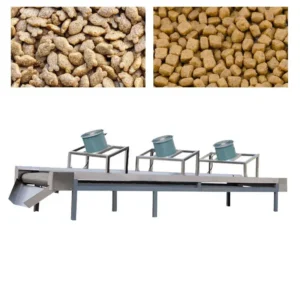
Process-Matched Extrusion Parameters — A twin-screw extrusion platform configured through in-house trial runs on the buyer’s specific aquatic feed formulation before any hardware leaves the workshop.
Technical Specifications
| Parameter | Value |
|---|---|
| Product Type | Fish Feed Extrusion Production Line |
| Output Capacity | 1.0–1.5 t/h (basis not stated in source — confirm raw material formulation, moisture content, pellet size) |
| Extruder Configuration | Twin-screw extruder |
| Contact Material | 304 stainless steel (food-grade) |
| Control System | Available with PLC or MCC control (basis to be confirmed) |
| Voltage & Frequency | Configurable per site utility supply (basis to be confirmed) |
| Certifications | CE, ISO |
Application Suitability
| Application | Material or Output |
|---|---|
| Floating feed for salmon and trout | High-protein and lipid formulations with controlled starch gelatinisation for buoyancy |
| Sinking pellets for catfish | Dense formulations requiring lower expansion ratios and higher moisture conditioning |
| Multi-species aquaculture operations | Rapid screw element and die plate changeover between production runs |
Why Generic Screw Configurations Sink Floating Pellets
Matching screw geometry to formulation chemistry determines whether a pellet floats or sinks.
Floating feed that sinks on the pond surface is rarely a dryer problem. The root cause usually traces back to a screw-and-die build that was copied from a generic template rather than engineered around the buyer’s actual protein-to-starch ratio [NEED_CITE: twin screw fish feed extrusion technology density control principles]. When the shear profile inside the barrel does not align with raw material behaviour, gelatinisation remains incomplete, cell structure collapses, and the pellet absorbs water too quickly to maintain buoyancy. I have seen lines where the die aperture was sized for a 30% starch formulation while the customer was running 18%, producing dense pellets that never expanded properly regardless of dryer temperature.
Shear, Residence Time and Gelatinisation Control
The twin-screw design allows individual screw elements to be swapped and rearranged along the shaft, altering the shear intensity and residence time the material experiences at each barrel zone. For a high-fat salmon feed requiring thorough lipid dispersion without destroying protein structure, the kneading block sequence must differ fundamentally from a lean catfish formulation. This configurability is what makes twin screw fish feed extrusion technology adaptable across species, provided the configuration is specified before production rather than adjusted reactively on site.
Barrel Temperature Profiling Across Zones
Each heating zone along the barrel can be set independently, creating a temperature gradient that manages moisture migration, starch swelling and dough viscosity through the extrusion stages. A gradual ramp prevents premature gelatinisation that would cause surging at the die face, while a steep profile in the final zones forces rapid expansion the moment pressure drops at the exit [NEED_CITE: barrel temperature profiling in aquatic feed extrusion]. The number of active zones and their wattage must correspond to the line’s throughput; undersized heaters cannot maintain setpoints at full capacity, causing density drift across a production shift.
Screw Diameter and Die Geometry
Screw diameter governs the volume of material conveyed per revolution, setting the upper boundary of line throughput. The die plate, in turn, controls pellet shape and expansion ratio — a die with smaller orifices and greater land length restricts flow, building internal pressure that translates into higher expansion upon exit. Switching from floating to sinking pellets often requires both a die change and a recalibration of the final barrel zones, since the target density differs by a significant margin between the two product types.
The Cost of Skipping Formulation-Matched Trials
Lines that ship without a recorded trial run on the customer’s own raw material arrive at site as unproven hardware. Operators then spend weeks — sometimes months — adjusting feed rates, moisture levels and barrel temperatures to chase the correct pellet density, burning through raw material and producing off-spec product that cannot be sold [NEED_CITE: aquaculture feed pellet buoyancy quality standards]. The downtime cost frequently exceeds what a pre-shipment trial would have required in both time and material.
Why Procurement Should Start in the Testing Workshop
Every screw element arrangement and die selection is documented against the buyer’s formulation and target pellet specification, so the line ships with a known-good recipe rather than a generic baseline. Trial runs in the in-house testing workshop confirm achievable throughput, pellet density and buoyancy on the customer’s actual raw material before the extruder is crated. Electrical schematics are issued with voltage and frequency matched to the buyer’s site utility supply, preventing commissioning delays caused by incorrect motor wiring or incompatible control voltages. Line layout and capacity calculations document throughput matching across every station from batching through extrusion to drying, coating and packing, ensuring no single station bottlenecks the declared output.
Documentation & Verification
- Screw and die configuration record matched to your raw material and target pellet density
- Trial run report on customer formulation confirming buoyancy and achievable output before dispatch
- Line layout with throughput calculations matching every station from mixer to packer
- Electrical schematic and voltage confirmation aligned to your site utility supply
- CE declaration of conformity and ISO certificate supplied with shipment
- Operation, maintenance manual and wear parts list included in delivery package
Installation, Commissioning & Support
- Foundation plan provided reflecting the twin-screw extruder weight and dynamic vibration loads
- Dedicated power circuit specified per confirmed voltage, frequency and total connected load
- Barrel heating zones and PLC control language verified before the line is assembled on site
- First production run supervised to replicate testing workshop parameters and confirm pellet buoyancy
- Operator training covers screw element changeover procedures for switching between floating and sinking formulations
- Wear parts list and reorder schedule supplied for screws, dies and barrel liners
What We Need to Size Your Line
To move past a generic quote, share your raw material formulation — particularly protein and starch percentages — along with the target pellet diameter and whether the end product must float or sink. Confirm the voltage and frequency available at your plant, the control language your operators require, and whether you need the line to run multiple species formulations on a weekly changeover cycle. If you can send a sample of your raw material, we will run it through the testing workshop and return a trial report before any commercial commitment.
Frequently Asked Questions
Q: How is the screw configuration and die design determined for a specific fish feed formulation?
A: We review your raw material composition — protein, starch, fat and fibre ratios — then select kneading block sequences and die orifice sizes that produce the required expansion and density. This configuration is validated through a trial run in our testing workshop before the line ships, and the full screw element arrangement is documented for your records.
Q: Can a trial run on our raw material be performed before shipment?
A: Yes. We run your actual formulation through the twin-screw extruder in our testing workshop, measuring pellet density, buoyancy and output rate. The trial report documents the confirmed screw configuration, barrel temperature profile and die selection so you have a proven recipe from the first day of operation on site.
Q: How is output capacity verified against our formulation rather than a nominal rating?
A: The trial run measures real throughput on your raw material at the target pellet size and moisture content. We report the achievable rate alongside the screw speed and feed rate used, so the capacity figure you receive is grounded in your specific production conditions rather than a generic benchmark.
Q: What barrel temperature profile is used to achieve floating versus sinking pellets?
A: Floating pellets require a higher expansion ratio, achieved through elevated final-zone temperatures and a die geometry that maintains internal pressure until the moment of exit. Sinking pellets use lower temperatures and longer die land lengths to restrict expansion. Both profiles are established during the pre-shipment trial run on your formulation.