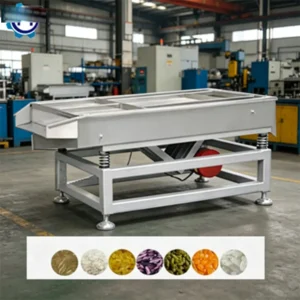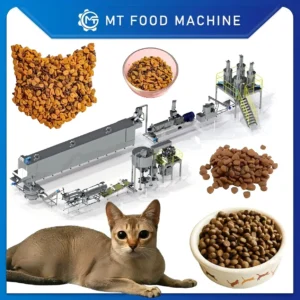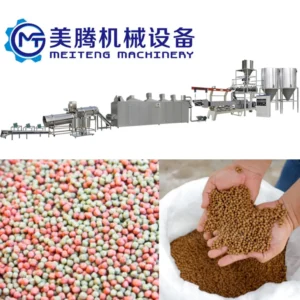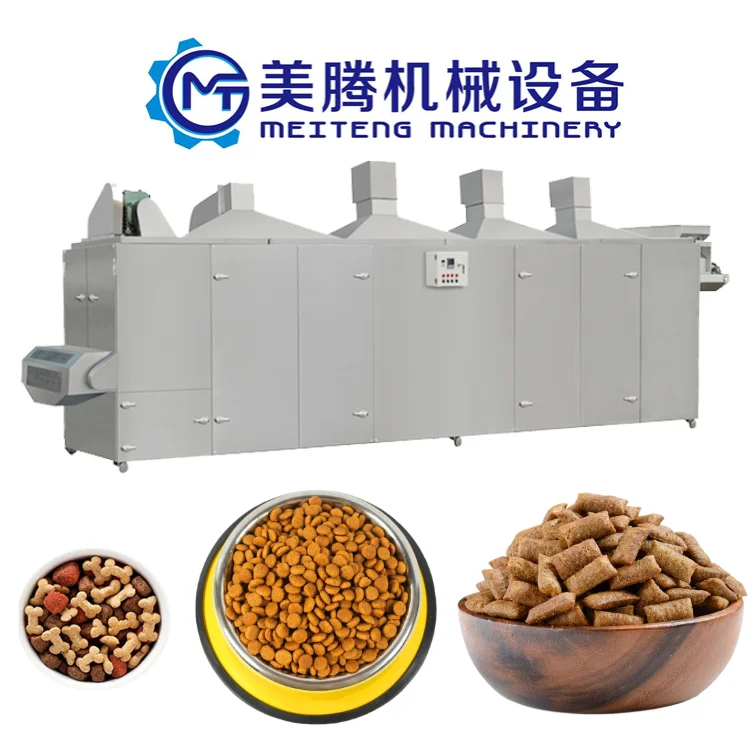
Matched Screw Geometry — Every MT85 barrel and die set is trialled on your actual meat meal and starch blend before the line leaves our Shandong workshop, preventing the density drift that generic builds cause on high-moisture recipes.
Technical Specifications
| Parameter | Value |
|---|---|
| Model | MT85 |
| Product Type | Multi-Purpose Pet Food Processing Line |
| Extruder Type | Twin-screw |
| Output Capacity | 500 kg/h (basis not stated in source — confirm raw material formulation / moisture content / kibble size) |
| Rated Power | 45 kW |
| Voltage & Frequency | 380V 50Hz Three Phase (configurable for export markets) |
| Control System | PLC / MCC |
| Line Stations | Mixing → Extrusion → Drying → Packaging |
| Contact Material | Food-grade stainless steel |
| Recipe Adaptability | Dry kibble, semi-moist, treats |
| Assembly State | Complete automated production line |
| Layout | Customizable to facility footprint |
| Certification Standards | CE, FDA, ISO |
Application Suitability
| Application | Material or Output |
|---|---|
| Dry canine kibble production | Corn flour, chicken meal, bone meal blends at varying protein ratios |
| Feline extruded diets | High-protein formulations requiring tight density and expansion control |
| Semi-moist pet treats | High-moisture doughs with humectants and meat slurry |
| Avian and ornamental fish feed | Small-diameter pellets and sinking or floating aquatic formats |
| Multi-species co-packing lines | Facilities running sequential dog, cat, and aquaculture batches on one platform |
What "500 kg/h" Actually Means on a High-Fresh-Meat Recipe
Nominal capacity figures assume a reference starch base — your real throughput depends entirely on how the twin-screw extrusion pet food processing line specifications align with your formulation’s fat, protein, and moisture content.
I learned this the hard way years ago on a Southeast Asian commissioning. The line was quoted at a rate based on a corn-dominant test recipe, but the buyer’s production formula carried a significant fresh-meat share. The screw profile could not ingest the material fast enough, and the extruder ran at roughly half its nameplate figure while the downstream dryer and flavouring drum sat idle. That bottleneck cascaded through the entire shift [NEED_CITE: impact of raw material viscosity on extruder throughput]. When you evaluate any twin-screw extrusion pet food processing line specifications sheet, always ask which formulation and moisture level the capacity number was measured against.
Barrel Temperature Zoning and Starch Gelatinisation
The MT85 barrel is divided into multiple independently heated and cooled zones. Precise thermal management across these zones governs the degree of starch gelatinisation inside the screw channel, which directly determines the expansion ratio the kibble achieves as it exits the die. Under-gelatinised starch produces a dense, hard pellet; over-gelatinised starch can cause excessive puffing and structural collapse during drying. The twin-screw extrusion pet food processing line specifications must therefore include a documented temperature profile matched to the buyer’s dominant carbohydrate source.
Screw Element Sequencing for Variable Protein Loads
Twin-screw extruders rely on interchangeable screw elements — conveying, kneading, and reverse-flight sections — assembled in a specific sequence along the shaft. A kibble formula heavy in animal protein demands a different shear history than a cereal-based one. The kneading blocks must generate enough mechanical energy to disperse fat and protein uniformly without degrading amino acids through excessive heat. On the MT85, this screw configuration is specified to the buyer’s target ingredient list before production begins [NEED_CITE: screw element selection methodology for high-protein extrusion]. The result is a documented element arrangement record that travels with every shipment.
Interpreting the Power Rating and Control Architecture
The 45 kW main drive motor must deliver consistent torque across fluctuating raw material viscosities. When a batch transitions from a low-fat cereal mix to a high-fat treat dough, the specific mechanical energy input changes — the PLC and MCC control system adjusts screw speed and feeder rate in tandem to maintain uniform residence time. The three-phase 380V 50Hz supply is standard for the domestic grid, but export buyers require voltage confirmation before the electrical cabinet is wired. Mismatched supply frequency on a VFD-driven extruder can shift motor cooling characteristics and thermal protection thresholds, delaying commissioning by days.
The Hidden Cost of an Unmatched Dryer
An extruder that outputs kibble at the correct density is only half the equation. If the downstream dryer lacks the belt length or airflow volume to handle the moisture load at full extruder throughput, kibble exits the line above safe water-activity levels, inviting mould during storage. I have seen lines where the dryer was sized for a lighter cereal recipe, then overloaded when the buyer switched to a meat-heavy formula that carried more internal moisture into the drying bed [NEED_CITE: moisture removal rates in pet food drying]. The MT85 line addresses this by matching dryer capacity to the extruder’s validated throughput on the buyer’s confirmed recipe.
Why Buyers Specify the MT85 for Multi-Format Production
Every screw and die combination is trialled in our Shandong testing workshop on the customer’s own raw material, producing a documented trial run report before the line ships. The line layout is engineered as one integrated system — mixing, extrusion, drying, flavouring, and packing — so throughput at each station is balanced rather than assembled from mismatched vendor capacities. Food-grade contact materials run throughout every product-contact surface, meeting FDA and CE requirements for export markets. The PLC and MCC control architecture supports recipe storage, allowing operators to switch between dry kibble and semi-moist formats without manual recalibration of every barrel zone. Pre-sales engineering consultation covers factory utility planning and phased installation scheduling to minimise production downtime.
Documentation & Verification
- Line layout drawing with throughput calculations matched to your recipe and kibble size
- Screw and die configuration record documenting the element sequence selected for your ingredients
- Trial run report from our testing workshop on your actual raw material before dispatch
- Electrical schematic with voltage and frequency confirmed against your facility supply
- Operation and maintenance manual with wear parts list and replacement intervals
Installation, Commissioning & Support
- Foundation plan referencing the MT85 footprint, operating weight, and vibration isolation points
- Dedicated 45 kW three-phase circuit with confirmed voltage and frequency before cabinet wiring
- Modular station delivery allowing phased assembly in facilities with limited overhead clearance
- First-run parameter logging during commissioning to establish baseline screw speed and barrel temperatures
- Operator training covering PLC recipe selection, screw element changeover, and daily sanitation procedures
- Wear parts inventory recommendation for screws, dies, and barrel liners based on your production schedule
Before You Request a Quote
To configure a line that actually runs at the rate you need, share your target formulation including protein and fat percentages, the kibble diameter and shape you intend to produce, and your daily output target in finished weight. Let us know your facility’s available floor space, ceiling height, and confirmed electrical supply specifications so the layout and control cabinet can be specified accurately from the start. If you are transitioning an existing recipe from a single-screw platform, include your current extrusion parameters so we can map the shear and thermal profile to the twin-screw environment.
Frequently Asked Questions
Q: How do you select the screw configuration and die geometry for a specific kibble formulation?
A: We start with your ingredient list and target density, then build a screw element sequence that delivers the correct shear and residence time. The die orifice diameter and land length are matched to the expansion ratio your kibble requires. A trial run in our workshop on your raw material validates the configuration before the line is approved for shipment.
Q: Which extrusion parameters determine whether kibble floats or sinks?
A: Floating or sinking behaviour is governed by barrel temperature profile, moisture content at the die face, and screw speed — all of which control the degree of starch expansion and the trapped air cell structure. Adjusting these variables shifts final kibble density above or below water. Our trial run process documents the parameter set that achieves your target buoyancy.
Q: Can you run trial production on my raw material before the line ships?
A: Yes. Every MT85 line undergoes a trial run in our testing workshop using the buyer’s actual raw material. The trial report covers throughput achieved, kibble density and expansion measurements, screw and die configuration used, and barrel zone temperatures — giving you validated production data before installation begins.
Q: How is starch gelatinisation controlled when switching between high-meat and cereal-heavy recipes?
A: Each barrel zone is independently heated and cooled, and the PLC stores separate temperature profiles for each recipe. When you switch from a cereal-dominant formula to a high-meat blend, the system adjusts thermal input and screw speed to maintain consistent gelatinisation without over-shearing heat-sensitive proteins.
Q: What is the relationship between die geometry and final kibble texture?
A: Die orifice shape defines the kibble cross-section, while land length controls the pressure drop at exit, which governs expansion. A shorter land produces a more open, crunchy cell structure; a longer land compresses the melt and yields a denser, harder bite. We specify die geometry during the trial run to match your target texture.