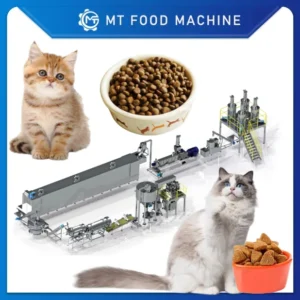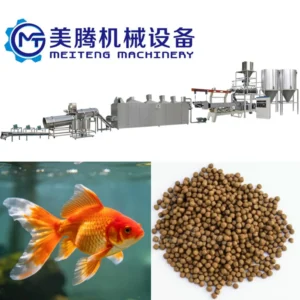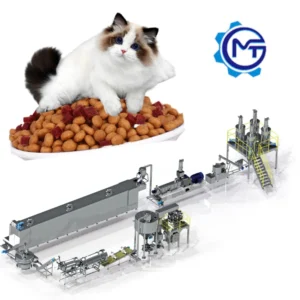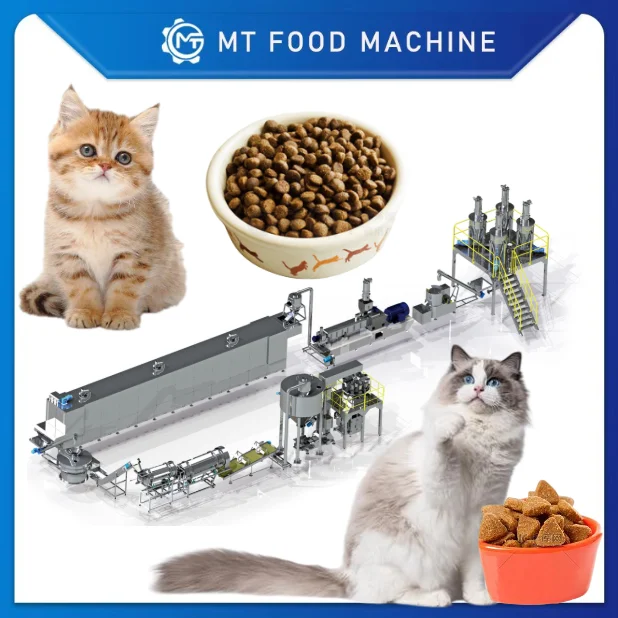
Material-Specific Configuration — Every MT135 build starts with a trial run on the buyer’s actual raw material in the testing workshop before screw and die geometry are finalized for production.
Technical Specifications
| Parameter | Value |
|---|---|
| Model | MT135 |
| Product Type | Multi-Species Pet Food Extrusion Line |
| Screw Type | Twin-screw |
| Output Capacity | 550 kg/h (basis not stated in source — confirm raw material, moisture, formulation) |
| Output Capacity (Title Reference) | 2.5–3.0 t/h (basis not stated in source — confirm raw material, moisture, shift duration) |
| Control System | PLC Controlled |
| Application Range | Cat, dog, fish, bird, and cattle feed |
| Line Stations | Complete line from batching to packing |
| Certification | CE, ISO |
Application Suitability
| Application | Material or Output |
|---|---|
| Dry kibble for cats and dogs | Corn, meat meal, poultry by-product, rice flour blends |
| Floating and sinking aquatic feed | Fish meal, soy protein, wheat gluten formulations for catfish, tilapia, shrimp |
| Bird and cattle feed pellets | Grain-based mixes with vitamin and mineral premix |
| Multi-species production runs | Formulation changeover requiring screw and die reconfiguration |
Why Kibble Density Misses Specification — And What Actually Fixes It
Floating feed that sinks and kibble that falls outside the density window buyers expect is almost always a screw configuration and die mismatch, not a machine capacity problem.
I have watched lines that were quoted on nominal output fail to hold that throughput once the buyer’s actual high-fresh-meat formulation went through the barrel. The twin-screw food extruder extrusion technology behind the MT135 addresses this by matching screw element arrangement and die geometry to the specific starch, protein, and moisture behaviour of the raw material being processed. Generic screw builds copied from one product to the next produce inconsistent expansion, and the problem only surfaces after installation — when reconfiguration means shipping parts back and forth across continents [NEED_CITE: twin-screw extrusion process parameters for varying protein and starch ratios].
Barrel Temperature Profiling and Starch Gelatinisation
The MT135 uses PLC-regulated barrel heating zones to manage the temperature gradient from the feed section to the die plate. Starch gelatinisation requires a specific thermal window — too cool and the matrix stays raw and brittle, too hot and the product collapses after exiting the die. Each zone is independently controlled so the thermal profile can be adjusted when switching between a high-corn kibble formula and a high-fresh-meat aquatic feed recipe, keeping gelatinisation consistent across the twin-screw food extruder extrusion technology process.
Screw Configuration Matched to Raw Material Behaviour
Screw element sequencing — conveying, kneading, reverse-pitch, and metering sections — determines shear intensity, residence time, and mechanical energy input. A formulation heavy in fresh meat slurry demands a different screw profile than one built primarily on corn grits and soy meal. The MT135 screw assembly is configured after testing the buyer’s actual material in the workshop, adjusting element order and gap tolerances until expansion ratio and kibble density meet the target specification rather than relying on a generic build [NEED_CITE: screw element configuration effects on extrudate density and expansion].
Die Geometry and Final Product Density Control
The die plate defines the cross-section of the extrudate, but its land length and orifice diameter also govern back-pressure inside the barrel. Longer land increases shear at the exit, tightening the surface skin and reducing post-die expansion — critical when producing sinking aquatic feed that must stay below the waterline. Shorter land allows greater puff for floating fish feed or light-texture dog kibble. The MT135 die selection is documented per formulation so that repeat orders produce the same density without re-development.
Reading the Spec Sheet Against Your Formulation
The listed 550 kg/h output capacity has no stated basis — raw material composition, incoming moisture, and target expansion ratio all shift actual throughput. When evaluating a twin-screw food extruder extrusion technology line, the meaningful question is what the machine produces on your specific recipe at your target kibble density. The PLC system logs barrel temperatures, screw speed, and feeder rates per batch, giving process engineers the data to verify that rated capacity aligns with their formulation rather than a generic benchmark. Screw L:D ratio, moisture injection points, and shear profile should all be confirmed against the buyer’s material before the line is built, not after it arrives on the factory floor.
The Cost of Skipping the Trial Run
Lines shipped without a material-specific trial run force product development into the commissioning window, where every adjustment delays production and burns raw material. Screw configurations that worked on the supplier’s test flour may produce kibbles that are too dense for the pet food market or too fragile for packaging. Aquatic feed that should float ends up sinking because the die land was never tuned to the buyer’s protein-to-starch ratio [NEED_CITE: pre-shipment testing protocols for food extrusion lines]. These problems compound when the line includes drying and coating stations sized for a throughput the extruder cannot actually sustain on the real formulation.
Why Source the MT135 Through This Process
The MT135 is configured as a complete line from batching through extrusion to packing under one supplier, so throughput is matched across every station rather than assembled from separate vendors with mismatched capacities. Screw configuration and die design are specified to the buyer’s raw material and target product, not copied from a generic template. The in-house testing workshop runs the buyer’s actual formulation before shipment, producing a trial run report that becomes the baseline for commissioning. Twin-screw expertise covers pet food, aquatic feed, and multi-species applications, and the PLC control system records process parameters for batch-to-batch traceability. Pre-sales consultation, on-site installation, commissioning, and operator training are included so the line reaches stable production without the buyer managing multiple contractors [NEED_CITE: turnkey extrusion line project delivery and commissioning standards].
Documentation & Verification
- Line layout and capacity calculation showing station-by-station throughput balance for your formulation
- Screw and die configuration record documenting element sequence matched to your raw material
- Trial run report on your actual raw material conducted in the testing workshop before dispatch
- Electrical schematic and voltage confirmation aligned to your facility grid and frequency standard
- CE declaration of conformity and ISO certificate for import clearance and regulatory compliance
- Operation and maintenance manual with wear parts list specific to the MT135 configuration
Installation, Commissioning & Support
- Foundation and floor space plan based on the MT135 complete line footprint from batching to packing
- Dedicated power circuit specification matching the PLC-controlled extruder and dryer motor loads
- Assembly sequence for the twin-screw barrel sections, die plate, and downstream stations on site
- First-run parameter setting using the trial run report as the baseline for screw speed and temperature zones
- Operator training covering formulation changeover, die swaps, and PLC batch logging procedures
- Wear parts list for screws, die inserts, and barrel liners with recommended replacement intervals
What to Include in Your Inquiry
Provide your target formulations with raw material composition and moisture content so screw and die configuration can be scoped before quotation. Specify your local voltage, frequency, and preferred PLC interface language to avoid commissioning delays. Share your workshop floor dimensions and ceiling height so the line layout accounts for the dryer and cooling conveyor run. Indicate whether you need a trial run on your own material before shipment — this step is available and recommended for new formulations.
Frequently Asked Questions
Q: How is screw configuration determined for different raw materials and target kibble densities?
A: The screw element sequence — conveying, kneading, reverse-pitch, and metering sections — is arranged based on the buyer’s raw material composition and the target expansion ratio. High-protein formulations with fresh meat require different shear profiles than corn-dominant recipes. The configuration is validated through a trial run in the testing workshop using the buyer’s actual material before the final screw build is approved for production.
Q: What barrel temperature profile and moisture range does the MT135 support for starch gelatinisation?
A: The PLC system manages multiple independent barrel heating zones, allowing the temperature gradient from feed section to die plate to be set per formulation. Moisture injection points along the barrel let operators adjust water content to reach the gelatinisation window required by the specific starch source. The exact profile depends on the raw material and is established during the pre-shipment trial run.
Q: Can a trial run be performed on the buyer’s own formulation before shipment?
A: Yes. The in-house testing workshop is equipped to run the buyer’s actual raw material on the MT135 before the line ships. The trial run produces a report covering kibble density, expansion ratio, and throughput on that specific formulation, which then serves as the baseline reference during on-site commissioning and operator training.
Q: How is die geometry selected to control expansion and final product density?
A: Die orifice diameter and land length are chosen based on the target product shape and required post-die expansion. Longer land increases exit shear and tightens the surface skin, reducing expansion for sinking aquatic feed. Shorter land allows greater puff for floating feed or light kibble. The die specification is recorded per formulation for consistent repeatability across production runs.
Q: What process data does the PLC system log for quality traceability across batches?
A: The PLC records barrel zone temperatures, screw speed, feeder rates, and moisture injection parameters for each production batch. This data allows process engineers to compare runs, identify deviations, and replicate settings when switching between formulations. The logged parameters also support quality audits and help trace any density or expansion variation back to its source in the extrusion process.