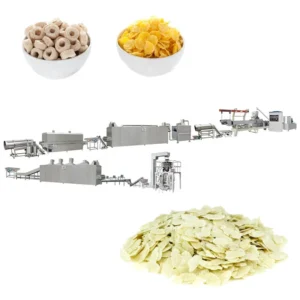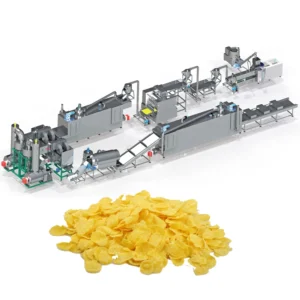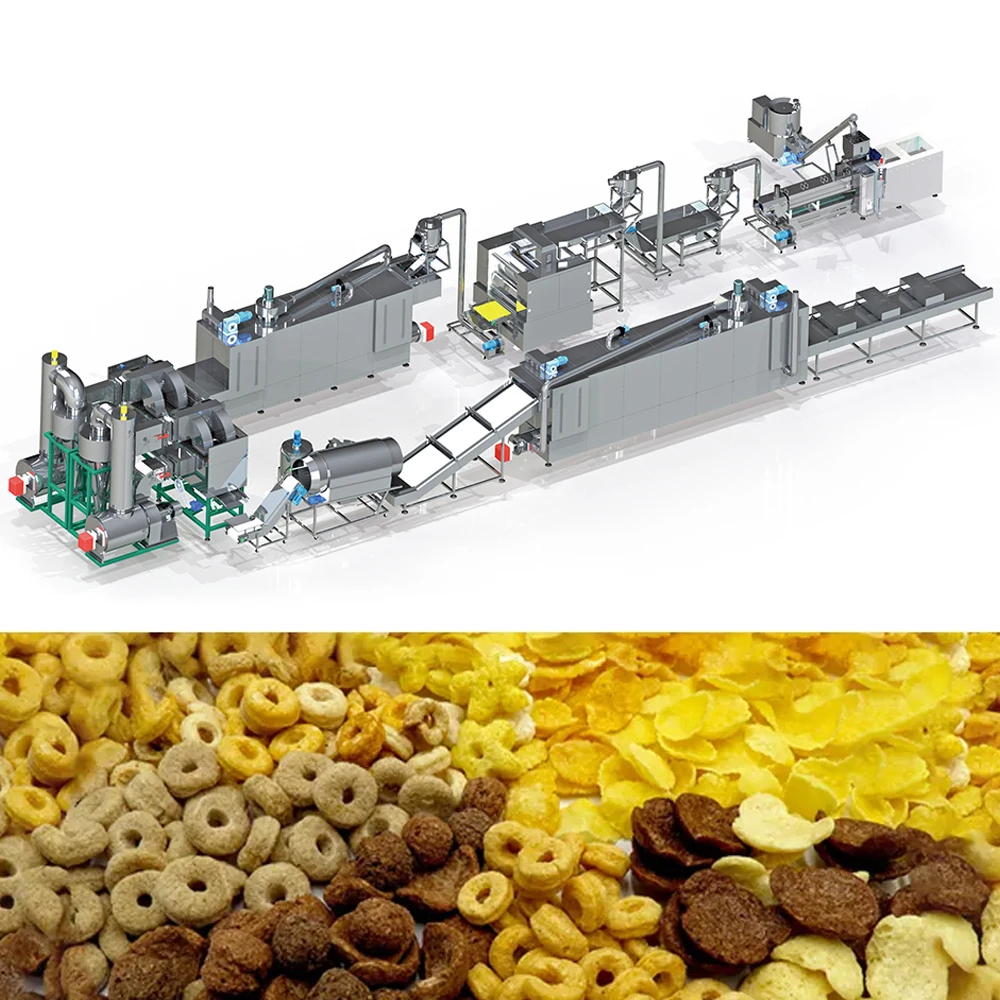
Extrusion geometry matched to recipe — Screw configuration, barrel zones, and die design are set after trial runs on your actual grain blend, not copied from a generic breakfast cereal build.
Technical Specifications
| Parameter | Value |
|---|---|
| Product Type | Twin Screw Extruder Corn Flakes Production Line |
| Model Options | MT70, MT85, MT75 |
| Screw Type | Twin Screw |
| Installed Power (MT70) | 160 kW |
| Installed Power (MT85) | 190 kW |
| Installed Power (MT75) | 210 kW |
| Power Consumption (MT70) | 120 kW |
| Power Consumption (MT85) | 140 kW |
| Power Consumption (MT75) | 150 kW |
| Output Capacity (MT70) | 150–200 kg/hr (basis not stated in source — confirm raw material, moisture, and product format) |
| Output Capacity (MT85) | 300–400 kg/hr (basis not stated in source — confirm raw material, moisture, and product format) |
| Output Capacity (MT75) | 300–500 kg/hr (basis not stated in source — confirm raw material, moisture, and product format) |
| Overall Dimensions (MT70) | 41 × 1.5 × 2.2 m |
| Overall Dimensions (MT85) | 43 × 1.5 × 3.2 m |
| Overall Dimensions (MT75) | 45 × 1.5 × 3.5 m |
| Control System | PLC control for flaking machinery; MCC available for line |
| Voltage & Frequency | Customizable (commonly 415V 50/60Hz, 440V 50/60Hz, 220V 60Hz) |
| Heating Source (Dryer) | Gas or Electric |
| Flaking Machinery Drive | Double motors for separate roller driving, hydraulic system for double rollers |
| Flaking Temperature Control | Infrared sensor for even temperature pipe control |
| Roasting Oven | Hot air roasting with conciliation burner, two circulating fans, cyclone dust removal |
| Coating System | Double tumble for sugar melting, elevator, coating drum, spraying nozzle |
| Extruder Working Principle | Feeding, extruding, cutting, heating, gearing, and controlling systems |
| Screw Feature | Automatic lubricating and cooling function; wear-resistant screw technology |
| Final Product Shapes | Ball, tube, stick, ring, fruit loop, star, wheel, flower, heart (via extruder mould adjustment) |
| Certifications | CE (since 2014), ISO certified |
Application Suitability
| Application | Material or Output |
|---|---|
| Natural corn flakes | Maize grits, corn flour |
| Sugar-coated breakfast cereals | Corn, rice, wheat, oat, barley powder blends |
| Instant breakfast cereals | Corn and multi-grain blends for milk or coffee mixing |
| Extruded snack formats | Corn, rice, and grain-based recipes shaped as rings, loops, stars |
| Fortified nutrition cereals | Grain blends with vitamin and mineral premix additions |
Why "300 kg/hr" Means Nothing Without the Recipe Behind It
A corn flakes extrusion line rated at a given throughput on standard maize may drop to a fraction of that on a high-fiber local grain blend if screw geometry and barrel heat are not re-matched.
I spent years commissioning breakfast cereal lines across Latin America, and I watched one corn flakes extrusion line manufacturer deliver a perfectly running system — on our standard test flour. The customer’s actual recipe used a high-fiber regional grain mix. Expansion collapsed, flakes came out thick and uneven, and the entire first production batch was scrapped. The extruder was not defective; the screw profile was simply wrong for that material [NEED_CITE: starch gelatinisation behaviour across different grain fiber levels]. That is why the capacity figure on a spec sheet only matters when it is tied to your specific raw material, moisture content, and target flake density.
How Screw Profile and Barrel Heat Shape the Flake
Every corn flakes extrusion line manufacturer builds the extruder around a screw configuration, but the arrangement of conveying, kneading, and reverse elements inside the barrel determines how completely starch gelatinises before the dough reaches the die. For corn flakes, you need a high degree of gelatinisation without over-expansion, because the pellet must remain dense enough to flatten into a thin, crisp flake during rolling. The barrel temperature profile — typically four to six independently heated zones — controls where and how fast that gelatinisation happens. Get the balance wrong, and the pellet either puffs too early and shatters in the flaking rollers, or stays under-cooked and produces a hard, gritty flake that breaks apart in the bowl.
Die Geometry, Moisture, and the Density the Market Expects
The die plate at the extruder outlet defines pellet cross-section and initial moisture retention, both of which govern how the pellet behaves when it passes through the flaking rollers and then into the hot air roasting oven. A die with too-large an opening yields a thick pellet that resists flattening, producing a heavy flake with poor bowl life. A die that is too small generates excessive shear at the screw tip, which can over-expand the dough and create surface blisters before the pellet even reaches the dryer [NEED_CITE: die land length and pellet density in breakfast cereal extrusion]. Moisture at the die face must be controlled within a narrow window so the pellet is pliable enough to flatten without cracking but dry enough to hold its shape through drying and roasting.
Reading the Spec Sheet: Power, Throughput, and What They Actually Tell You
The installed power ratings across the MT70, MT85, and MT75 models — 160 kW, 190 kW, and 210 kW respectively — reflect the combined motor load for feeding, extruding, cutting, and heating systems running at full capacity. Power consumption figures are lower because heaters cycle and motors rarely draw peak current simultaneously. The output ranges listed for each model are based on standard conditions; actual throughput on your recipe will differ depending on fiber content, fat level, and target moisture at the die. The overall line dimensions — up to 45 metres long for the MT75 — account for the full sequence from mixing through extruding, flaking, drying, hot air roasting, cooling, and packing. That footprint tells you the plant floor and utility planning required before installation begins.
The Cost of Skipping the Trial Run
When a line is shipped without a trial on the buyer’s actual grain blend, the first weeks of production become an expensive experiment. Operators adjust screw speed, barrel temperatures, and die openings while burning raw material and producing off-spec flake that cannot be sold. Flakes may sink in milk too quickly or fail to develop the surface blister pattern that consumers associate with quality corn flakes. In the worst cases, the flaking rollers cannot compress the pellet uniformly, and the entire downstream station — dryer, roaster, coater — sits idle waiting for a consistent feed [NEED_CITE: cost of post-installation commissioning versus pre-shipment trial runs]. All of this is avoidable when the corn flakes extrusion line manufacturer tests with the buyer’s real material beforehand.
Why This Corn Flakes Line Is Configured, Not Catalogued
The screw configuration and die design are specified to the buyer’s raw material and target flake density rather than pulled from a standard build template. The in-house testing workshop runs trial batches on customer-supplied grain blends before shipment, producing a trial run report that documents the exact screw profile, barrel temperatures, and die geometry used. Every downstream station — flaking, drying, roasting, coating — is sized so throughput is matched across the line, preventing the bottleneck that occurs when an extruder is paired with an undersized dryer. The PLC and MCC control systems are configurable for local voltage, frequency, and operator language before production starts. CE and ISO certification documentation ships with every line, and wear parts such as screws and dies are listed with part numbers from day one.
Documentation & Verification
- Line layout and capacity calculation showing matched throughput at every station
- Screw and die configuration record tied to your raw material trial results
- Trial run report on customer grain blend documenting expansion and flake density
- Electrical schematic with voltage and frequency confirmed for target market
- Operation and maintenance manual with wear parts list and replacement intervals
Installation, Commissioning & Support
- Foundation planning based on the MT75’s 45-metre line length and station weights
- Dedicated electrical circuits sized to the MT85’s 190 kW installed power draw
- Staged assembly from extruder through flaking, roasting, and cooling stations
- First-run parameter setting using the pre-shipment trial report as baseline
- Operator training on PLC interface language and MCC emergency procedures
- Wear parts inventory including replacement screws, dies, and flaking roller sleeves
What to Include in Your Inquiry
To configure the right corn flakes extrusion line manufacturer proposal, share your raw material type and typical blend ratios, including any high-fiber or fortified components. Specify the target daily output and the shift pattern your plant will run. Confirm the local voltage, frequency, and the control language your operators prefer. If you have existing upstream mixing or downstream packing equipment, describe the interface points so the line layout can account for them.
Frequently Asked Questions
Q: How are screw configuration and die design matched to my raw material?
A: We run trial batches in our testing workshop using your actual grain blend. The screw element arrangement, barrel temperature profile, and die opening are adjusted until the pellet produces the target flake density, expansion ratio, and surface texture. The final configuration is documented and ships with the line.
Q: How is capacity verified before the line leaves the factory?
A: Throughput is measured during the in-house trial run on your raw material at your specified moisture level. The results — including actual kg/hr output and flake quality metrics — are recorded in a trial run report shared with you before shipment approval.
Q: How do barrel temperature zones affect starch gelatinisation and expansion?
A: Each zone controls a section of the barrel where heat and shear combine to gelatinise starch. Too little heat leaves raw starch that produces gritty flakes; too much causes premature expansion before the die. The profile is tuned during your material trial to achieve consistent gelatinisation and controlled pellet density.
Q: How are voltage, frequency, and control language confirmed before production?
A: We collect your site electrical specifications during the proposal stage and confirm them on the electrical schematic. The PLC and MCC panels are built and labelled in your preferred language before the factory test, so no re-wiring or re-programming is needed on site.
Q: How do you ensure the dryer and roaster keep up with extruder output?
A: Every station is sized based on the throughput recorded during your material trial. The dryer, flaking rollers, roasting oven, and cooling conveyor are specified so their individual capacities match or exceed the extruder output, preventing bottlenecks anywhere on the line.