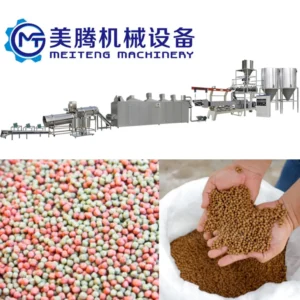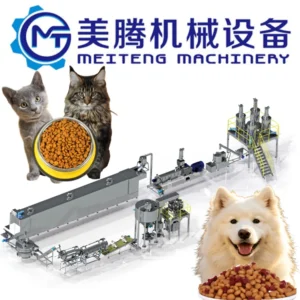
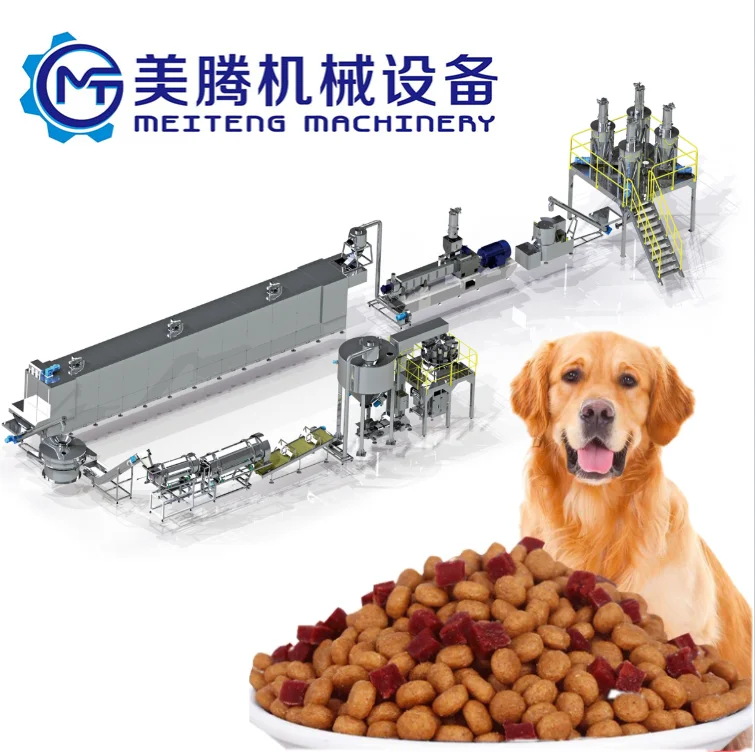
Screw Configuration Matched to Formula — Every die and screw segment is specified against the buyer’s actual raw material and target kibble density, never copied from a generic build.
Technical Specifications
| Parameter | Value |
|---|---|
| Product Type | Pet Food Extrusion Production Line |
| Extruder Type | Twin-screw extrusion |
| Automation Level | Fully automated with PLC and MCC control |
| Construction Material | Food-grade materials in all product contact zones |
| Recipe Adaptability | Dry kibble, semi-moist, and treat formats (basis to be confirmed) |
| Quality Control | Sensor-driven controls for batch-to-batch uniformity |
| Energy Design | Energy-efficient motor and heating configuration (basis to be confirmed) |
| Maintenance Design | Modular components enabling quick cleaning |
| Configuration Flexibility | Layout and throughput configurable to factory footprint (basis to be confirmed) |
| Operation Interface | HMI with language options (basis to be confirmed) |
| Standards | CE, FDA (basis to be confirmed) |
Application Suitability
| Application | Material or Output |
|---|---|
| Dry kibble production for dogs and cats | Corn, wheat, rice, meat meal, bone meal, fish meal blends |
| Bird feed extrusion | Millet, sorghum, soy, seed mixtures |
| Floating and sinking fish feed | Soybean meal, corn flour, wheat bran, fish meal |
| Cattle and livestock feed pellets | Corn stover, barley, soy meal, molasses blends |
| Semi-moist pet treats | High-moisture meat and starch combinations |
Why Kibble Density Fails Before the Line Even Ships
A pet food extrusion line twin screw technology setup that ships without validating your formula will almost certainly miss the density window your market requires.
The problem usually starts upstream in the sales process. A supplier quotes a standard screw configuration, assumes a generic cereal recipe, and locks in the barrel profile. When your high-protein or high-fat formula arrives at the factory, the starch gelatinisation behaviour changes entirely. Kibble that should float sinks. Pieces that should crunch collapse. The expansion ratio falls outside what pet owners and retailers expect. I have watched this exact sequence play out more times than I can count — a buyer invests in a complete line, installs it, and only then discovers the core product parameter is wrong. Correcting it after installation means replacing screw elements, reprogramming temperature zones, and potentially redesigning the die plate, all while production deadlines slide. [NEED_CITE: impact of screw configuration on extruded product density]
Barrel Zone Profiling and Starch Behaviour
The barrel on a twin-screw extruder is divided into multiple temperature zones, each governing a specific phase of the material transformation. In a pet food extrusion line twin screw technology setup, the early zones handle hydration and initial gelatinisation, while later zones control shear intensity and melt temperature. When a formula shifts from a corn-dominant blend to one heavy in meat meal or fat, those zone temperatures must be reprofiled. A single zone running too hot can collapse the cell structure; one running too cool leaves raw starch pockets that compromise digestibility.
Die Geometry and Expansion Control
The die plate determines not just the shape of each kibble piece but its internal cell structure and final density. For floating aquatic feed, the die orifices must allow sufficient expansion as the superheated moisture flashes off at the die face. For dense sinking kibble, the same geometry would produce an unacceptable product. Die selection is therefore inseparable from the screw configuration and barrel profile — all three must be designed as a coordinated system, matched to the specific raw material behaviour and the target bulk density the market demands. [NEED_CITE: relationship between die geometry and extrudate expansion ratio]
Interpreting the Configuration Record
The configuration record is the document that ties every hardware decision to a production outcome. For twin-screw extrusion in pet food, the key parameters to examine include the screw element arrangement — conveying, kneading, and reverse elements in what sequence — and the L:D ratio, which governs residence time and the degree of mechanical work applied to the material. Moisture injection points and steam conditioning options directly affect gelatinisation completeness and expansion uniformity. On the control side, PLC architecture with zone-specific PID loops gives operators the resolution needed to hold barrel temperatures within tight tolerances, which is what prevents density drift across a production run. Food-grade construction in all contact zones is non-negotiable for regulatory compliance and product safety.
What Generic Builds Cost You in the First Six Months
A line assembled from standard configurations will run, but it will run wrong on your specific formula. The consequences accumulate quietly — higher reject rates, inconsistent kibble size that triggers packaging line jams, excess wear on screw elements running outside their designed load range. Buyers who skip the trial run phase often spend the first several months after commissioning troubleshooting problems that could have been resolved before the machine left the factory. Energy consumption climbs as operators push barrel heaters and motors harder to compensate for a misconfigured screw profile. [NEED_CITE: hidden costs of untested extrusion line commissioning]
Engineering Decisions That Hold Up After Commissioning
The screw and die configuration is documented against your raw material and target product, so there is no ambiguity about what was built and why. An in-house testing workshop runs your actual formula before shipment, producing a trial run report that validates expansion, texture, and density. Electrical schematics and voltage specifications are confirmed against your target market before production begins, preventing commissioning delays. The complete line — from batching through extrusion, drying, coating, and packing — is supplied by a single source, which means throughput at every station is balanced rather than mismatched across vendors. CE and ISO documentation is provided as part of the standard deliverable package.
Documentation & Verification
- Screw and die configuration record specifying the build matched to your raw material and kibble density target
- Trial run report from in-house testing workshop validating texture, expansion, and density on your formula before dispatch
- Electrical schematic and voltage confirmation aligned with your target market power grid
- CE declaration of conformity and ISO certificate as standard documentation
- Operation and maintenance manual with wear parts list and replacement intervals
- Factory test record with packing photographs and customs documentation support
Installation, Commissioning & Support
- Floor plan and utility layout provided based on the configured line footprint and twin-screw extruder weight
- Power supply requirements confirmed to match the PLC and MCC control voltage and frequency specification
- Modular component design allows sectional assembly in facilities with limited access clearance
- First-run parameter setting performed on-site with barrel zone and screw speed calibration to your formula
- Operator training covers HMI navigation, recipe storage, and real-time density adjustment procedures
- Wear parts list provided with recommended screw element and die replacement intervals based on production hours
- Ongoing maintenance support includes remote troubleshooting for PLC fault codes and process deviations
What We Need to Configure Your Line
Share your raw material composition and moisture range, along with the target kibble density and size specifications for each product in your range. Confirm the local voltage and frequency standard, and whether your operators require a specific control language on the HMI. If you have existing upstream or downstream equipment — mixers, dryers, packaging systems — provide their throughput ratings so the line can be balanced end to end.
Frequently Asked Questions
Q: How is screw configuration and die design matched to my specific raw material and kibble density target?
A: We start with your formula composition, target expansion ratio, and market density specification. Screw elements are arranged — conveying, kneading, and reverse segments — to deliver the correct shear and residence time. Die orifice geometry is selected to produce the required cell structure. The full configuration is documented and validated through a trial run on your material before shipment.
Q: Can I run a trial on my own formula in the testing workshop before shipment?
A: Yes. The in-house testing workshop runs your actual raw material through the configured twin-screw extruder. The trial run report documents expansion, texture, bulk density, and moisture levels. Any adjustments to screw elements, barrel temperatures, or die selection are completed and re-verified before the line is packed for dispatch.
Q: How are barrel temperature zones and moisture injection set for different starch gelatinisation levels?
A: Each barrel zone has independent temperature control via the PLC, allowing precise profiling from hydration through melt and expansion. Moisture and steam injection points are positioned to match the gelatinisation window of your starch source. High-protein formulas typically require different profiling than cereal-dominant blends, and the configuration record captures these settings for your operators.
Q: What happens if kibble density or expansion falls outside specification after installation?
A: The trial run report establishes the baseline parameters before shipment. If on-site conditions — ambient temperature, raw material batch variation — shift the output, the PLC recipe system allows operators to adjust zone temperatures and screw speed within documented ranges. Our commissioning team calibrates these parameters during on-site installation and provides training for ongoing fine-tuning.
Q: How are voltage, frequency and control language confirmed before production?
A: During the specification phase, we confirm your facility’s power supply standard and operator language requirements. The electrical schematic, motor ratings, and PLC configuration are built to match. Voltage and frequency are verified on the factory test record before the line ships, preventing commissioning delays caused by electrical mismatches.