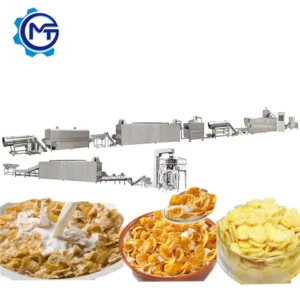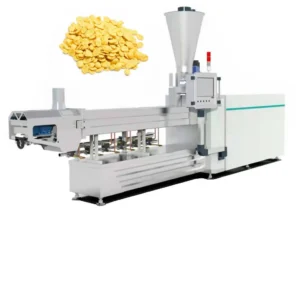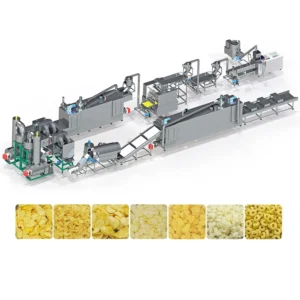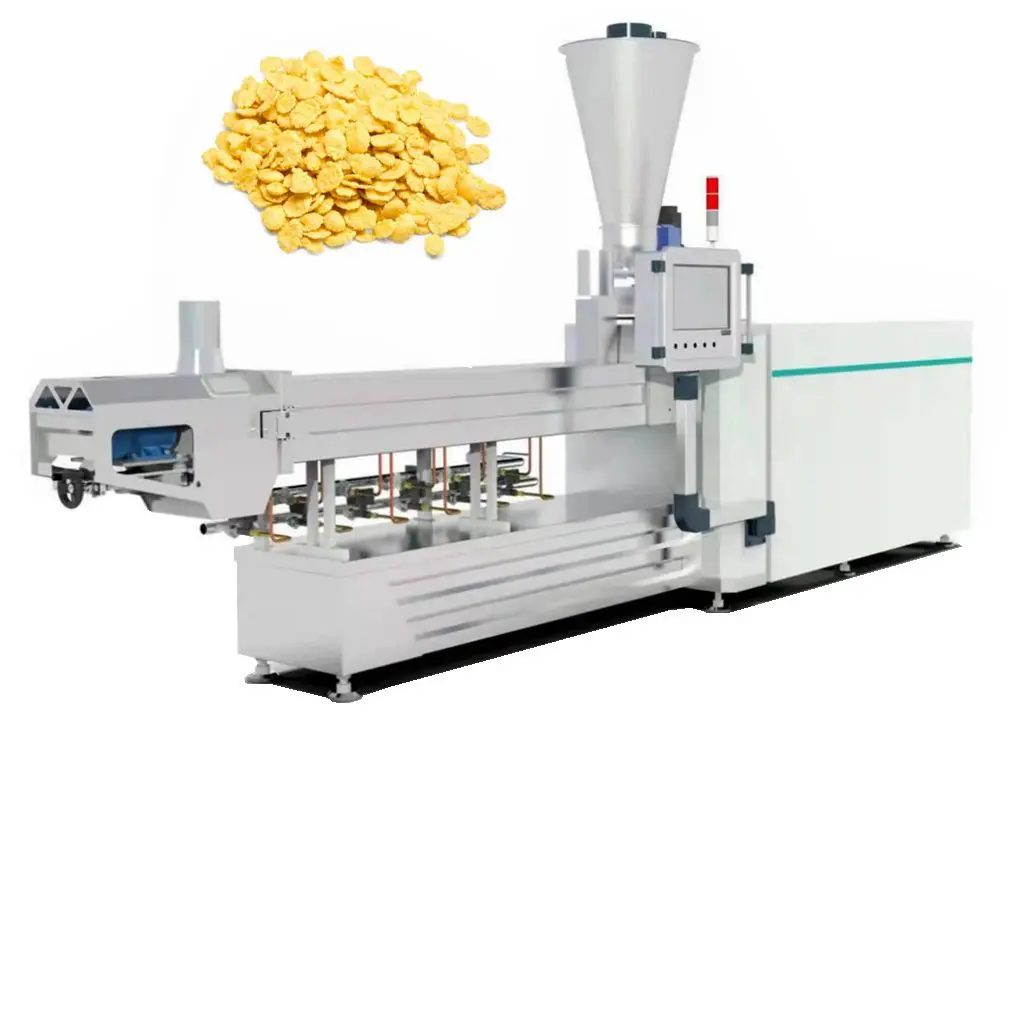
Precision-Engineered Screw Configurations — Every MT-series corn flakes line ships with a screw and die setup specified to your grain formulation, validated by an in-house trial run before dispatch.
Technical Specifications
| Parameter | Value |
|---|---|
| Product Type | Corn Flakes Production Line |
| Model | MT-65processing line / MT-70processing line / MT-85processing line / MT-75processing line |
| Installed Power | 84 kW (MT-65) / 132 kW (MT-70) / 186 kW (MT-75) / 239 kW (MT-85) |
| Real Power Consumption | 59 kW (MT-65) / 92 kW (MT-70) / 140 kW (MT-75) / 167 kW (MT-85) |
| Output Capacity | 120-150 kg/h (MT-65, basis not stated in source) / 200-250 kg/h (MT-70, basis not stated in source) / 400-500 kg/h (MT-75, basis not stated in source) / 300-400 kg/h (MT-85, basis not stated in source) |
| Extruder Type | Twin Screw |
| Flaking Machine | Water-cooled cast iron rollers, adjustable gap, carbon steel frame |
| Hot Air Roaster | Up to 400°C, high-pressure blower, electric or gas heating |
| Dryer Configuration | 3, 5, or 7 layers, adjustable mesh belt speed |
| Extruder Control | Button start with real-time data storage, monitoring, and alarm functions |
| Dimensions (L×W×H) | 21000×1200×2200 mm (MT-65) / 23000×1500×2200 mm (MT-70) / 24000×1500×2800 mm (MT-75) / 28000×3500×4300 mm (MT-85) |
| Certification | CE |
Application Suitability
| Application | Material or Output |
|---|---|
| Traditional Corn Flakes | Corn grits or corn flour, plain or sugar-coated |
| Multi-Grain Flakes | Blends of wheat, oat, barley, rice, and millets |
| Puffed Cereal Shapes | Cheerios, loops, honey rings, stars, cocoa flakes, crunch corn balls |
| Fortified Cereal Formats | Extruded shapes requiring vitamin or mineral premix incorporation |
Why Standard Screw Builds Fail on Local Grain
A generic screw configuration produces corn flakes that are either too dense, too fragile, or fail to achieve the bowl-life crispness the market expects. The extrusion parameters must be matched to your specific raw material before the machine is built.
I once saw a line commissioned using standard corn grits that produced excellent results during factory testing. When the buyer switched to locally sourced corn flour with different moisture and particle size, the flakes came out uneven in thickness, and the entire batch scorched during roasting. That mismatch happens when the corn flakes extrusion technology is treated as a one-size-fits-all solution rather than a material-specific engineering process [NEED_CITE: starch gelatinisation behaviour across different grain particle sizes]. The screw pitch, compression ratio, and die geometry all need to account for how your particular grain absorbs water and responds to shear.
Barrel Temperature and Moisture Control in Extrusion
The quality of the final flake is largely determined inside the extruder barrel, where starch gelatinisation must occur uniformly. The breakfast cereal twin screw extruder screw configuration is designed using 3D software with analogue simulation to ensure each screw element delivers the correct shear and residence time. Multiple heating zones along the barrel allow operators to set a precise temperature profile that matches the moisture content of the incoming mix.
From Extrudate to Flake: The Role of Roller Gap and Roasting
After extrusion, the cooked dough pellets pass through the flaking machine, where water-cooled cast iron rollers compress them to a controlled thickness. The adjustable gap lets you set flake geometry precisely. Downstream, the hot air roaster operates at temperatures reaching 400°C with a high-pressure blower, creating the rapid steam expansion that generates the characteristic surface bubbles and crispness. If the roaster temperature and pellet moisture are not synchronised, flakes emerge either under-expanded or burnt at the edges [NEED_CITE: thermal dynamics in breakfast cereal roasting processes].
Reading the Spec Sheet: What Matters for Corn Flake Lines
The twin-screw design is fundamental here. Unlike single-screw extruders, the intermeshing screw pair provides positive conveying and self-cleaning action, which matters when processing starchy grain mixes that can stick and degrade. The L:D ratio determines how long the material stays in the barrel — longer residence supports more complete gelatinisation at lower shear, producing a denser, more uniform pellet ideal for flaking. The installed power ratings across the line — from 84 kW on the MT-65processing line to 239 kW on the MT-85processing line — reflect the mechanical energy needed for both cooking and conveying. Real power consumption runs considerably lower, which is typical for extrusion lines where heaters and motors do not all peak simultaneously. The dryer’s multi-layer belt configuration allows extended drying time within a compact footprint, which is critical because under-dried flakes will not toast correctly in the roaster.
The Hidden Cost of Unmatched Throughput Across Stations
An extruder that runs faster than the downstream flaking machine creates a bottleneck of cooked pellets sitting and cooling before they can be pressed. Those cooled pellets do not flatten properly, yielding thick, hard flakes that resist roasting. Conversely, an oversized roaster paired with a smaller extruder wastes energy and may over-dry the product. These mismatches are common when line components are sourced from separate vendors without a unified capacity calculation [NEED_CITE: throughput balancing in multi-station food processing lines]. The result is a line that technically runs but never hits the target output consistently.
Why Engineers Source Their Cereal Lines Here
Every station — from the mixer through the extruder, flaking machine, roaster, dryer, and packing — is designed under one supplier, so throughput is matched at each stage rather than assembled from mismatched standalone units. The screw configuration and die design are specified to your raw material and target product, not copied from a generic template. Before any line ships, your actual grain sample runs through the in-house testing workshop, producing a trial run report that confirms the breakfast cereal twin screw extruder screw configuration delivers the correct pellet texture. The electrical schematic and control language are confirmed to your facility’s voltage and frequency standard before production begins. Post-installation, operator training covers parameter adjustment so your team can fine-tune the line as raw material batches vary.
Documentation & Verification
- Line layout and capacity calculation matching extruder output to flaking and roasting throughput
- Screw and die configuration record specific to your grain formulation and target flake density
- Trial run report produced on your raw material sample before equipment dispatch
- Electrical schematic with voltage and frequency confirmed to your local supply standard
- Factory test record documenting operational checks across all line stations
- CE declaration of conformity for the complete processing line
Installation, Commissioning & Support
- Floor plan based on line dimensions up to 28000×3500×4300 mm for the MT-85processing line configuration
- Power supply planning for installed loads ranging from 84 kW to 239 kW depending on model selected
- Centralised control system commissioning with real-time monitoring and alarm function calibration
- Flaking machine roller gap and roaster temperature profiling during initial production runs
- Operator training on screw speed, barrel temperature, and moisture adjustment for consistent output
- Wear parts list covering screws, dies, and roller surfaces with recommended replacement intervals
What We Need to Configure Your Line
To specify the correct extrusion parameters and line capacity, we need your target grain type and whether you plan to use grits, flour, or a blend. Share your local voltage and frequency so the electrical design is confirmed before production. Let us know your daily production target and available workshop dimensions so we can propose a layout that fits your space and avoids station bottlenecks.
Frequently Asked Questions
Q: How is the screw configuration chosen for different grain blends?
A: The L:D ratio and screw element arrangement are selected based on your grain type, particle size, and target flake density. Higher-amylose grains like certain corn varieties need a different compression profile than oat-heavy blends. We run your sample material in the testing workshop to validate the configuration before building your production screws.
Q: What moisture range is needed for proper starch gelatinisation?
A: Typical corn flake extrusion requires moisture in the barrel between specific ranges depending on the grain and target pellet density. Too little moisture limits gelatinisation, producing hard, gritty flakes. Too much causes sticking and uneven expansion. The exact range is established during the pre-shipment trial run on your material.
Q: How do the flaking roller gap and roaster temperature interact?
A: The roller gap sets the physical thickness of each flake, while the roaster temperature controls how rapidly moisture flashes into steam inside that flake. A thinner flake at high roaster temperature puffs quickly with a light, crispy texture. A thicker flake needs a longer residence or adjusted temperature to achieve the same crispness without surface scorching.
Q: How is extruder throughput balanced with downstream equipment?
A: Each station — flaking machine, roaster, dryer — is sized to handle the extruder output without accumulation or starvation. The dryer’s multi-layer belt speed is adjustable so that drying time matches the moisture load coming from the flaking stage, preventing a bottleneck before the roaster.
Q: How does a pre-shipment trial run validate extrusion parameters?
A: We run your actual raw material through the extruder in our testing workshop, producing pellets that are then flaked and roasted to check final texture, density, and crispness. The trial run report documents screw speed, barrel temperatures, and moisture settings so the same parameters can be replicated when the line is installed at your facility.