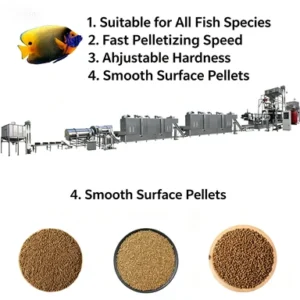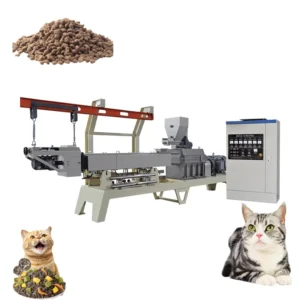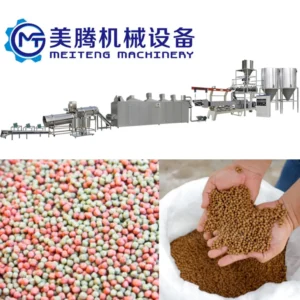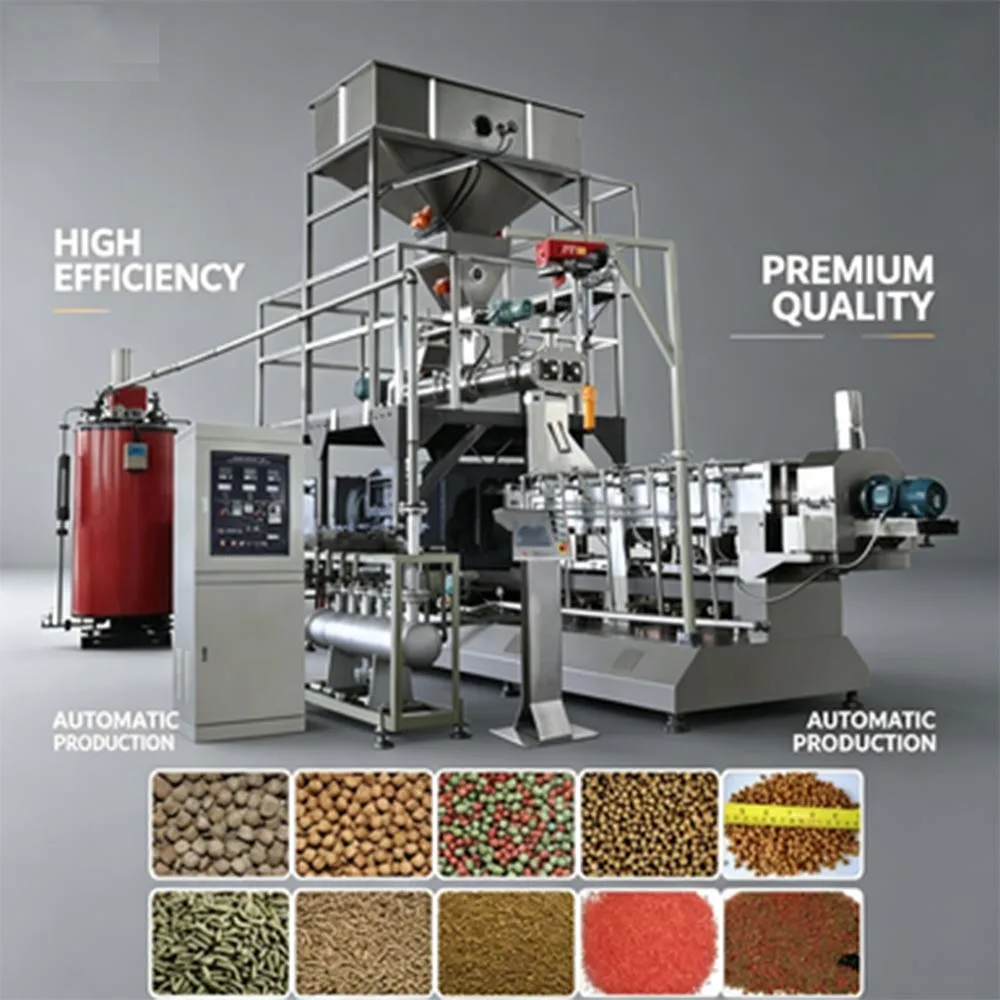
Matched Screw Geometry — twin screw profiles and die orifice layout specified against the buyer’s aquatic feed formulation to hold pellet buoyancy within target density bands.
Technical Specifications
| Parameter | Value |
|---|---|
| Product Type | Twin Screw Floating Fish Feed Extruder Production Line |
| Output Capacity | 500 kg/h (basis not stated in source — confirm raw material formulation, moisture content, pellet diameter) |
| Pellet Size Range | 0.5 mm – 12 mm |
| Screw Configuration | Twin screw, modular elements |
| Control System | Simple control panel (PLC/MCC not specified in source — confirm automation level) |
| Contact Material | Stainless steel (main parts in extrusion and pelletizing zones) |
| Line Stations | Feeding, mixing, extruding, pelletizing (dryer, cooler, coating, packing not stated — confirm full layout) |
| Automation Level | Fully automatic continuous operation |
| Energy Consumption | Low consumption with reasonable power matching (specific kW not stated in source — confirm utility requirement) |
| Voltage & Frequency | To be confirmed against installation site |
Application Suitability
| Application | Material or Output |
|---|---|
| Floating pellets for tilapia grow-out | Fish meal, soybean meal, wheat flour, rice bran blends |
| Catfish and carp starter feed | High-protein formulations with added vitamin premix |
| Shrimp pellet production | Shrimp meal, squid liver powder, starch binder blends |
| Small-to-medium aquaculture mills | Continuous runs across 0.5 mm fry feed up to 12 mm grower pellets |
What "500 kg/h" Means When the Feed Formula Changes
Rated throughput is only valid at the moisture content, starch ratio, and pellet diameter used during the test run.
Many aquatic feed buyers receive a twin screw fish feed extruder production line specifications sheet quoting a single capacity figure with no mention of the formulation behind it. When their own high-fiber or high-fat recipe runs through the same screw profile, residence time shifts and the extruder output drops noticeably. I have seen lines where the dryer ended up oversized for actual throughput, while the pelletizer bottlenecked at the cutter because pellet density was higher than the generic trial assumed. The discrepancy shows up during commissioning, not during the quotation stage [NEED_CITE: throughput verification standards for extruded aquatic feed].
Shear Control Through Screw Element Sequencing
The twin screw configuration allows modular screw elements to be arranged in alternating conveying and kneading zones. For floating fish feed, achieving the right starch gelatinisation degree requires sufficient shear in the mid-barrel section without over-compressing the dough toward the die. The barrel temperature profile works alongside mechanical shear to control expansion at the die exit. Selecting the correct element sequence is what separates stable buoyancy from pellets that sink after a few minutes in water.
Die Geometry and Pellet Density Matching
The 0.5 mm to 12 mm pellet size range is achieved by swapping die plates and adjusting cutter speed. Smaller orifices generate higher pressure, increasing expansion ratio and lowering pellet density — critical for fry-stage feed that must remain at the water surface. Larger dies suit grow-out pellets where a slower sink rate is acceptable for species like catfish. The twin screw fish feed extruder production line specifications must pair each die option with a confirmed screw speed and barrel moisture setting to reproduce results consistently across batches [NEED_CITE: die design parameters for extruded aquatic pellets].
Reading the Specs That Actually Matter on Site
Stainless steel contact surfaces in the extrusion zone resist corrosion from high-moisture dough and acidic fish meal blends, extending service intervals between barrel liner replacements. The simple control panel listed in the specifications needs clarification before order: confirm whether it includes variable frequency drives on the main motor and feeder, or only basic start-stop functions. Without VFD control, screw speed adjustments require manual pulley changes, which limits fine-tuning during recipe transitions. Energy consumption claims depend entirely on motor power and heater wattage — request the full electrical schematic before committing to a layout.
When a Generic Build Reaches the Buyer’s Workshop
A screw configuration designed for standard corn starch will not process a 40% fish meal recipe without modification. The result is under-gelatinised feed with poor water stability, and floating pellets that absorb moisture and sink within minutes. Downstream, if the dryer capacity was sized for the quoted 500 kg/h but the actual recipe throughput is lower, energy costs per ton of finished product rise. Cutter blade wear accelerates when pellet texture is inconsistent, increasing unplanned downtime during production runs [NEED_CITE: aquatic feed quality loss from mismatched extrusion parameters].
Why the Configuration Conversation Happens Before Quotation
Screw elements and die plates are selected based on the buyer’s submitted formulation, not pulled from a default build. The in-house testing workshop runs the actual raw material before shipment, generating a trial report that documents buoyancy, pellet integrity, and real throughput under confirmed moisture conditions. Line layout calculations match extruder output to downstream dryer and cooler capacity so no station becomes a bottleneck. Electrical schematics confirm voltage, frequency, and control panel language for the installation site before production begins, avoiding commissioning delays caused by mismatched utility supply [NEED_CITE: pre-shipment trial run requirements for food extrusion equipment].
Documentation & Verification
- Screw and die configuration record matched to your aquatic feed formulation
- Trial run report documenting buoyancy and throughput on your raw material
- Electrical schematic with voltage and control language confirmed for your site
- Line layout showing capacity matching across extruder, dryer, and cooler stations
- CE declaration of conformity and ISO certificate for export clearance
- Wear parts list specifying screw elements, die plates, and cutter blades
Installation, Commissioning & Support
- Foundation must support the full line weight with level concrete rated for continuous vibration
- Dedicated electrical circuit sized to the confirmed motor power and heater load
- Extruder barrel arrives pre-assembled; downstream stations require on-site alignment
- First production run verifies screw speed, barrel temperature, and moisture injection settings
- Operator training covers die changeover across the 0.5 mm to 12 mm pellet range
- Initial spare package includes replacement screw elements and stainless steel cutter blades
What to Include in Your First Inquiry
Send your typical aquatic feed formulation with protein, fat, and starch percentages, along with the target pellet diameter for each species you produce. Specify the local voltage and frequency at your facility, plus the control panel language your operators require. If you have existing dryers or coolers, share their capacity so the line layout avoids throughput mismatches between stations.
Frequently Asked Questions
Q: How is the 500 kg/h output capacity verified before shipment?
A: Capacity is confirmed through a trial run using your actual raw material formulation at a specified moisture content and pellet diameter. The resulting report documents real throughput, pellet buoyancy, and energy consumption under those exact conditions, rather than relying on a generic benchmark recipe.
Q: How are screw configuration and die design chosen for my formulation?
A: Screw element sequencing and die orifice size are selected based on your recipe’s protein, fat, and starch ratios. High fish meal content requires different kneading zone placement than starch-heavy blends to achieve proper gelatinisation and stable pellet buoyancy for your target species.
Q: What barrel temperature profile is recommended for floating pellets?
A: The profile depends on your formulation’s starch gelatinisation temperature and moisture injection rate. Typically, barrel zones increase progressively toward the die, but the exact settings are finalized during the pre-shipment trial run on your raw material to ensure repeatable buoyancy across production batches.
Q: How do I confirm dryer and cooler capacity matches the extruder?
A: The line layout calculation accounts for actual extruder throughput on your recipe, moisture removal rate in the dryer, and cooling time needed before packing. This prevents situations where one station bottlenecks the line or runs underloaded, wasting energy per ton of finished product.
Q: Is a trial run on my raw material possible before shipment?
A: Yes. The testing workshop processes your supplied raw material through the configured screw and die setup, generating a report covering pellet density, water stability, expansion ratio, and measured throughput. This confirms the line meets your product specification before it leaves the factory.