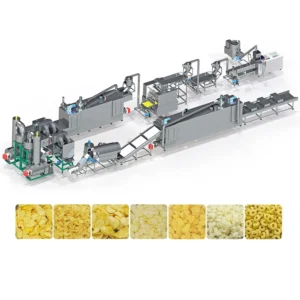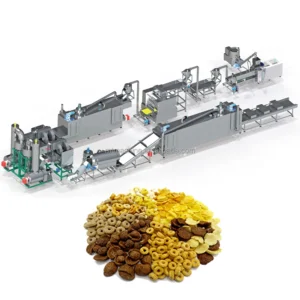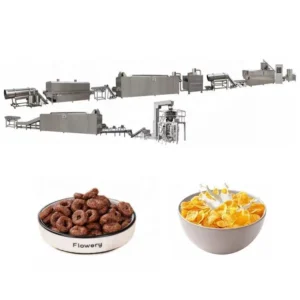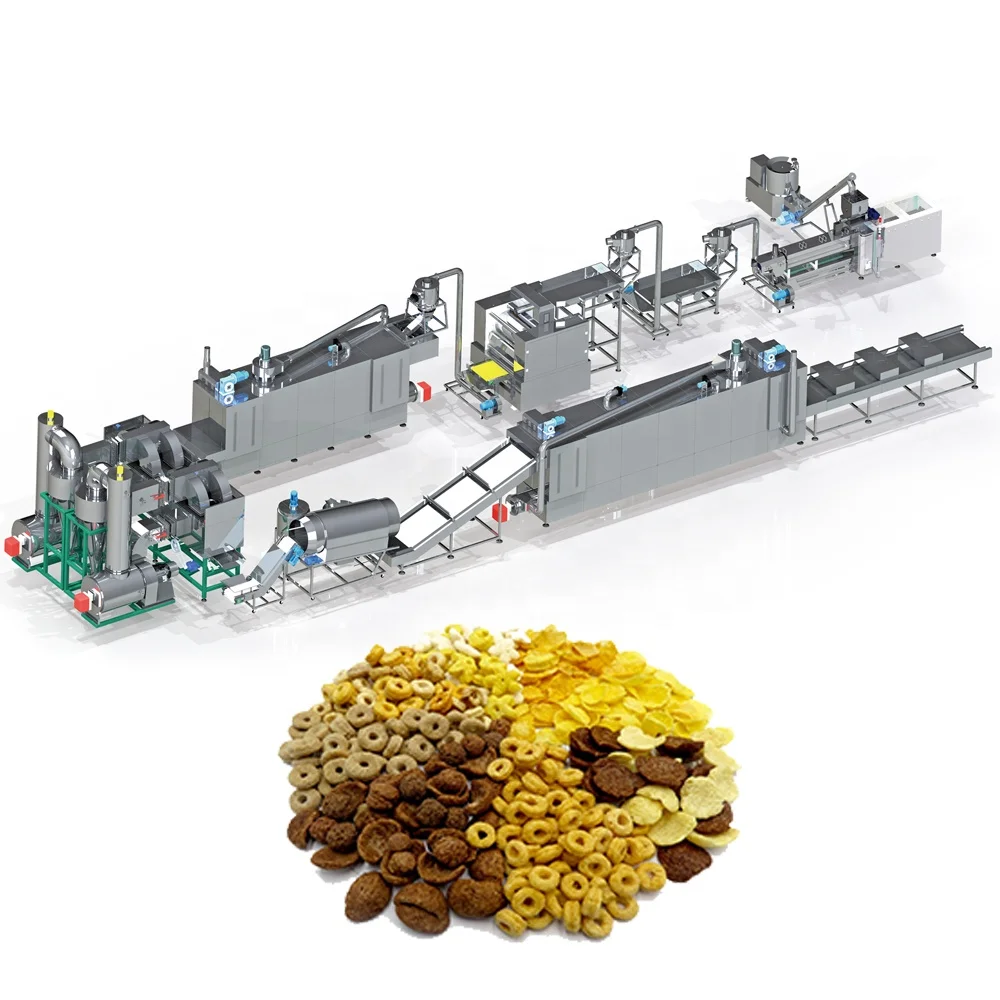
Screw Configuration Matched to Material — Every MT-65 barrel zone and screw module is selected after testing the buyer’s actual corn grits or flour blend, not copied from a generic build.
Technical Specifications
| Parameter | Value |
|---|---|
| Model | MT-65 |
| Product Type | Corn Flakes Production Line (Twin-Screw Extrusion Line) |
| Screw Type | Co-rotating twin screw, sectional modules |
| Installed Power | 84 kW |
| Real Power Consumption | 59 kW |
| Output Capacity | 120–150 kg/h (basis not stated in source — confirm raw material, moisture content, flake thickness) |
| Overall Line Dimensions | 12000 × 1200 × 2200 mm |
| Control System | Separate controller box (PLC/MCC configurable) |
| Mixer Tank Size | Φ600 × 500 mm |
| Mixer Batch Load | 10–30 kg/load (basis to be confirmed) |
| Mixer Power | 4 kW |
| Screw Conveyor Power | 0.75 kW |
| Corn Flakes Press Power | 16.12 kW |
| Press Roller Size | 510 × 310 × 1050 mm |
| Oven Heating Source | Gas-fired, both-side baking |
| Oven Power | 3.75 kW |
| Sugar Spraying System Power | 28.75 kW |
| Gearbox Lubrication | Oil forced automatic system |
| Cutting System | Non-stop cutting |
| Contact Materials | Food-grade stainless steel |
| Self-Cleaning | Yes |
| Standards | CE, ISO certified |
Application Suitability
| Application | Material or Output |
|---|---|
| Toasted corn flakes for breakfast cereal | Corn grits, corn flour at controlled moisture |
| Multi-grain breakfast flakes | Rice flour, wheat flour blends |
| Puffed extruded snacks | Soya bean, peanut, walnut-based formulations |
| Core-filled snacks | Chocolate-filled extrudate with cereal shell |
What "150 kg/h Corn Flakes" Actually Means on Your Material
Nominal capacity figures only hold when the screw profile, barrel temperature, and moisture content all match the raw material you actually feed into the hopper.
A corn flakes extrusion production line technology rated at a certain throughput on standard corn flour can behave very differently when the buyer switches to脱germed corn grits with a coarser particle size. I once watched a trial where the gelatinisation degree dropped sharply because the residence time inside the barrel was too short for the denser grits. The flakes shrank after pressing, output fell noticeably, and the entire batch was scrapped before we reworked the screw combination and barrel zone temperatures [NEED_CITE: starch gelatinisation behaviour across corn grit particle sizes]. That is the gap between a brochure number and a real production day.
Barrel Temperature Profile and Starch Gelatinisation
The MT-65 uses sectional co-rotating twin-screw modules, which means each segment along the barrel can be swapped to adjust shear intensity and residence time. For corn flakes, the goal is partial gelatinisation — enough to bind the dough but not so much that the extrudate becomes fully puffed. Getting that balance right depends on the barrel temperature gradient and the screw pitch at each zone.
Roller Pressing and Flake Density Control
After extrusion, the dough pellets pass through a roller press with an adjustable gap and integrated cooling. The roller distance directly sets flake thickness, while the cooling system prevents sticking on the roller surface. Consistent gap settings across the roller width are what keep flake density uniform from edge to centre — a parameter that bowl-life testing will eventually expose if it drifts [NEED_CITE: flake density and bowl-life correlation in breakfast cereals].
Reading the Spec Sheet Like a Process Engineer
The 84 kW installed power and 59 kW real consumption tell you the line runs with meaningful headroom, which matters when you push barrel temperature higher for a harder-to-gelatinise flour blend. The gas-fired oven with both-side baking handles the toasting stage where moisture drops to the level needed for crispness; uneven heat distribution here shows up as colour variation across the conveyor belt. The non-stop cutting system at the die face eliminates manual intervention that would otherwise interrupt extrudate flow and create density inconsistencies in downstream pressing. Oil-forced automatic gearbox lubrication keeps the drivetrain stable during long runs without scheduled stops for manual greasing.
When the Extruder and Dryer Are Not Talking to Each Other
A bottleneck at the oven or coating drum is one of the most common reasons a corn flakes extrusion production line technology fails to hold its rated output. If the oven cannot remove moisture fast enough, flakes leave the toasting zone soft and break during packing. If the sugar spraying drum runs slower than the extruder feeds, product backs up and cools before coating, leading to uneven glaze adhesion. These mismatches are invisible on a spec sheet that lists each machine in isolation [NEED_CITE: throughput balancing across extrusion line stations].
Why Sourcing the Full Line From One Builder Matters
The screw configuration and die design are specified against the buyer’s raw material and target flake density before the line ships, not adjusted blindly on arrival. Throughput is calculated across every station — mixer batch cycle, extruder output, press speed, oven dwell time, coating drum rotation — so no single unit chokes the rest. An in-house testing workshop allows trial runs on the customer’s actual corn grits or flour blend before dispatch. Electrical schematics and voltage are confirmed for the destination market before production begins, avoiding rewiring delays during commissioning. Wear parts lists covering screws, dies, and press roller components ship with the line so the first replacement cycle does not trigger an emergency order.
Documentation & Verification
- Line layout drawing showing throughput matching between mixer, extruder, press, and oven
- Screw and die configuration record specific to your corn grits or flour blend
- Trial run report on your raw material conducted before shipment
- Electrical schematic with voltage and frequency confirmed for your market
- Operation and maintenance manual with wear parts list and replacement intervals
Installation, Commissioning & Support
- Floor plan requirement based on the 12 m line length with clearance for oven ventilation
- Dedicated power circuit sized for 84 kW installed load with voltage confirmed pre-production
- Separate controller box positioned for operator access away from the press and oven heat zones
- Gas supply connection and pressure testing for the both-side baking oven before first run
- Roller gap calibration and barrel zone temperature mapping during commissioning
- Screw module and die inventory reviewed with the operator team during training
What to Include in Your Inquiry
Send the specific corn grits or flour blend you plan to run, including particle size and moisture content on arrival at your factory. Confirm your target flake thickness, daily production volume, and the local voltage and frequency standard. If you have existing upstream milling or downstream packing equipment, share the interface dimensions so the line layout accounts for them.
Frequently Asked Questions
Q: How is output capacity verified on my specific raw material and moisture content?
A: We run your actual corn grits or flour blend through the MT-65 in the testing workshop, recording throughput, gelatinisation degree, and flake density at the target moisture level. The trial run report documents the results and becomes the baseline for your line configuration.
Q: How are screw configuration and barrel zone temperatures determined for my flour blend?
A: Each screw module segment is selected based on your material’s particle size and starch behaviour. Barrel zone temperatures are mapped during the trial run to achieve partial gelatinisation without over-puffing, then locked into the controller recipe for repeatable production.
Q: How is flake thickness and density controlled through the roller press?
A: The press roller gap is adjustable across its full width, and the integrated cooling system keeps the roller surface temperature stable. Together they set flake thickness and prevent density variation from edge to centre, which directly affects bowl-life performance.
Q: Can a trial run be performed on my raw material before shipment?
A: Yes. The in-house testing workshop runs your raw material through the complete extrusion and pressing sequence. You receive the trial report before the line ships, and any screw or temperature adjustments are made at the factory rather than during commissioning.
Q: What voltage, frequency, and control language are confirmed before commissioning?
A: Electrical schematics are prepared after confirming your local power standard. The controller box language and interface are set to match your operator team before the line enters production, preventing rewiring or reprogramming delays on site.