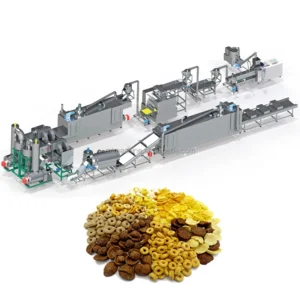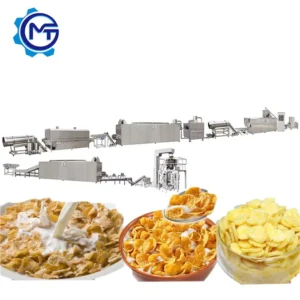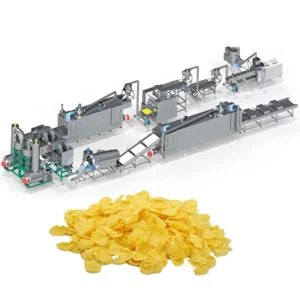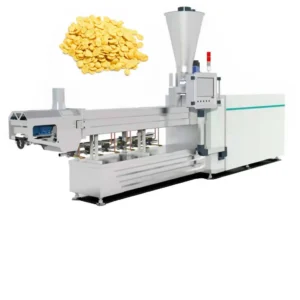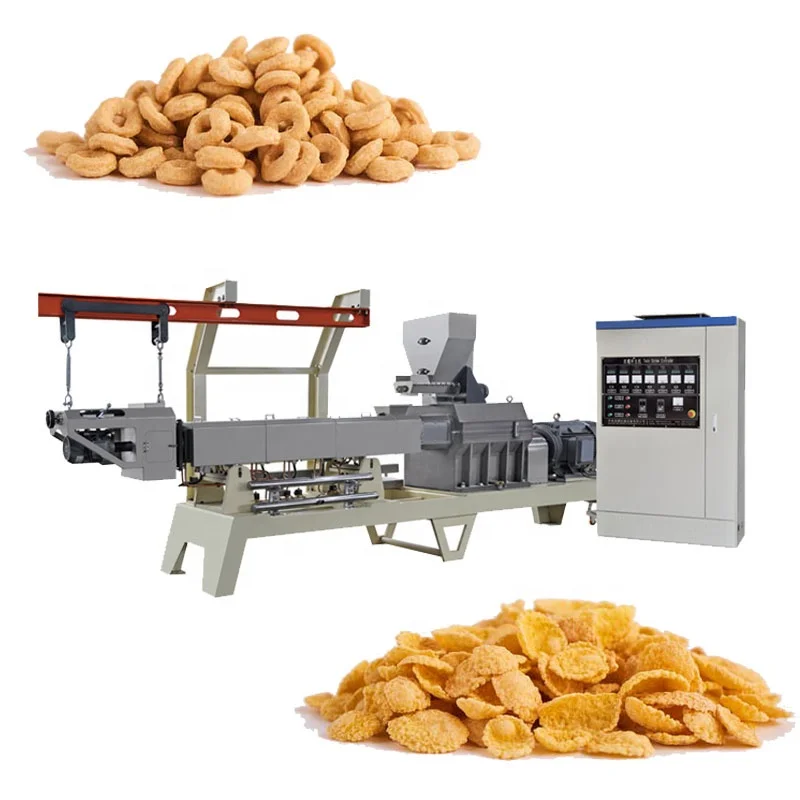
Screw Configuration Matched to Grain — every twin-screw module and die is specified against the buyer’s actual corn, wheat or multi-grain formulation before the line ships.
Technical Specifications
| Parameter | Value |
|---|---|
| Product Type | Corn Flakes Making Machine / Breakfast Cereal Production Line |
| Available Models | MT-65 / MT-70 / MT-85 / MT-75 |
| Screw Type | Co-rotating twin screw, sectional modules |
| Installed Power | 84 kW (MT-65) / 132 kW (MT-70) / 186 kW (MT-75) / 239 kW (MT-85) |
| Real Power Consumption | 59 kW (MT-65) / 92 kW (MT-70) / 140 kW (MT-75) / 167 kW (MT-85) |
| Output Capacity | 120–150 kg/h (MT-65) / 200–250 kg/h (MT-70) / 400–500 kg/h (MT-75) / 300–400 kg/h (MT-85) (basis not stated in source — confirm raw material type, moisture content and flake thickness) |
| Overall Dimensions (L×W×H) | 21000×1200×2200 mm (MT-65) / 23000×1500×2200 mm (MT-70) / 24000×1500×2800 mm (MT-75) / 28000×3500×4300 mm (MT-85) |
| Line Stations | Mixer → Screw Conveyor → Twin Screw Extruder → Air Conveyor → Dryer → Hoister → Flavoring Drum & Oil Sprayer → Cooling Machine → Packing Machine |
| Corn Flakes Press Machine Power | 16.12 kW |
| Press Roller Size | 510×310×1050 mm |
| High-Temperature Oven Heating | Gas-fired, both-side baking system |
| Control System | PLC and MCC |
| Raw Material Form | Powder (flour) or grits |
| Standards | CE (since 2014), ISO |
Application Suitability
| Application | Material or Output |
|---|---|
| Traditional corn flakes breakfast cereal | Corn grits or corn flour, toasted for crisp bowl-life |
| Multi-grain flake blends | Corn, rice, wheat, oat or barley mixed formulations |
| Fortified breakfast cereals | Vitamin- or mineral-enriched grain blends requiring precise gelatinisation |
| Extruded cereal formats | Rice, millet and wheat-based puffed or flaked shapes |
What "300 kg/h" Leaves Out About Corn Flakes Extrusion
Capacity is only meaningful when tied to your exact grain formulation, moisture level and target flake thickness.
I remember setting up a corn flakes line for a buyer who sent standard corn flour samples for the trial run. When their actual production corn grits arrived — coarser, with germ still attached — the screw torque could not handle the load. The flakes came out as hard pellets instead of crisp sheets. It took an overnight reconfiguration of the screw modules and barrel temperature profile to recover the batch. Generic capacity numbers on a quotation hide this reality. The corn flakes extrusion technology must be matched to the specific raw material before the line is built, not adjusted after installation fails [NEED_CITE: twin screw extrusion process validation for breakfast cereal production].
How Co-Rotating Twin-Screw Modules Shape the Flake
The co-rotating twin screw with sectional modules allows each zone — feeding, mixing, de-gassing, cooking and forming — to be tuned independently. For corn flakes, the screw elements are arranged to deliver sufficient shear for starch gelatinisation without overworking the dough, which would collapse the expansion and produce a dense, chewy flake rather than a crisp one. This level of control over the twin screw extruder corn flakes process is what separates consistent bowl-quality cereal from uneven, under-cooked output.
Barrel Temperature Zones and Starch Gelatinisation Control
Proper starch gelatinisation in corn or multi-grain blends requires a precise barrel temperature profile combined with controlled moisture injection. Too low a temperature and the starch remains raw, giving the flake a floury taste and poor crispness. Too high and the sugars caramelise prematurely, darkening the flake and creating bitter notes. The barrel zones on this line are set to match the gelatinisation window of the buyer’s specific grain blend, verified during the in-house trial run before dispatch [NEED_CITE: starch gelatinisation temperature ranges for corn and wheat in extrusion].
Press Roller Gap, Die Design and Final Flake Density
The corn flakes press machine uses a 510×310×1050 mm roller set with an adjustable gap to control flake thickness after extrusion. A narrower gap produces thinner, crisper flakes that toast evenly in the gas-fired oven, while a wider gap yields thicker flakes suited to multi-grain or fortified formulations that need structural integrity during coating and packaging. The die configuration at the extruder outlet determines the initial pellet shape and size, which directly affects how uniformly the press roller flattens each piece.
When a Generic Screw Build Costs You a Production Run
A screw and die configuration copied from a standard build ignores the particle size, fat content and fibre level of the buyer’s actual grain. The result is an extruder that either surges — pushing uneven dough through the die — or stalls under torque overload. Downstream, the press roller cannot flatten inconsistent pellets into uniform flakes, and the oven produces a mix of burnt and under-toasted pieces. The line technically runs, but the product does not meet the buyer’s market specification for colour, texture or bowl-life [NEED_CITE: extruder surge causes and effects on flake uniformity].
Why the Process Matters More Than the Nameplate
Each model in this range — from the MT-65 to the MT-85 — is specified around the buyer’s grain formulation and target flake profile rather than sold as a fixed catalogue build. The screw configuration and die design are documented against the raw material you supply for the trial run. The gas-fired high-temperature oven uses a both-side baking system to ensure even toasting across the full belt width, avoiding the common problem of edge flakes burning while centre flakes remain soft. PLC and MCC control maintains consistent barrel temperatures and screw speed across shifts, reducing batch-to-batch variation that manual adjustment cannot hold.
Engineering Decisions That Affect Daily Production
The installed power versus real power gap across all models reflects the difference between peak motor rating and actual operating draw — a line rated at 239 kW installed (MT-85) draws approximately 167 kW in continuous production, which matters for your transformer sizing and utility agreement. The overall line length, reaching up to 28 metres for the MT-85 configuration, determines your workshop floor plan and the spacing between the extruder, dryer and oven stations. The 16.12 kW press machine operates independently from the main extruder drive, allowing roller gap adjustments without interrupting extrusion throughput.
Documentation & Verification
- Screw and die configuration record matched to your grain formulation
- Trial run report on your actual corn or multi-grain raw material before shipment
- Line layout and capacity calculation showing throughput balance across all stations
- Electrical schematic with voltage and frequency confirmed for your facility
- CE declaration of conformity and ISO certificate for import compliance
- Wear parts list covering screw modules, dies and press roller components
Installation, Commissioning & Support
- Foundation plan accounts for the 28-metre line length and oven weight distribution
- Dedicated electrical circuit sized to the real power draw of up to 167 kW
- Gas supply connection and ventilation specified for the both-side baking oven system
- PLC interface language and MCC labelling confirmed before dispatch
- Operator training covers screw module changes for different grain formulations
- Spare screw elements and die inserts shipped with the initial order
Preparing Your Inquiry
To size the right line, share your grain formulation — whether corn grits, corn flour, or a multi-grain blend — along with target flake thickness and daily output requirement. Confirm your workshop’s available floor length, ceiling height, and local voltage and frequency. If you have existing upstream mixing or downstream packing equipment, provide those specifications so the line throughput can be balanced to your current setup.
Frequently Asked Questions
Q: How is the screw configuration chosen for different grain blends?
A: The screw modules are selected based on your specific raw material — corn grits, corn flour, or multi-grain blends — considering particle size, fat content and fibre level. A trial run on your actual material in the testing workshop confirms the configuration before shipment, ensuring proper gelatinisation and flake texture.
Q: What moisture and temperature range is needed for starch gelatinisation?
A: Corn starch gelatinisation typically occurs between specific barrel zone temperatures with controlled moisture addition. The exact profile depends on your grain type and blend ratio. The barrel temperature zones and moisture injection rate are set during the trial run to match your formulation’s requirements.
Q: How is output capacity verified against our raw material?
A: Capacity varies with grain type, moisture content and target flake thickness. A trial run using your actual raw material is conducted in the testing workshop before shipment, producing a documented report that confirms the achievable throughput on your specific formulation.
Q: Can we send our own grain for a trial before the line ships?
A: Yes, sending your production raw material for a trial run is a standard step. The extruder, press roller and oven are tested together on your grain, and the resulting flakes are evaluated for thickness, crispness, colour and bowl-life before the line is approved for dispatch.
Q: How is flake thickness controlled on the press roller?
A: The press roller gap is adjustable to set the target flake thickness. Combined with the die configuration at the extruder outlet, this controls the final density and crispness. Settings are recorded during the trial run and documented in the configuration record provided with the line.