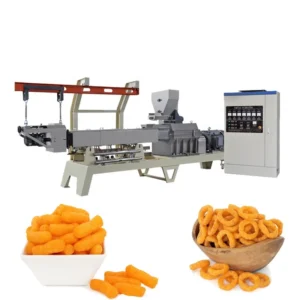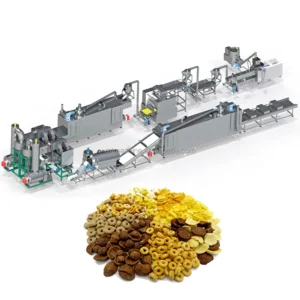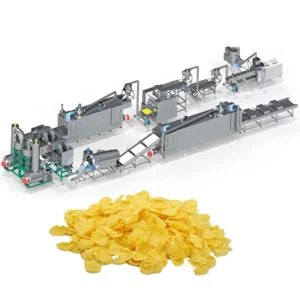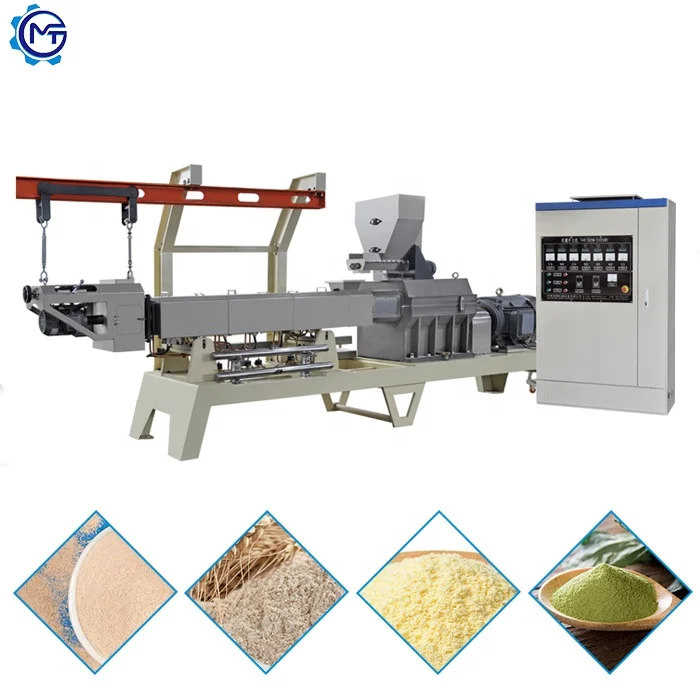
Screw Configuration Matched to Your Grain — Every barrel zone and die opening is specified after testing your exact corn, rice, or barley blend in our workshop, not copied from a generic cereal build.
Technical Specifications
| Parameter | Value |
|---|---|
| Product Type | Twin Screw Extrusion Corn Flakes Production Line |
| Model Options | MT70 / MT75 / MT85 |
| Screw Type | Twin Screw, wear-resistant manufacturing |
| Installed Power (MT70) | 160 kW |
| Power Consumption (MT70) | 120 kW |
| Output Capacity (MT70) | 150–200 kg/hr (basis not stated in source — confirm raw material / moisture content) |
| Overall Dimensions (MT70) | 41 × 1.5 × 2.2 m |
| Installed Power (MT75) | 210 kW |
| Power Consumption (MT75) | 150 kW |
| Output Capacity (MT75) | 300–500 kg/hr (basis not stated in source — confirm raw material / moisture content) |
| Overall Dimensions (MT75) | 45 × 1.5 × 3.5 m |
| Installed Power (MT85) | 190 kW |
| Power Consumption (MT85) | 140 kW |
| Output Capacity (MT85) | 300–400 kg/hr (basis not stated in source — confirm raw material / moisture content) |
| Overall Dimensions (MT85) | 43 × 1.5 × 3.2 m |
| Control System | PLC control; MCC and PLC available for full line |
| Flaking Drive | Double motors, separate roller driving, hydraulic system |
| Flaking Temperature Control | Infrared sensor for even temperature pipe control |
| Dryer Heating Source | Gas or Electric |
| Roasting Oven | Hot air with conciliation burner, two circulating fans, cyclone dust removal |
| Voltage Options | 415V 50/60Hz; 440V 50/60Hz; 220V 60Hz (customizable) |
| Lubrication | Automatic lubricating and cooling function |
| Certifications | CE (declared since 2014); ISO certified |
Application Suitability
| Application | Material or Output |
|---|---|
| Natural corn flakes | Corn grits and maize powder processed through extrusion, flaking, and hot air roasting |
| Sugar-coated breakfast cereal | Corn or rice base with double tumble sugar coating and secondary drying stage |
| Multi-grain flake blends | Rice, wheat, oat, and barley powder mixed and extruded through twin-screw configuration |
| Shaped cereal pieces | Ball, ring, star, heart, fruit loop, tube, stick, and wheel forms via die adjustment |
| Instant porridge base | Pregelatinised cereal pellets dried and roasted for rapid hydration |
What "300 kg/hr on Corn Flakes" Actually Means on Your Grain
A nominal capacity figure is only valid when the screw configuration, barrel temperature, and moisture content all match your specific raw material.
I have watched a buyer sign off on a line rated for a certain hourly output, only to discover during commissioning that their corn blend required a different screw pitch and barrel zone profile. The extruder could not hold throughput without burning the starch. That is why a corn flakes extrusion line screw configuration and die design must be validated on the buyer’s actual material before the machine leaves the factory [NEED_CITE: starch gelatinisation behaviour varies significantly across corn varieties and moisture levels]. Generic builds assume a standard yellow dent corn at a fixed moisture point. If your supply chain delivers a harder endosperm variety or a different grain ratio, the shear profile inside the barrel changes entirely.
Barrel Temperature Zones and Starch Gelatinisation Control
The twin-screw barrel is divided into multiple heating and cooling zones. Each zone must hold a precise temperature so that starch granules absorb moisture and swell at the correct rate. Too much heat in the early zones causes premature gelatinisation, and the dough becomes sticky before it reaches the die. Too little heat leaves raw starch cores that produce a dense, hard flake after roasting. The corn flakes extrusion line screw configuration and die design must account for the specific gelatinisation temperature of your grain blend, which shifts depending on amylose content and particle size distribution.
Shear, Moisture, and the Expansion Window
Moisture injection and screw speed together define the shear energy applied to the dough. Higher shear with controlled moisture produces a pellet that expands uniformly when it exits the die, creating the internal structure that later becomes the flake’s crispness. If the moisture is off by even a small margin, the pellet either collapses or over-expands, and no amount of adjustment at the flaking rollers will recover the texture. This is the stage where process engineers see the difference between a line that holds its specification and one that drifts [NEED_CITE: moisture content tolerance in twin-screw cereal extrusion].
Die Geometry and Its Effect on Flake Thickness
The die plate determines the cross-section and wall thickness of the extruded pellet before it reaches the flaking rollers. A pellet with a thicker wall will resist compression differently, producing a heavier flake that may not achieve the target crunch. The die opening shape, land length, and number of holes all influence throughput balance and pellet uniformity. Matching the die to the screw configuration ensures that every pellet arrives at the flaking station with consistent geometry and internal moisture.
Hot Air Roasting and Surface Bubble Formation
After flaking and drying, the roasting oven applies high-velocity hot air to the flake surface. The rapid heat causes residual moisture to flash into steam, forming the characteristic surface bubbles that define a corn flake’s crispness. The conciliation burner and dual circulating fans maintain even temperature across the bed, while the cyclone dust removal device captures fines. If the pellet density entering the roaster is inconsistent, some flakes will scorch while others remain leathery.
Reading the Spec Sheet Beyond the Headline Numbers
The installed power on the MT75 reaches 210 kW with a working consumption around 150 kW, which tells you the extruder has headroom for harder grain blends that demand higher torque. The automatic lubricating and cooling function protects the screw shafts during continuous runs where bearing temperatures can climb. The hydraulic flaking system with double motor drive keeps roller pressure even across the full width, preventing flakes that are thicker on one edge. Voltage options cover 415V, 440V, and 220V at 50 or 60 Hz, so the electrical schematic must be confirmed against your facility supply before production starts.
When the Line Bottlenecks at the Dryer or Roaster
A common mistake is sizing the extruder correctly but specifying a dryer or roasting oven that cannot keep pace. If the dryer cannot remove moisture fast enough, flakes pile up, cool unevenly, and absorb ambient humidity before packing. The flaking machinery may also become the constraint if its roller speed cannot match the extruder output. Throughput must be calculated across every station — mixing, extruding, flaking, drying, roasting, cooling — so that no single machine governs the entire line’s output [NEED_CITE: throughput balancing in multi-stage cereal processing lines].
Why Source Validation Matters Before Shipment
Every line we build includes a complete documentation package. You receive the screw and die configuration record specific to your raw material, the trial run report from our in-house testing workshop, the line layout with capacity calculations for each station, and the electrical schematic with voltage confirmation. The factory test record shows the machine running your actual grain blend before it is crated. This is how you know the corn flakes extrusion line screw configuration and die design matches your product, not someone else’s.
Documentation & Verification
- Screw and die configuration record matched to your grain blend and target flake density
- Trial run report on your raw material from the in-house testing workshop before dispatch
- Line layout and throughput calculation showing capacity at every station from mixer to packer
- Electrical schematic with voltage, frequency, and control language confirmed for your market
- CE declaration of conformity and ISO certificate included with shipping documents
- Wear parts list covering screws, dies, and flaking roller surfaces with replacement intervals
Installation, Commissioning & Support
- Foundation plan accounts for the MT75 footprint of 45 × 1.5 m and total line length
- Dedicated power circuit sized for the 210 kW installed load with confirmed voltage and frequency
- Extruder barrel and flaking unit shipped in separate modules for workshop door clearance
- First-run parameter setting includes barrel zone temperatures, screw speed, and roller gap calibration
- Operator training covers PLC interface, hydraulic flaking pressure adjustment, and roasting oven fan balance
- Spare screw elements and die plates supplied with initial shipment for first replacement cycle
What to Prepare Before You Send an Inquiry
We need your grain formulation — the exact ratio of corn, rice, wheat, or oat powder along with typical moisture content at intake. Tell us your target flake density, whether you are producing natural or sugar-coated variants, and the daily output you need to sustain. Share your facility voltage, frequency, and preferred control language. If you already have upstream milling or downstream packing equipment, provide the interface details so we can match throughput at every station.
Frequently Asked Questions
Q: How is the screw configuration determined for different cereal raw materials?
A: We start with your grain formulation and target flake density. The screw element sequence — conveying, kneading, and reverse elements — is arranged to deliver the correct shear and residence time for your specific starch type. A harder corn endosperm needs a different pitch than a soft wheat blend. We validate the configuration on your actual material in our testing workshop before finalising the build.
Q: What barrel temperature profile is needed for proper starch gelatinisation in corn flakes?
A: The profile depends on your grain’s amylose content and moisture level. Early barrel zones typically hold a lower temperature to hydrate the starch without premature gelatinisation, while later zones increase heat to complete the cooking. Each zone is independently controlled and logged by the PLC. We establish the exact setpoints during the trial run on your raw material.
Q: Can a trial run be done on my specific raw material before the line ships?
A: Yes. Our in-house testing workshop runs your grain blend through the configured extruder, flaking unit, and roasting oven. You receive a trial run report documenting throughput, pellet geometry, flake density, and surface texture. Any adjustments to the screw configuration or die design are made at this stage, not after the line arrives at your facility.
Q: How does die design affect the final flake shape and thickness?
A: The die opening determines the pellet’s cross-section and wall thickness before it reaches the flaking rollers. A round die with a specific land length produces a cylindrical pellet that flakes into a uniform disc. Changing the die geometry alters how the pellet compresses between rollers, which directly controls the final flake thickness and its behaviour during roasting.
Q: What extrusion parameters differ between natural and sugar-coated corn flakes?
A: Sugar-coated flakes require a denser pellet that can withstand the double tumble coating process without breaking apart. This typically means adjusting the screw configuration for lower expansion and modifying the die design for a thicker wall. The roasting profile also shifts because the sugar coating changes how surface moisture evaporates during the hot air stage.