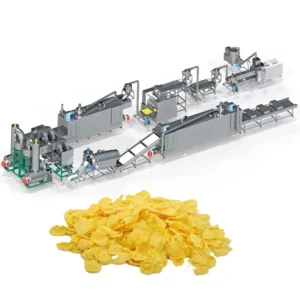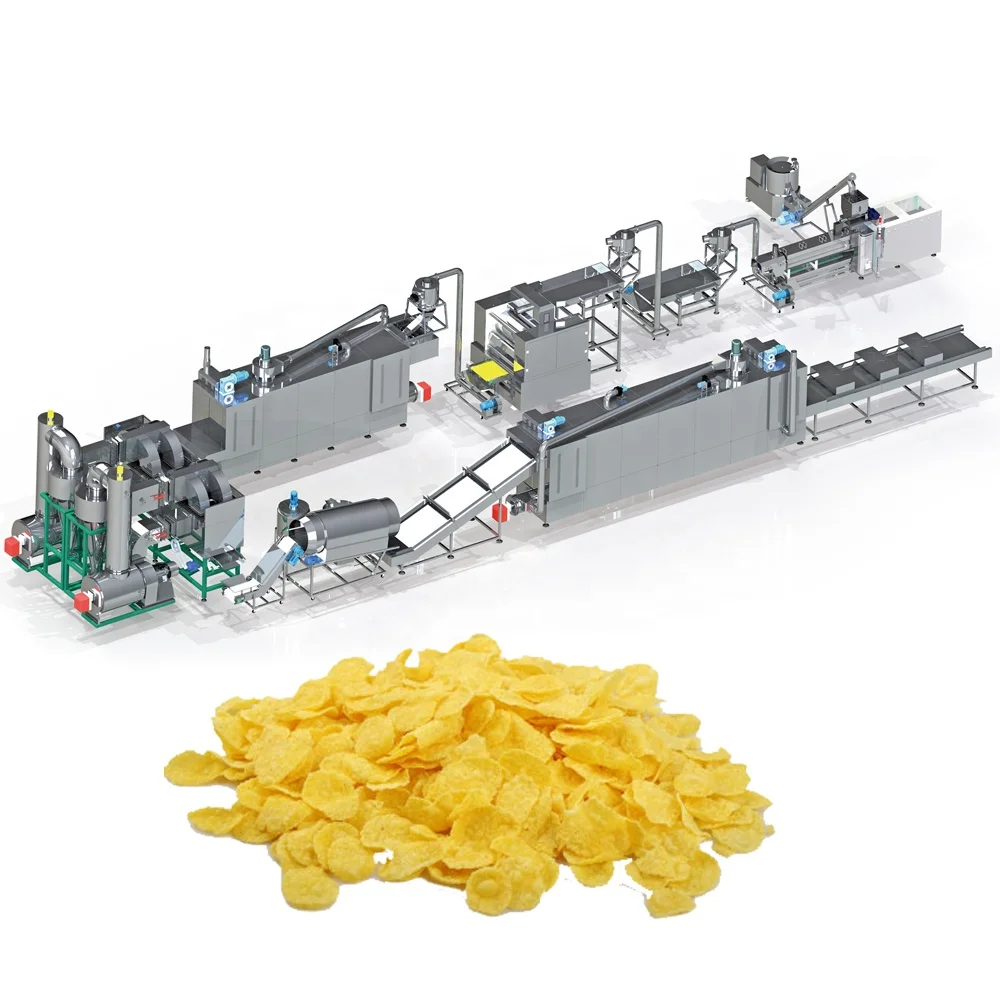
Corn Flakes Extrusion Line for Breakfast Cereal – Specifications
Screw and die configuration matched to raw material — Every MT75 corn flakes line ships with a documented screw profile and die geometry record based on trial runs using your specific corn grit formulation, not a generic catalog build.
Technical Specifications
| Parameter | Value |
|---|---|
| Model | MT75 (also available: MT70, MT85) |
| Product Type | Corn Flakes Extrusion Production Line |
| Screw Type | Twin screw |
| Installed Power | 210 kW (MT75); 160 kW (MT70); 190 kW (MT85) |
| Power Consumption | 150 kW (MT75); 120 kW (MT70); 140 kW (MT85) |
| Output Capacity | 300–500 kg/h for MT75 (basis not stated in source — confirm raw material formulation and moisture content); 150–200 kg/h for MT70; 300–400 kg/h for MT85 |
| Overall Dimensions | 45 × 1.5 × 3.5 m (MT75); 41 × 1.5 × 2.2 m (MT70); 43 × 1.5 × 3.2 m (MT85) |
| Extruder Working Principle | Feeding system, extruding system, cutting system, heating system, gearing system, controlling system |
| Control System | PLC control on flaking machinery; MCC integrated line control |
| Flaking Machinery Drive | Double motors for separate roller driving; hydraulic system for double rollers |
| Flaking Temperature Control | Infrared sensor for even pipe temperature regulation |
| Dryer Function | Pre-drying after extrusion to prevent sticking in downstream stations |
| Dryer Heating Source | Gas or electric (verify against manufacturer catalog) |
| Roasting Oven Type | Hot air roasting with conciliation burner; two separate circulating fans; cyclone dust removal device |
| Coating System | Double tumble for sugar melting, elevator, coating drum, spraying nozzle |
| Line Stations | Mixing → extrusion → flaking → drying → roasting → sugar coating → packing |
| Automation | Automatic lubricating and cooling function on extruder |
| Screw Material | Special technology wear-resistant alloy (verify against manufacturer catalog) |
| Standards | CE, ISO (electronic edition certificates available for export) |
| Warranty | 24 months, lifetime service |
Application Suitability
| Application | Material or Output |
|---|---|
| Standard corn flakes production | Corn grits, plain or sugar-coated finish |
| Multigrain breakfast cereals | Wheat, rice, oat, and blended grain formulations |
| Fortified nutritional cereal bars | Grain base with added vitamin and mineral premix |
| Puffed snack variants on same extrusion base | Corn, rice, and multigrain blends in alternate die shapes |
What "300–500 kg/h" Leaves Out About Corn Flake Density
Capacity figures only hold when corn grit particle size, moisture content, and starch composition match the screw configuration inside the barrel.
I worked with a breakfast cereal producer who ordered a line based on catalog output numbers. Their corn grit was coarser than the standard test material. The extruder ran, but throughput settled well below the nameplate because the coarser particles needed longer residence time and different shear distribution to achieve full starch gelatinisation. The entire screw combination had to be reconfigured before the line could approach its rated range. That experience shaped how I approach every corn flakes extrusion technology twin screw project now — the raw material comes first, and the machine follows. [NEED_CITE: starch gelatinisation degree and residence time requirements in twin-screw extrusion]
How Screw Configuration Controls Starch Gelatinisation
The twin-screw arrangement inside the MT75 barrel gives process engineers independent control over shear intensity and residence time across multiple heating zones. Corn grit enters the feed section and progressively hydrates as it moves through preconditioning and compression zones where barrel heaters raise the material temperature in measured increments. The degree of starch gelatinisation — typically the single most important variable for final flake texture — depends on how long the material stays under combined heat and mechanical shear. A screw profile with wider kneading blocks increases shear and gelatinisation but shortens throughput windows; a more open flight design does the opposite. Getting this balance right for corn flakes extrusion technology twin screw applications means matching the configuration to the exact corn variety, particle size distribution, and amylose-to-amylopectin ratio in the buyer’s formulation.
Barrel Temperature Profile and Moisture Flash at the Die
Each barrel zone has independent heating control, and the temperature gradient across these zones governs how moisture behaves when the dough exits the die. If the final barrel zone runs too hot relative to the moisture content, steam flashes violently at the die face and the extrudate expands beyond what the downstream flaking rollers can compress into a coherent flake. Too cool, and the extrudate leaves the die under-expanded, producing a dense flake that turns hard rather than crisp after roasting. The infrared sensor on the flaking machinery monitors pipe temperature continuously, giving operators real-time feedback to adjust barrel zone setpoints before a batch drifts out of specification. This level of thermal control is where corn flakes extrusion technology twin screw systems separate from simpler single-screw alternatives that offer fewer independent heating zones. [NEED_CITE: barrel zone temperature profiling in cereal extrusion processes]
Reading the Specifications That Actually Matter
The MT75 draws 150 kW during operation across 210 kW installed capacity, meaning the drive system has headroom for harder formulations like high-amylose corn or multigrain blends that demand more torque. The overall footprint of 45 × 1.5 × 3.5 m reflects the full station sequence from mixer through roaster, so buyers need to plan utility drops and floor space for the complete line, not just the extruder. The flaking station uses double motors with separate roller driving and a hydraulic pressure system — this means each roller speed and gap can be adjusted independently, which directly controls flake thickness and the surface blister pattern that consumers associate with quality corn flakes. The PLC and MCC control architecture keeps the extruder parameters and downstream stations on a single integrated network, reducing the coordination errors that happen when each machine runs on its own isolated controller.
The Hidden Cost of Skipping the Trial Run
When an extruder ships without a trial on the buyer’s actual corn grit, the first weeks of production become an expensive experiment. Screw segments get swapped, barrel temperatures get pushed outside safe ranges, and the flaking rollers cycle through gap settings while operators guess at the right combination. Material waste accumulates. The roaster runs batches that are either under-toasted or scorched because the extrudate density never stabilised. All of this happens after the buyer has already paid for the machine, shipped it internationally, and waited through installation. [NEED_CITE: commissioning delays caused by untested raw material compatibility]
Why Source This Line Here
Complete throughput matching from the batching system through extrusion, flaking, drying, roasting, and coating means no single station bottlenecks the line because every component was specified as part of one integrated system. Screw configuration and die design are documented against your specific corn formulation before the extruder enters production. The in-house testing workshop runs your raw material on the actual screw profile ordered, producing a trial report that confirms capacity, gelatinisation degree, and extrudate density before the machine leaves the factory. Pre-sales engineering consultation covers line layout, utility planning, and voltage confirmation so that commissioning starts with parameters already close to final values rather than requiring weeks of adjustment.
Documentation & Verification
- Screw and die configuration record matched to your corn grit formulation
- Trial run report on customer raw material completed before shipment
- Line layout and capacity calculation with throughput matched across all stations
- Electrical schematic with voltage and frequency confirmed for your country
- CE declaration of conformity and ISO certificate in electronic edition for export
- Operation and maintenance manual with wear parts list included
Installation, Commissioning & Support
- Foundation plan based on the 45 × 1.5 × 3.5 m line footprint and station weights
- Power supply verification for 210 kW installed capacity at your local voltage and frequency
- Overseas installation with on-site assembly of flaking rollers and roasting oven
- First-run parameter setting using trial report data as the commissioning baseline
- Operator training on PLC interface, hydraulic roller adjustment, and roasting temperature control
- Wear parts list covering screw segments, die plates, and flaking roller surfaces
What We Need to Build Your Line Proposal
Share your corn grit specification — particle size distribution, moisture content, and whether the blend includes wheat, rice, or other grains — along with your target daily output and the bowl-life expectation for your market. Confirm your facility voltage, frequency, and preferred control language so that electrical schematics match your site before production begins. If you need a trial run on your raw material before committing, let us know the quantity you can send to the testing workshop.
Frequently Asked Questions
Q: How is screw configuration chosen for my specific corn grit formulation and target flake density?
A: We start with your raw material specification — particle size, moisture, and starch composition — then select kneading block arrangement, screw pitch, and flight depth to control shear and residence time. A trial run in the testing workshop confirms the configuration produces the target gelatinisation degree and extrudate density before the extruder ships.
Q: What barrel temperature profile and moisture level produce the correct expansion without collapsing the flake structure?
A: The gradient across barrel zones is set so moisture remains bound in the dough until the die exit, where controlled steam flash creates uniform expansion. The exact profile depends on your corn formulation and is validated during the pre-shipment trial run, with setpoints recorded in the commissioning documentation for your operators.
Q: Can I run a trial on my own raw material before the extruder ships, and what does the test report cover?
A: Yes. Send a sample of your corn grit to the in-house testing workshop. The trial run report documents throughput, barrel temperature profile, screw configuration used, extrudate density, and starch gelatinisation measurements, giving you a verified baseline before the line enters production.
Q: How does die design interact with the flaking rollers to control final flake thickness and surface blister pattern?
A: Die aperture shape and size determine the extrudate cross-section entering the flaking station. The hydraulic double-roller system then compresses that extrudate to the target flake thickness while surface moisture flashes into the characteristic blister pattern. Roller gap, pressure, and speed are independently adjustable through the PLC interface.
Q: What starch gelatinisation degree should I expect, and how is it measured during commissioning?
A: Corn flakes typically require a high gelatinisation degree for proper texture and bowl-life. During commissioning, samples are taken from the extruder discharge and tested for gelatinisation completeness. Results are compared against the pre-shipment trial report to confirm the line is performing within the validated parameter window.