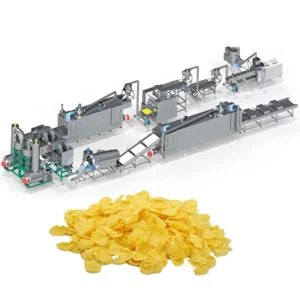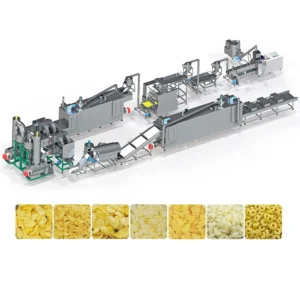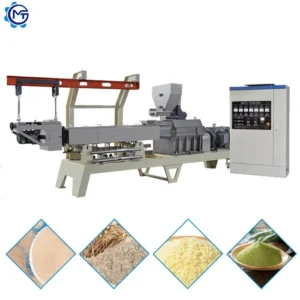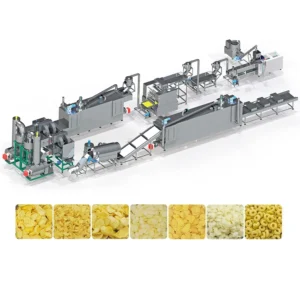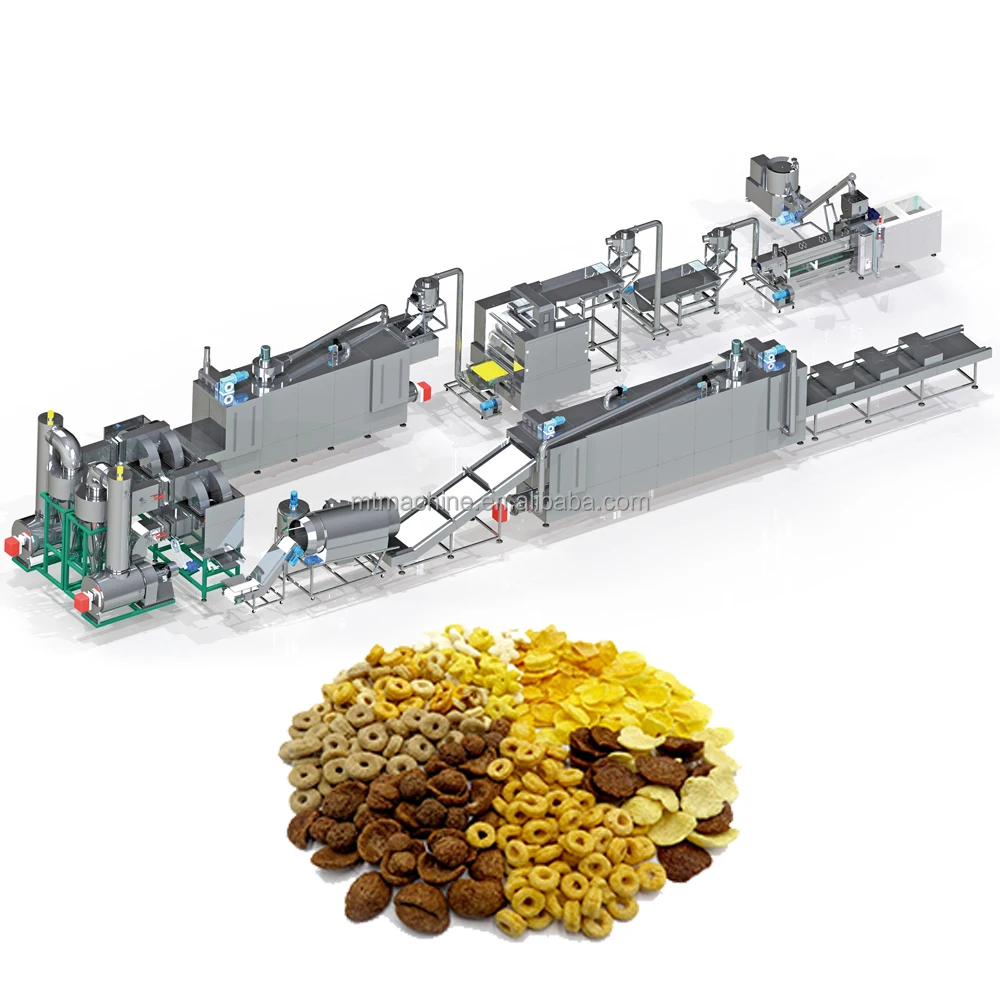
Screw and Die Matched to Your Grain — Every corn flakes extrusion production line specifications package we ship starts with a trial run on the buyer’s actual corn, wheat, or oat blend, not a generic factory test.
Technical Specifications
| Parameter | Value |
|---|---|
| Product Type | Breakfast Cereal Corn Flakes Production Line |
| Extruder Model | MT-75 Twin Screw Extruder |
| Screw Configuration | Twin-screw, modular element arrangement |
| Control System | PLC control system |
| Heating Source (Dryer) | Gas or Electric |
| Flaking System | Hydraulic double-roller, separate motor drives, infrared temperature feedback |
| Roasting Oven | Hot air with conciliation burner, dual circulating fans, cyclone dust removal |
| Coating System | Double tumble sugar melting, spraying nozzle, secondary drying |
| Core Component | Gearbox |
| Machinery Test Report | Provided |
| Video Outgoing-Inspection | Provided |
| Warranty | 1 Year (including core components) |
| Certifications | CE, ISO |
Application Suitability
| Application | Material or Output |
|---|---|
| Natural corn flakes for breakfast cereal | Corn grits, corn flour |
| Multi-grain breakfast flakes | Wheat, rice, oat, barley blends |
| Sugar-coated cereal flakes | Corn or multi-grain base with sugar syrup |
| Fortified breakfast cereal | Grain mash with added vitamin and mineral premix |
| Puffed snack shapes | Same extrusion platform with die variation |
Why Nominal Capacity Figures Fail on Corn Flakes Lines
Output numbers mean nothing unless they are tied to a specific grain formulation and moisture content.
Many buyers receive a quotation stating a fixed hourly throughput for a corn flakes extrusion production line specifications sheet, only to discover during commissioning that the screw configuration and barrel temperature profile were copied from a standard build. The result is a mash that exits the die with inconsistent gelatinisation, producing flakes that are either too dense to crisp properly in the roaster or too fragile to survive the flaking rollers [NEED_CITE: starch gelatinisation temperature thresholds for different grain types]. When the raw material changes — even a different corn grits supplier with a slightly coarser particle size — the entire line can drift outside acceptable density and thickness tolerances. That drift does not show up on paper until the first production run fails quality checks.
Barrel Zone Temperature and Starch Behaviour
The MT-75 twin-screw extruder divides the barrel into independently heated and cooled zones, each governed by the PLC control system. Corn starch gelatinises within a narrow temperature band, and the residence time inside the barrel must be sufficient for complete hydration without over-shearing the mash. When processing wheat or oat — which carry different protein and lipid profiles — the barrel temperature profile needs adjustment zone by zone to maintain consistent dough viscosity at the die face. This is where the corn flakes extrusion production line specifications either hold up under real production conditions or fall apart.
Die Geometry and Flake Integrity After Rolling
Die aperture shape and land length determine the cross-section of the extruded pellet before it enters the flaking rollers. A pellet that is too thick will resist compression, producing a flake with internal stress cracks that shatter during roasting. A pellet that is too thin will flatten unevenly, leaving dense centres that refuse to blister properly in the hot air oven. The die design must be selected in relation to the hydraulic flaking system’s roller gap setting and the infrared temperature feedback that keeps the roller surface at the correct working temperature. [NEED_CITE: relationship between extrudate cross-section and final flake tensile strength]
Reading the Specs That Actually Matter
The PLC control system governs barrel temperature, screw speed, and feed rate simultaneously, which is critical when switching between corn and multi-grain formulations mid-week. The hydraulic double-roller flaking system uses separate motor drives per roller, allowing independent speed adjustment to control shear on the pellet surface — a detail that directly affects how evenly the flake blisters in the roasting oven. The hot air roasting oven’s conciliation burner and dual circulating fans work together to distribute heat across the belt; without cyclone dust removal, fine particle accumulation on the heat exchanger degrades thermal efficiency over successive shifts. These are the specifications that determine whether a line can sustain consistent output over a production week, not the headline throughput figure.
The Cost of Skipping Raw Material Trials
Buyers who approve a line without requiring a trial run on their own grain blend frequently encounter problems only after installation. The flaking rollers may compress the pellet unevenly, the roasting oven may scorch the edges while the centre remains soft, and the sugar coating station may not achieve uniform adhesion on a flake surface that was never designed for that syrup viscosity [NEED_CITE: sugar coating adhesion failure on improperly extruded cereal flakes]. These issues require on-site re-engineering of screw elements and die selection — work that should have been completed before the machine left the factory floor.
What the Engineering Record Actually Covers
Every corn flakes extrusion production line specifications package begins with the buyer’s raw material sample tested in the in-house workshop. The screw configuration and die design are documented specifically for that formulation. The line layout and capacity calculation ensures that throughput is matched across every station — extruder, flaker, dryer, roaster, and packing — so no single stage becomes a bottleneck. Electrical schematics confirm voltage, frequency, and PLC language before production starts, preventing commissioning delays. The trial run report on the buyer’s raw material travels with the shipment, giving the installation team a verified baseline for parameter settings on day one.
Documentation & Verification
- Screw and die configuration record matched to your grain formulation and target flake density
- Trial run report on your raw material completed in the testing workshop before dispatch
- Electrical schematic confirming voltage, frequency, and PLC language for your facility
- Line layout and capacity calculation showing throughput matching across all stations
- Operation and maintenance manual with wear parts list specific to your configuration
- CE declaration of conformity and ISO certificate
Installation, Commissioning & Support
- Foundation and utility planning based on line layout including dryer gas or electric heating source requirements
- PLC control system commissioning with parameter baseline set from the factory trial run report
- Hydraulic flaking roller gap and infrared sensor calibration during on-site installation
- Hot air roasting oven burner adjustment and cyclone dust removal system verification
- Operator training covering screw element changes for formulation switches and daily barrel cleaning procedures
- Wear parts supply plan for screws, dies, and gearbox components with documented replacement intervals
What We Need to Configure Your Line
To prepare a line layout and trial run plan, we need your target grain type or blend, the moisture content and particle size of your raw material, and your daily output target across natural and sugar-coated SKUs. Provide your facility’s voltage and frequency, available floor space and ceiling height, and whether you have existing upstream mixing or downstream packing equipment that must interface with the line. If your formulation includes vitamin premix or specialty ingredients, share the inclusion ratios so we can account for their effect on dough rheology during extrusion.
Frequently Asked Questions
Q: How is the output capacity figure verified for my specific grain blend?
A: The 200–300 kg/h range referenced for the MT-75 platform is a starting point, not a guarantee. We run your actual raw material — at your specified moisture content and particle size — in the testing workshop and document the achievable throughput. The trial run report becomes part of your shipment documentation and sets the baseline parameters for commissioning.
Q: How do you select screw elements for corn versus wheat or oat formulations?
A: Corn, wheat, oat, and barley each have different starch gelatinisation temperatures and protein structures. We adjust the screw element sequence — kneading block angles, conveying pitch, and reverse element placement — along with barrel zone temperatures to match your specific grain. This configuration is recorded and shipped with the machine.
Q: What electrical and control details are confirmed before production begins?
A: We confirm voltage, frequency, and phase with your facility’s electrical supply before finalising the electrical schematic. The PLC control language is set to your operator team’s requirement. These details are documented in the specification sheet and verified during the factory test before the line is packed for shipment.
Q: Can the same line produce both natural and sugar-coated cereal flakes?
A: Yes. The sugar coating station — with its double tumble melting system, spraying nozzle, and secondary drying stage — is engaged only for coated SKUs. For natural flakes, the product bypasses the coating drum and moves directly from the roasting oven to cooling. No extruder or flaker reconfiguration is needed between variants.
Q: What testing happens on my raw material before the line ships?
A: Your raw material is processed through the extruder, flaker, dryer, and roaster in the testing workshop under production conditions. We measure flake thickness, density, blistering uniformity, and crispness. The trial run report documents all parameter settings and product measurements, and this report is included in your documentation package.