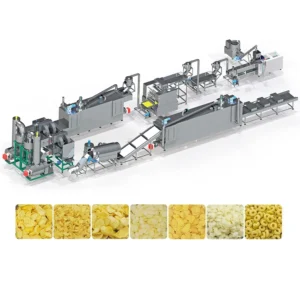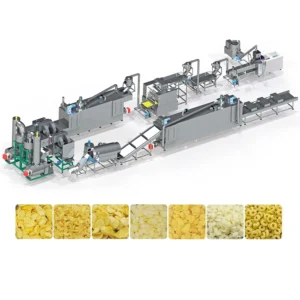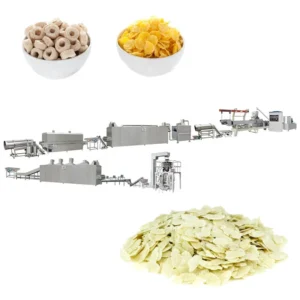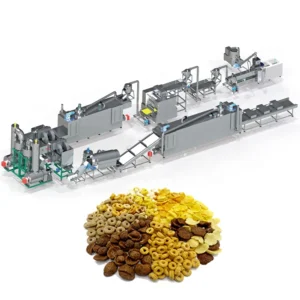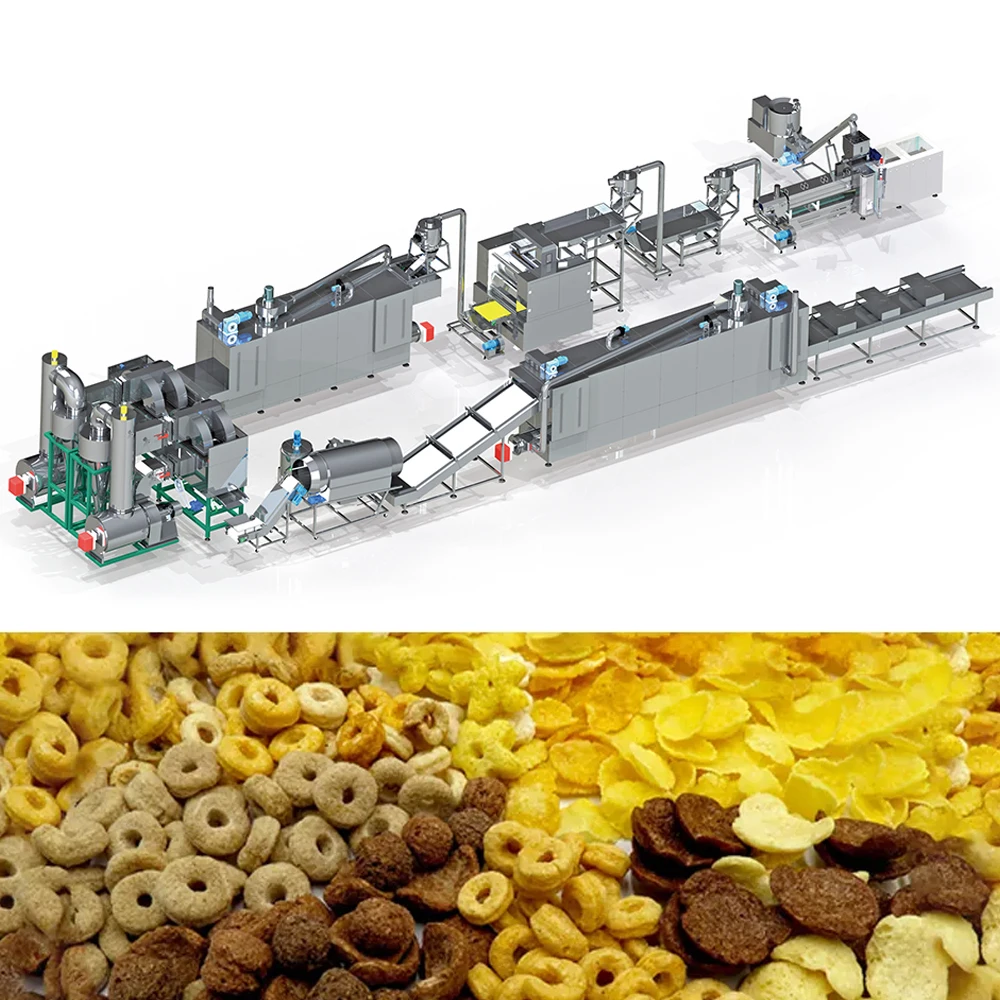
Twin-screw extrusion expertise — screw configuration and die design matched to your corn grit formulation for consistent flake expansion, blister formation, and the crispy bite your market expects.
Technical Specifications
| Parameter | Value |
|---|---|
| Model | MT70 / MT85 / MT75 |
| Product Type | Corn Flakes Breakfast Cereal Production Line |
| Extruder Type | Twin Screw (MT75) |
| Installed Power | 160 kW (MT70) / 190 kW (MT85) / 210 kW (MT75) |
| Power Consumption | 120 kW (MT70) / 140 kW (MT85) / 150 kW (MT75) |
| Output Capacity | 150–200 kg/h (MT70) / 300–400 kg/h (MT85) / 300–500 kg/h (MT75) (basis to be confirmed on buyer’s raw material and moisture) |
| Overall Dimensions | 41 × 1.5 × 2.2 m (MT70) / 43 × 1.5 × 3.2 m (MT85) / 45 × 1.5 × 3.5 m (MT75) |
| Screw Material | Special alloy, wear-resistant |
| Lubrication System | Automatic lubricating with cooling function |
| Control System | PLC control |
| Flaking Machinery | Hydraulic double-roller system, double motors for separate roller driving, infrared sensor temperature control |
| Dryer Heating Source | Gas or Electric |
| Hot Air Roasting Oven | Vibrating pan, conciliation burner, dual circulating fans, cyclone dust removal |
| Coating System | Double tumble drum, elevator, coating drum, spraying nozzle |
| Warranty | 24 months, lifetime service |
| Certification | CE, ISO |
Application Suitability
| Application | Material or Output |
|---|---|
| Plain corn flakes | Corn grits, corn meal, maize flour |
| Sugar-coated corn flakes | Corn grits base with sugar or honey glaze |
| Chocapic-style chocolate cereal | Corn or mixed grain base with cocoa coating |
| Fortified breakfast flakes | Corn grits blended with vitamin and mineral premix |
What "Rated Capacity" Leaves Out on a corn flakes breakfast cereal production line
A line is only as fast as its slowest matched station — and throughput must be proven on your actual corn grit formulation, not a generic benchmark.
I once watched a corn flakes line in a Midwest plant where the extruder was rated at a certain hourly output, but the flaking rolls and roasting oven could not keep pace. Corn half-pellets piled up at the flaking station, stuck together, and went into the oven as clumps. The result was uneven blistering and scorch marks across the batch. That plant ran below its expected throughput for months before the owner realized the line had never been balanced as a single system [NEED_CITE: throughput balancing across extrusion line stations]. The corn flakes breakfast cereal production line you evaluate must be configured so that extrusion output, flaking speed, roasting time, and coating drum capacity all align on the specific formulation and moisture level you intend to run.
Barrel Temperature Profile and Starch Gelatinisation
Proper starch gelatinisation in corn flakes requires precise temperature management across the twin-screw extruder barrel zones. The MT75 extruder features multiple independent heating zones, and maintaining the correct profile ensures the corn grits reach full gelatinisation without premature expansion inside the barrel. If the profile drifts — too hot too early — the dough expands before the die, producing irregular half-pellets that flake poorly. The automatic lubrication system with integrated cooling helps stabilise barrel temperatures during continuous production runs.
Hydraulic Flaking and Surface Blister Control
The flaking station uses a hydraulic double-roller system driven by two separate motors. This arrangement allows independent pressure adjustment on each roller, which is critical when corn half-pellets vary slightly in size or moisture. Infrared sensor temperature control on the flaking rolls prevents the corn sheet from sticking or tearing. Consistent flake thickness directly determines how evenly blisters form in the roasting oven — a flake that is too thick stays doughy in the centre, while one that is too thin burns before the blister pattern develops.
Roasting Oven Airflow and Flake Crispiness
The hot air roasting oven is equipped with a conciliation burner, two separate circulating fans, and a cyclone dust removal device. The vibrating pan keeps flakes in constant motion, preventing them from overlapping and sticking during roasting. Dual circulating fans ensure uniform hot air distribution so that blisters form consistently across every flake surface [NEED_CITE: hot air circulation requirements for breakfast cereal roasting]. The cyclone system captures fine corn dust before it carbonises inside the oven chamber, protecting both product colour and food safety compliance.
How Screw Configuration and Die Geometry Shape the Final Flake
In twin-screw extrusion for corn flakes, the screw configuration — the arrangement of conveying, kneading, and reverse elements — controls the residence time and shear intensity applied to the corn grits. A configuration with too much shear generates excessive heat, causing starch degradation and a brittle, pale flake. Too little shear leaves starch under-gelatinised, producing a dense, hard flake that fails the crispiness test. Die geometry then determines the half-pellet shape and thickness before flaking. The die opening must be matched to the corn grit particle size and moisture content so that each pellet flakes into a uniform sheet. This is why screw and die specifications cannot be copied from a generic build — they must be configured for the buyer’s specific raw material.
The Hidden Cost of Mismatched Line Stations
When the extruder produces half-pellets faster than the flaking rolls can compress them, a backlog forms. Pellets cool and harden while waiting, then crack instead of flattening when they finally enter the rollers. Downstream, an under-sized roasting oven forces the line to slow down to achieve the target moisture, meaning the extruder and flaking station run below capacity. These mismatches are rarely obvious at quotation stage because each station is often quoted at its own nominal rating [NEED_CITE: equipment sizing errors in breakfast cereal production lines]. The financial impact shows up later as lost output, rework, and product that does not meet the crispiness and blister pattern the market expects.
Why Source This Line From a Single Supplier
A corn flakes breakfast cereal production line built from separate vendors often suffers from throughput gaps between stations — one supplier’s extruder does not communicate timing with another’s roaster. Sourcing the full line from batching through extrusion, flaking, roasting, and coating under one supplier means every station is sized to the same proven throughput. Screw configuration and die design are specified against your raw material and target flake density before the line is built, not adjusted as an afterthought. In-house trial runs on your actual corn grit formulation verify expansion, flake thickness, and blister formation before shipment, so product development does not start only after installation. Pre-sales engineering covers line layout, utility planning, and voltage confirmation for your target market.
Documentation & Verification
- Line layout and capacity calculation matched across every station
- Screw and die configuration record for your corn grit formulation
- Electrical schematic with voltage and frequency confirmation
- Trial run report on your raw material before dispatch
- CE declaration of conformity and ISO certificate
- Operation and maintenance manual with wear parts list
Installation, Commissioning & Support
- Line footprint requires approximately 41–45 m length depending on model selected
- Power supply must match 120–150 kW consumption with dedicated circuit protection
- Arrives in modular sections; on-site assembly and station alignment included
- First-run commissioning covers PLC parameter setting for your corn formulation
- Operator training on flaking pressure adjustment and roasting temperature profiles
- Wear parts list provided covering screws, dies, and flaking roller surfaces
What to Prepare Before Requesting a Quotation
To configure the right corn flakes breakfast cereal production line for your facility, share your corn grit particle size distribution, target moisture content at extrusion, and the flake thickness your market prefers. Specify your local voltage and frequency, the control language your operators need, and whether you plan to run sugar coating, chocolate coating, or plain flakes. If you have an existing mixing or packing station you want to integrate, provide its throughput rating so the new line can be balanced accordingly.
Frequently Asked Questions
Q: How is extrusion capacity verified on my specific corn grit formulation and moisture content?
A: The extruder is trial-run in the in-house testing workshop using your actual corn grits at the moisture level you intend to run. Output is measured, and screw configuration is adjusted if expansion or pellet density falls outside specification before the line ships.
Q: How do screw configuration and die design affect flake expansion, blister pattern, and final density?
A: Conveying and kneading element arrangement controls shear and residence time, which determine gelatinisation completeness. Die geometry sets half-pellet dimensions, directly influencing how each flake expands and blisters during roasting.
Q: What barrel temperature profile is required for proper starch gelatinisation in corn flakes?
A: Corn flakes need a progressive temperature profile across multiple barrel zones, rising from the feed section to the die zone. The PLC-controlled heating system maintains this profile, and the automatic lubrication cooling function prevents drift during long production runs.
Q: How is throughput matched between the extruder, flaking rolls, roasting oven, and coating drum?
A: Each station is sized to the same target throughput based on your formulation. The line layout calculation confirms that flaking speed, oven residence time, and coating drum cycle all align so no single station becomes a bottleneck.
Q: Can I run a trial on my raw material before the line ships?
A: Yes. Send your corn grits to the in-house testing workshop where the extruder, flaking rolls, and roasting oven are run together. You receive a trial run report documenting expansion rate, flake thickness, blister pattern, and moisture levels.