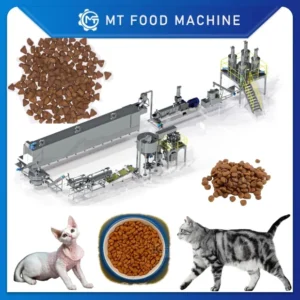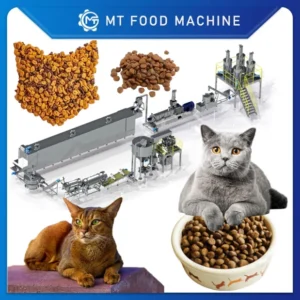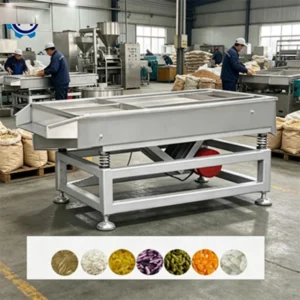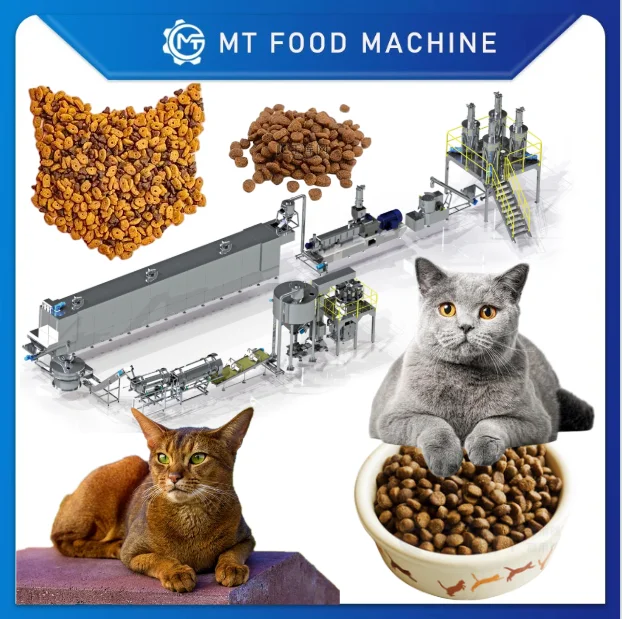
Matched Screw Geometry — Trial runs on the buyer’s actual recipe verify expansion, density, and starch gelatinisation targets before the twin-screw pet food extrusion line PLC controlled leaves the workshop.
Technical Specifications
| Parameter | Value |
|---|---|
| Product Type | Pet Food Extrusion Line |
| Output Capacity | 250–300 kg/h (basis not stated in source — confirm raw material formulation, moisture content, kibble size & density) |
| Control System | PLC with user-friendly HMI |
| Automation Level | Fully automated |
| Screw Type | Twin-screw |
| Product Formats | Dry kibble, semi-moist, treats |
| Species Coverage | Cat, dog, and other companion animals |
| Line Scope | Complete from batching to packing |
| Energy Design | Energy-saving barrel and drive configuration |
| Standards | CE, ISO |
Application Suitability
| Application | Material or Output |
|---|---|
| Dry kibble production for cats and dogs | Corn, meat meal, fish meal, rice, vitamins, mineral premix |
| Semi-moist pet food processing | High-moisture protein blends with humectants and binders |
| Pet treat and snack-format extrusion | Palatant-coated doughs shaped through custom die plates |
| Multi-recipe manufacturing with frequent changeovers | Variable starch-to-protein ratios across companion animal species |
What a Nominal Capacity Figure Leaves Out on a Pet Food Line
A twin-screw pet food extrusion line PLC controlled rated at a fixed output rarely holds that number when the buyer’s raw material diverges from the test formula — real throughput depends on formulation, moisture, and die geometry, not catalogue claims.
I have seen lines quoted at a comfortable capacity on standard corn starch, only to stall when the buyer switched to a high-protein, high-fat recipe for premium cat kibble. The screw shear profile simply could not handle the viscosity change, and output dropped while motor load spiked. That mismatch is never the buyer’s fault — it happens when the supplier skips recipe-specific screw configuration and assumes a generic build will cover every formulation. [NEED_CITE: impact of protein content on extruder throughput in pet food production]
How Screw Configuration Drives Kibble Expansion and Density
Every dry kibble format demands a specific expansion ratio, and that ratio is set by the interplay between screw element geometry, barrel temperature zones, and die orifice design. On this PLC-controlled line, the screw profile is selected after reviewing the buyer’s actual ingredient blend — a high-starch recipe needs different conveying and kneading elements than a formulation loaded with fresh meat or fish meal. The PLC manages barrel zone temperatures and screw speed in coordinated profiles so that starch gelatinisation stays repeatable across batches.
Barrel Temperature Profiles and Moisture Shear Balance
Semi-moist formats require a different thermal and mechanical environment than crunchy dry kibble, and the difference is managed inside the twin-screw barrel itself. Moisture injection points, steam conditioning, and barrel heating zones must be tuned as a single system rather than adjusted independently. The PLC architecture on this extrusion platform coordinates feeder rate, screw speed, and zone temperatures so that switching from a dry cat kibble recipe to a semi-moist dog treat formulation does not demand a full manual recalibration. This coordination reduces scrap during recipe changeovers and keeps product density within the specification the market expects. [NEED_CITE: barrel temperature zone control in twin-screw food extrusion]
Reading the Specs That Actually Matter for Pet Food Extrusion
Output capacity figures mean little without the formulation context behind them. A 250–300 kg/h rating may hold for a standard corn-based kibble but can shift significantly when protein or fat content rises. The PLC control system matters because it governs how consistently barrel temperatures, screw speed, and feeder rates are maintained once a recipe is locked in — manual lines drift as operators adjust settings shift by shift. Twin-screw architecture gives processors the shear versatility needed for both high-starch expansion and high-protein texturisation on a single platform. The energy-saving barrel and drive design reduces consumption per unit of output across different formats, though the exact savings depend on the recipe and production schedule in use.
The Cost of Skipping a Pre-Shipment Trial Run
Buyers who accept a line without seeing their own raw material processed in the supplier’s workshop often face weeks of on-site recipe development after installation. That delay means raw material waste, missed delivery windows, and production crews learning through trial and error instead of following a validated parameter set. [NEED_CITE: commissioning delays caused by untested extrusion formulations] I have watched entire launch schedules slip because kibble density fell outside market tolerances, and the screw configuration had to be reworked from scratch on the factory floor. A trial run before shipment catches these issues early, while there is still time to swap screw elements or adjust die geometry without disrupting the buyer’s production calendar.
Why This Extrusion Platform Earns Its Place in a Pet Food Plant
Complete line integration from batching through extrusion to packing means every station is throughput-matched, so the dryer does not bottleneck the extruder and the coating drum does not starve the cooler. Screw configuration and die design are specified against the buyer’s ingredient list and target product format — not pulled from a generic catalogue. The in-house testing workshop allows trial runs on the buyer’s actual raw material, generating a documented parameter set before the line ships. Twin-screw expertise covers dry kibble, semi-moist, and treat formats within a single platform, giving processors flexibility as product portfolios expand. Pre-sales engineering, on-site installation, commissioning, and ongoing maintenance support remain under one supplier’s responsibility throughout the equipment lifecycle.
Documentation & Verification
- Line layout showing throughput matching across batching, extrusion, drying, coating, and packing stations
- Screw and die configuration record documenting geometry selected for your formulation and kibble density target
- Trial run report on your raw material verifying expansion, texture, and output before dispatch
- Electrical schematic with voltage, frequency, and PLC control language confirmed to your site requirements
- CE declaration of conformity and ISO certificate for import and regulatory compliance
- Operation and maintenance manual covering recipe parameter sets and wear part replacement intervals
Installation, Commissioning & Support
- Foundation and floor space planned around the full line footprint from batching silos to packing station
- Electrical supply sized for PLC cabinet, extruder drive, and barrel heating circuits with dedicated breakers
- Modular delivery allows phased assembly so extruder, dryer, and coating drum align to the site layout
- First-run commissioning sets PLC recipe parameters for your specific kibble density and expansion targets
- Operator training covers HMI navigation, recipe changeover sequences, and screw element inspection routines
- Wear parts list identifies screws, dies, and barrel liners with reorder lead times for your maintenance schedule
Before You Request a Quote
Share your target formulation including protein, starch, and fat percentages along with desired kibble size and density range. Specify your local voltage and frequency so the PLC cabinet and barrel heaters are built to match. Let us know whether you want to schedule a trial run on your raw material before shipment — this step resolves most configuration questions and gives your team a validated parameter set from day one.
Frequently Asked Questions
Q: How is the 250–300 kg/h capacity verified against my raw material formulation?
A: We run your actual ingredient blend through the twin-screw extruder in our testing workshop before shipment. The trial run report documents achieved output, kibble density, and expansion ratio on your specific recipe. Capacity varies with protein content, moisture, and die geometry, so the verified figure may differ from the nominal range depending on your formulation.
Q: What screw configuration and die geometry are chosen for my recipe?
A: Screw elements and die orifice design are selected based on your ingredient list, target kibble size, and desired density. High-protein formulations require different kneading and conveying elements than starch-dominant recipes. The selected configuration is recorded in a configuration document you receive before shipment for future reference and reordering.
Q: How does the PLC handle recipe changeovers between dry kibble and semi-moist formats?
A: The PLC stores separate parameter sets for each product format, managing barrel zone temperatures, screw speed, feeder rate, and moisture injection as a coordinated profile. Switching recipes involves loading the stored set rather than manual recalibration, reducing scrap and maintaining consistent starch gelatinisation across batches.
Q: Can I arrange a trial run on my raw material before the line ships?
A: Yes. The in-house testing workshop processes your supplied raw material through the configured twin-screw extruder, generating a trial run report that covers output rate, kibble texture, density, and expansion. This gives your production team validated parameters and confirms the screw and die configuration meets your market specification.
Q: How is kibble density held within specification when raw material batches vary?
A: Natural variation in ingredient moisture and composition is managed through the PLC’s real-time monitoring of barrel temperatures, motor load, and feeder rate. Operators can make fine adjustments within the stored recipe envelope to compensate for batch differences, keeping expansion ratio and final kibble density within the tolerances your market requires.