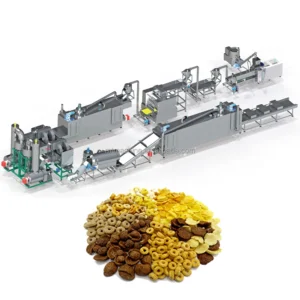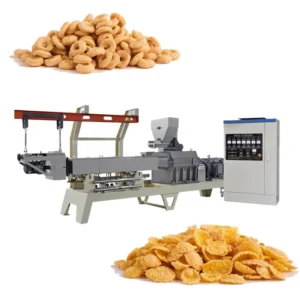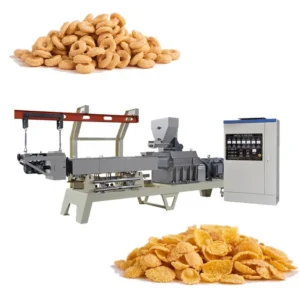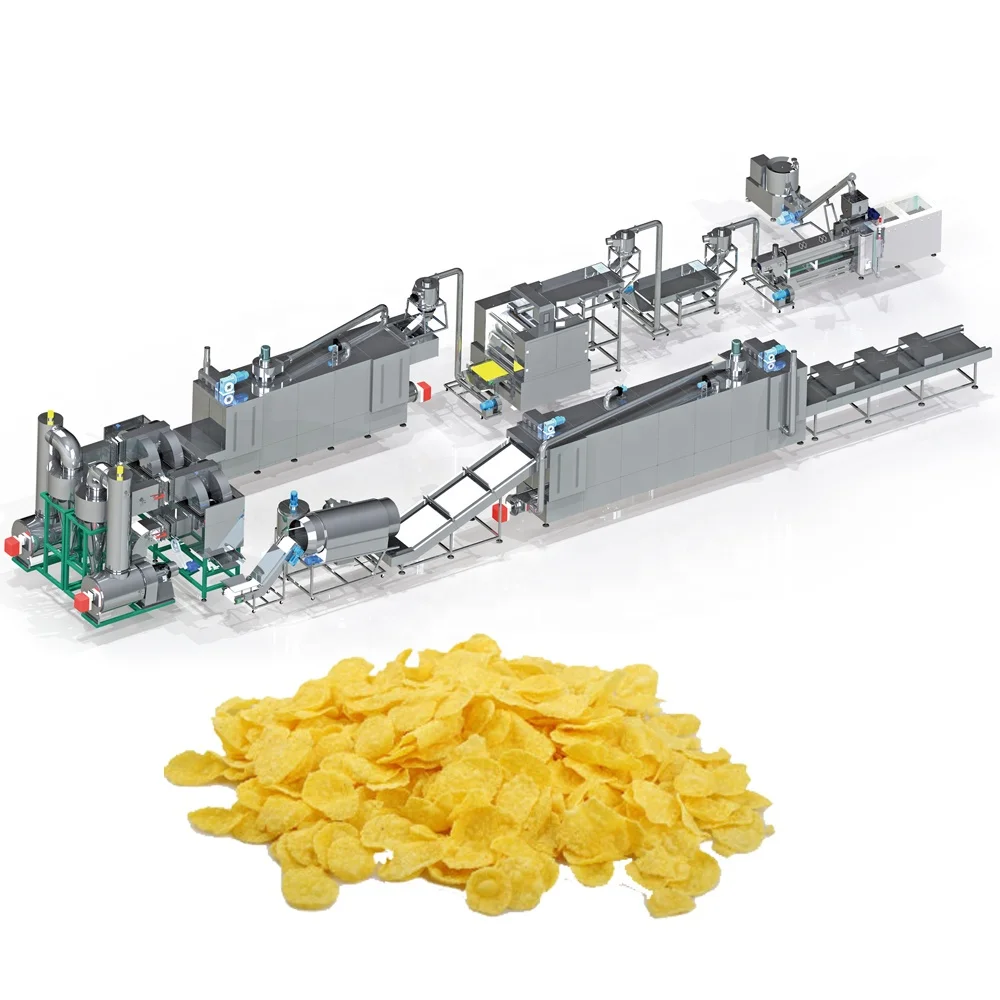
Screw Profile Matched to Your Grain — Every corn flake extrusion line we ship includes a screw configuration record and die design documented against the buyer’s specific flour blend and target flake density, not a generic catalog build.
Technical Specifications
| Parameter | Value |
|---|---|
| Product Type | Corn Flakes Production Line |
| Output Capacity | 750 kg/hr (basis not stated in source — confirm raw material, moisture content, and product format) |
| Control System | Easy-to-operate interface (PLC / MCC options available) |
| Line Stations | Mixing, extrusion, flaking, drying, coating |
| Product Formats | Natural corn flakes, sugar-coated flakes, various shaped breakfast cereals |
| Layout | Customizable engineered drawings tailored to factory size |
| Motor | Robust motor (rated power to be confirmed at quotation) |
| Voltage & Frequency | Configurable per destination market (to be confirmed) |
| Certification | CE, ISO |
Application Suitability
| Application | Material or Output |
|---|---|
| Natural corn flake production | Degerminated corn grits, whole corn flour |
| Sugar-coated and frosted flakes | Corn base with sugar, honey, malt, or vitamin slurry coatings |
| Multi-grain breakfast cereals | Blends of corn, wheat, oat, rice, and barley flours |
| Shaped cereal formats | Grain doughs processed through interchangeable die plates |
Why "750 kg/hr" Means Nothing Without the Raw Material
Capacity is only real when measured on the buyer’s actual grain blend at a defined moisture level.
The most common reason a breakfast cereal line disappoints after commissioning is that the quoted throughput was measured on a reference material the buyer never uses. A corn flakes extrusion production line specifications sheet might show an impressive hourly number, but if that number was generated on a low-fiber, high-starch corn grit at optimal moisture, it will not hold when you switch to a multi-grain blend with higher fat content or a coarser grind. I have stood on factory floors watching operators throttle back the feeder because the extruder motor amps spiked every time the recipe changed. The throughput gap between lab conditions and actual production is where projects lose money [NEED_CITE: throughput variance between reference and production materials in food extrusion].
Barrel Temperature Zones and Starch Gelatinisation
Corn flake texture is decided inside the barrel. The corn flakes extrusion production line specifications depend on how many independently heated zones the barrel provides and how precisely each zone holds its setpoint. Starch gelatinisation in corn requires a specific thermal history: too cool and the flake turns gritty and opaque; too hot and the dough loses viscosity before it reaches the die, producing flakes that shatter during drying. Matching the barrel profile to the grain’s amylose-to-amylopectin ratio is where screw configuration and thermal control work together.
Moisture Injection and Shear Control
Water or steam injection into the barrel directly governs expansion ratio. A half-percent shift in barrel moisture can move the final flake density outside the window that the flaking rolls and dryer downstream expect. Automated PLC control on the extrusion station lets operators store moisture setpoints per recipe and recall them at the push of a button, which matters when a facility runs natural flakes in the morning shift and sugar-coated formats in the afternoon [NEED_CITE: moisture tolerance windows in twin-screw cereal extrusion].
Reading the Specs That Actually Matter
Output capacity figures quoted without a raw material reference are a starting point, not a guarantee. What you should focus on instead is the screw configuration record — the document that maps element arrangement, pitch, and kneading block angle to your specific formulation. The die design determines pellet geometry before the flaking mill, and pellet geometry governs how evenly the flake compresses. Motor power must be sized for the highest-viscosity recipe you plan to run, not the lightest. And the control system language needs to match your operators’ working language before the panel is wired, because relabeling an HMI on site adds days to commissioning.
When the Extruder and Dryer Disagree on Throughput
If the extruder pushes more wet pellet than the dryer can handle at its design belt speed, moisture stays trapped in the flake core. The flakes emerge from the dryer soft, off-color, and prone to sogginess in the bowl. I once helped troubleshoot a line where two tons of product was scrapped in a single week because the oven residence time was never recalculated after the extruder was upgraded. Every station must be throughput-matched to the actual recipe, not to nameplate capacity. This is where a line layout and capacity calculation document becomes essential [NEED_CITE: throughput mismatch failures in cereal processing lines].
Why the Engineering Starts Before the Quotation
Our process for this line begins with your raw material sample. You send us the exact corn grit or multi-grain blend you intend to run, and we conduct trial extrusions in our in-house testing workshop. The screw configuration, die selection, barrel temperature profile, and moisture setpoints are all documented during that trial. The trial run report ships with the machine, so your commissioning team has a verified baseline rather than a generic starting point. We also provide the line layout and capacity calculation showing matched throughput from the mixer through the coating drum, the electrical schematic with your local voltage and frequency confirmed, and a wear parts list covering screws, dies, and barrel liners so your first replacement order is already planned before production begins.
Documentation & Verification
- Screw and die configuration record matched to your grain formulation
- Trial run report generated on your raw material in our testing workshop
- Line layout and capacity calculation with throughput matched across every station
- Electrical schematic with voltage and frequency confirmed for your facility
- CE declaration of conformity and ISO certificate included with shipment
- Operation and maintenance manual with wear parts list and replacement intervals
Installation, Commissioning & Support
- Foundation plan accounts for extruder motor weight and vibration isolation pads
- Dedicated circuit sized to the confirmed motor power and barrel heater load
- Extruder arrives with barrel sections pre-assembled; die and hopper mounted on site
- First-run parameters loaded from the trial report; fine-tuned with your operators present
- Spare screw elements and die plates shipped with the line for the first maintenance cycle
- Barrel liner inspection schedule set based on your production hours and grain abrasiveness
What We Need from You to Move Forward
To configure a corn flakes extrusion production line that holds its rated output on your actual material, we need your grain formulation and typical moisture range, the flake formats you plan to run, and the daily production target for each format. Please also share your facility’s voltage, frequency, and preferred control language, along with a floor plan showing available space and ceiling height so we can engineer a layout that fits your building without compromising station access for maintenance.
Frequently Asked Questions
Q: How is the screw configuration selected for my specific grain formulation and target flake density?
A: We run your actual corn grit or multi-grain blend through our testing workshop, adjusting kneading block angle, element pitch, and die geometry until gelatinisation, expansion, and pellet density meet your flake specification. The final configuration is recorded and shipped with the extruder so your team has a verified starting point at commissioning.
Q: What barrel temperature profile and moisture range are used during extrusion?
A: Each barrel zone is set independently to build a thermal curve that fully gelatinises your starch without degrading viscosity before the die. Moisture is injected as water or steam within a narrow band that keeps expansion consistent. Both parameters are stored in the PLC per recipe for repeatable runs.
Q: Can a trial run be done on my raw material before the extruder ships?
A: Yes. Our in-house testing workshop runs your grain sample through the configured extruder, documenting screw profile, barrel temperatures, moisture levels, and output density. The trial report travels with the machine and serves as the commissioning baseline.
Q: How do you confirm extruder output on my flour blend rather than a generic test material?
A: The trial run measures actual throughput on your material at production-relevant moisture and temperature. That measured value, not a catalog figure, is what we quote and what the downstream dryer and flaking mill are sized to handle.