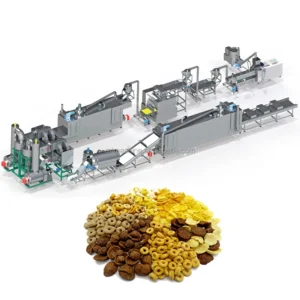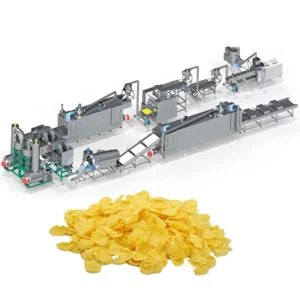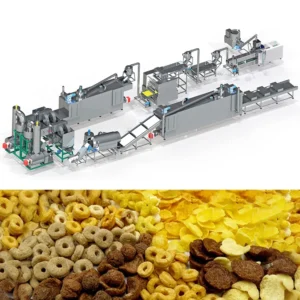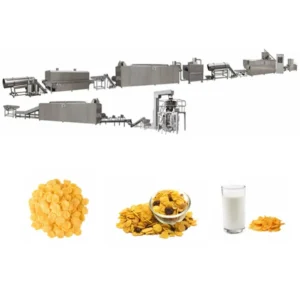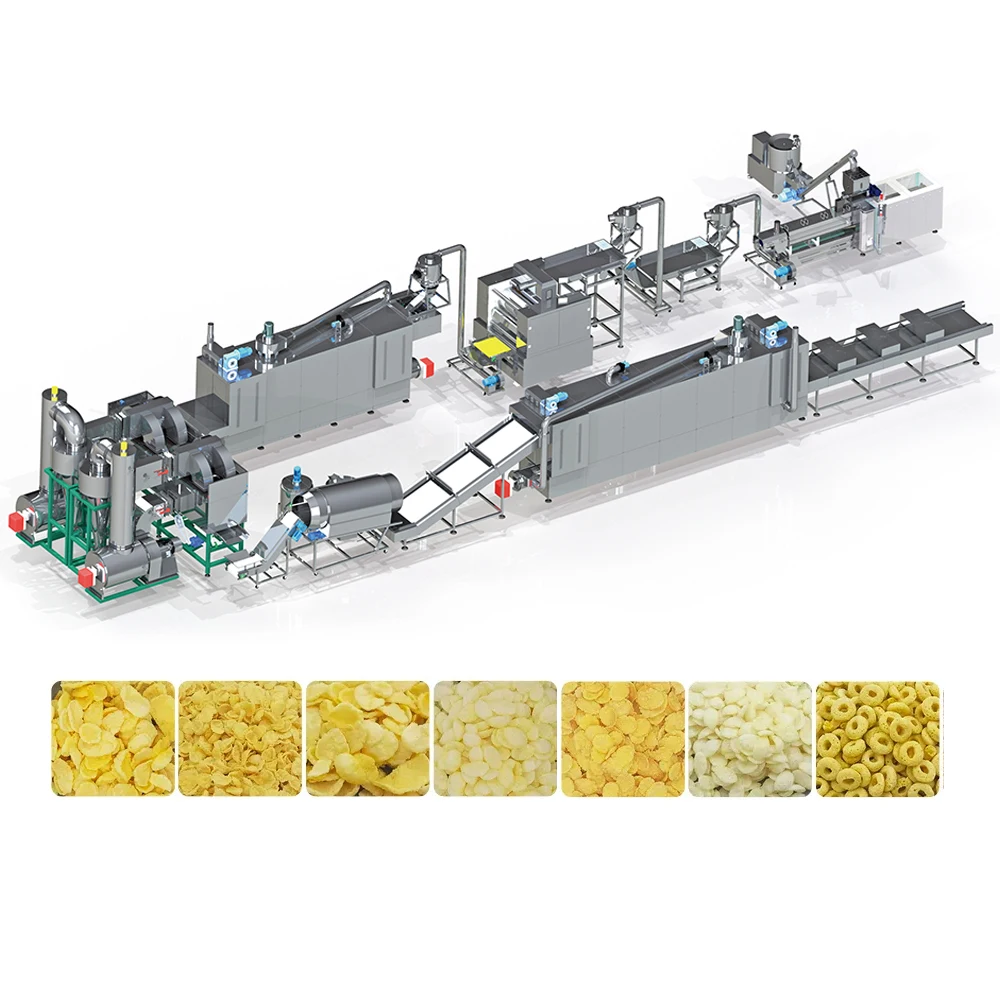
Matched Throughput at Every Station — this corn flakes line is engineered as a single integrated system where mixing, extrusion, flaking, drying, and coating capacities are calculated together, so no single machine bottlenecks your output.
Technical Specifications
| Parameter | Value |
|---|---|
| Product Type | Corn Flakes Breakfast Cereal Production Line |
| Extruder Model | MT-65 |
| Screw Type | Twin-screw, co-rotating sectional modules |
| Extruder Functions | Forward/backward transport, mixing, de-gassing, cooking, forming |
| Corn Flakes Press Machine Power | 16.12 kW |
| Corn Flakes Press Machine Dimensions | 1550 × 1300 × 2000 mm |
| Roller Size | 510 × 310 × 1050 mm |
| Mixer Output | 10–30 kg per load |
| Mixer Power | 4 kW |
| Mixer Tank Size | φ600 × 500 mm |
| Mixer Dimensions | 1000 × 800 × 1200 mm |
| Screw Conveyor Power | 0.75 kW |
| Screw Conveyor Dimensions | 2700 × 500 × 2400 mm |
| High-temperature Oven Dimensions | 4.5 × 1.4 × 1.8 m |
| Oven Power | 3.75 kW |
| Oven Heating Method | Gas, dual-side baking system |
| Sugar Spraying System Total Power | 28.75 kW |
| Sugar Spraying System Dimensions | 4000 × 1900 × 1880 mm |
| Sugar Spraying Roller Size | Ø600 × 2700 mm |
| Control System | PLC and MCC (basis not stated in source) |
| Contact Material | Food-grade stainless steel |
| Output Capacity | To be confirmed per specific raw material and moisture content |
| Voltage & Frequency | Customizable (e.g., 3ph 380V 50Hz, 3ph 415V 60Hz, 3ph 220V 60Hz) |
| Standards | CE |
Application Suitability
| Application | Material or Output |
|---|---|
| Traditional corn flakes | Maize or corn grain, milled to specified particle size |
| Multi-grain breakfast cereals | Blends of corn, rice, oat, and other grain powders |
| Sugar- or honey-coated cereal | Extruded pellets or flakes with syrup coating applied post-drying |
| Fortified nutritional cereal | Grain base with added vitamin and mineral premixes |
| Alternate snack shapes | Rings, balls, stars, sticks via interchangeable die configurations |
Why Nominal Capacity Fails the Moment You Load Real Grain
A line rated in the abstract is only as good as the raw material it actually runs.
When I first transitioned from the assembly floor to technical sales, I saw a corn flakes installation stall because the buyer’s local corn flour was ground noticeably coarser than the generic test batch used during factory trials. The resulting flakes fractured at the press rollers, and yield dropped sharply. The extruder barrel temperature profile and screw module arrangement had to be completely reworked on-site, which took weeks of adjustment and lost production time. [NEED_CITE: impact of feedstock particle size on extrusion stability and gelatinisation rate]
A corn flakes extrusion production line turnkey should never be evaluated on nameplate output alone — it must be validated against the specific grain blend and moisture level you will actually feed into the hopper.
Barrel Temperature Profile and Starch Gelatinisation
The MT-65 twin-screw extruder uses co-rotating sectional screw modules, which means the screw configuration can be rearranged to control how long material stays inside each barrel zone. Starch gelatinisation in corn requires precise moisture and shear at specific temperature bands — too little shear leaves uncooked starch that produces gritty flakes, while excessive shear breaks down the dough before it reaches the die. For a corn flakes extrusion production line turnkey, the screw arrangement is matched to your exact grain formulation so the expansion leaving the die is consistent and predictable.
Roller Gap, Flake Density, and Market Expectation
The dedicated flaking press features a 510 × 310 × 1050 mm roller set with an adjustable gap and integrated cooling system. Flake thickness directly controls the bowl-life crispness that breakfast cereal consumers expect — a gap set too wide yields a dense, chewy flake that goes stale quickly, while a gap set too narrow produces thin flakes that shatter during coating and packing. [NEED_CITE: relationship between flake thickness and moisture migration in coated breakfast cereals] The cooling circuit on the rollers prevents the warm extrudate from sticking and tearing, maintaining surface integrity through the press stage.
Reading the Specifications That Matter on the Floor
The mixer handles 10–30 kg per load inside a φ600 × 500 mm tank, which sets the batch rhythm feeding the extruder — undersizing the mixer relative to extruder intake causes surge loading and inconsistent moisture distribution. The gas-fired oven at 4.5 m length with dual-side baking ensures that flakes across the full conveyor width reach uniform moisture content before coating, preventing soft spots in the finished pack. The sugar spraying system uses a Ø600 × 2700 mm drum with independent drive power of 28.75 kW, sized to tumble the full throughput without overloading the coating surface. Each station’s power and dimension spec is cross-checked against the others so the corn flakes extrusion production line turnkey runs as a single continuous process.
The Hidden Cost of Mismatched Stations
Buyers assembling a cereal line from separate vendors often discover after installation that the dryer cannot remove moisture fast enough for the extruder’s actual throughput, forcing the entire line to slow down. The flaking press may be rated for the nominal output but cannot handle the extrudate temperature coming off a higher-capacity extruder, leading to roller adhesion and frequent stops for cleaning. [NEED_CITE: consequences of throughput mismatch between extrusion and downstream drying stages] These bottlenecks are invisible on a quotation that lists each machine’s individual capacity without showing the integrated line calculation.
Why the Engineering Approach Here Is Different
Every station from the flour mixer through the cooling conveyor is specified as one system, so throughput calculations run across the entire chain rather than stopping at the extruder door. The screw configuration and die design are set based on your raw material sample, not copied from a generic build — I have seen generic builds produce the wrong texture more times than I can count. An in-house testing workshop runs your actual grain blend before the equipment ships, catching problems that would otherwise surface during commissioning. Food-grade stainless steel contact surfaces are standard across all stations. Pre-sales consultation covers line layout, utility planning, and control system specification so nothing is left to assumption when the equipment arrives on your floor.
Documentation & Verification
- Line layout drawing showing throughput matched from mixer through cooling conveyor
- Screw and die configuration record specified to your grain type and target flake density
- Trial run report produced on your raw material sample before dispatch
- Electrical schematic with voltage, frequency, and control language confirmed to your facility
- CE declaration of conformity covering the complete integrated line
Installation, Commissioning & Support
- Foundation plan accounts for the 4.5 m oven length and full line footprint including elevators
- Dedicated electrical circuits sized for the 28.75 kW sugar spraying system and 16.12 kW press
- Extruder arrives with screw modules pre-assembled; barrel sections aligned and checked on-site
- First production run supervised to confirm flake thickness at the adjustable roller gap
- Operator training covers PLC and MCC interface navigation in your preferred control language
- Wear parts list identifies screw segments and die plates with recommended reorder intervals
What to Share with Your Inquiry
Send a representative sample of the grain or grain blend you plan to run, including current milling particle size and typical moisture content. Confirm your facility’s three-phase voltage, frequency, and any local control panel language requirements. Provide available floor space dimensions and ceiling height so the line layout can be drafted to your building envelope before quotation, and indicate whether you need a trial run on your material before shipment.
Frequently Asked Questions
Q: How is line capacity verified against my specific grain formulation?
A: Before shipment, your raw material is run through the twin-screw extruder and flaking press in the testing workshop. The trial run report documents actual throughput, flake density, and surface quality at your material’s moisture content, so the capacity figure you receive is based on your grain, not a generic benchmark.
Q: How do you match throughput between the extruder and downstream stations?
A: Each station — mixer, oven, sugar spraying drum, cooling conveyor — is calculated against the extruder’s confirmed output on your material. The oven length, drum diameter, and conveyor speed are specified so no single machine forces the entire corn flakes extrusion production line turnkey to run below its validated rate.
Q: What voltage and control language options are confirmed before production?
A: Voltage and frequency are locked to your facility supply during the specification stage, with options such as 3ph 380V 50Hz or 3ph 415V 60Hz. Control panel language is confirmed in writing before electrical schematics are finalized, preventing commissioning delays caused by mismatched interfaces.
Q: Can I send my raw material for a trial run before the line ships?
A: Yes. The in-house testing workshop accepts your grain sample and runs it through the configured screw and die setup. The resulting trial run report is shared before dispatch, and any required screw module adjustments are completed at the factory rather than during installation on your floor.
Q: What does on-site installation and operator training include?
A: An engineer supervises equipment positioning, utility connection, and the first full production cycle. Training covers PLC operation, screw module changeover for alternate shapes, roller gap adjustment on the flaking press, and daily maintenance routines including wear part inspection intervals.