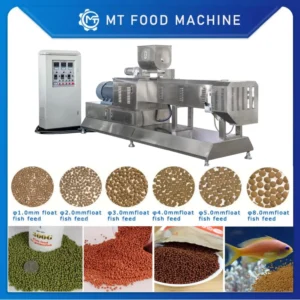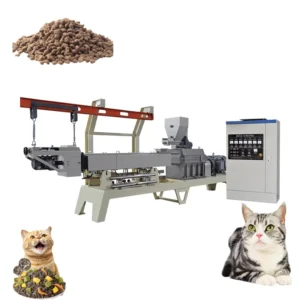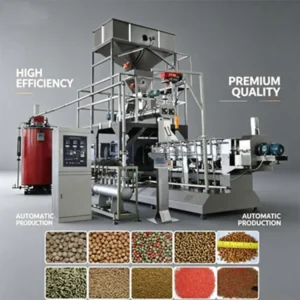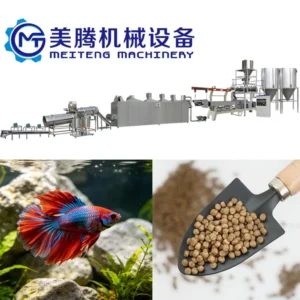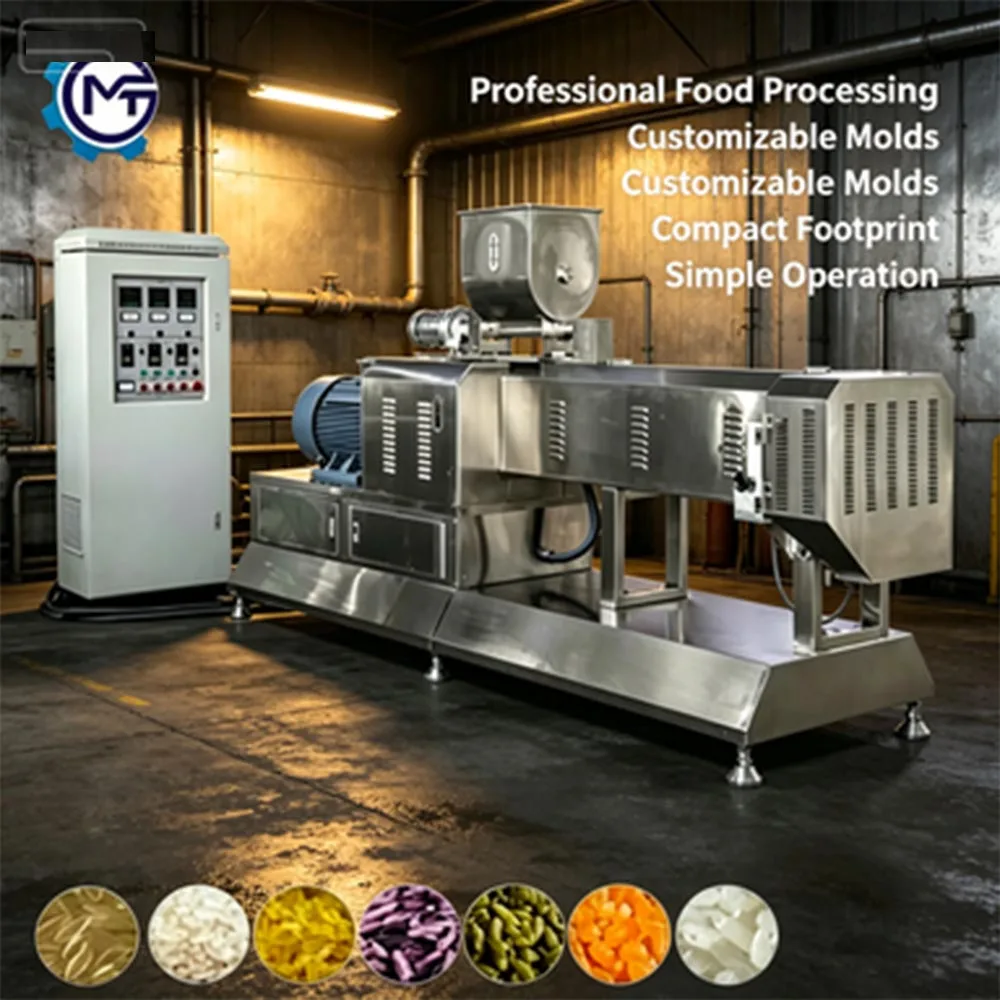
Precise extrusion control — Screw configuration and die design specified to your raw material formulation and target pellet buoyancy, validated in our testing workshop before shipment.
Technical Specifications
| Parameter | Value |
|---|---|
| Product Type | Aquatic Feed Twin Screw Extruder Production Line |
| Screw Type | Twin screw |
| Control System | Intelligent PLC automatic control system |
| Material Contact Parts | Food grade 304 stainless steel |
| Line Stations | Raw material mixer, extruder, dryer, seasoning coating machine, vibrating sieve, conveyor equipment |
| Process Stages | Raw material mixing, extrusion, drying, seasoning, screening, finished product discharging |
| Pellet Adjustability | Pellet size, hardness, buoyancy adjustable |
| Output Products | Floating and sinking fish feed pellets |
| Raw Materials Processed | Fish meal, soybean meal, corn powder, compound additives |
| Automation Level | Full continuous automatic production |
| Output Capacity | (basis to be confirmed) |
| Rated Power (kW) | (basis to be confirmed) |
| Voltage & Frequency | (basis to be confirmed — confirm target market requirement) |
| Overall Dimensions (L×W×H) | (basis to be confirmed) |
| Net Weight | (basis to be confirmed) |
| Screw Diameter | (basis to be confirmed) |
| L:D Ratio | (basis to be confirmed) |
| Barrel Zones | (basis to be confirmed) |
| Die Configuration | (basis to be confirmed) |
| Standards | CE, ISO |
Application Suitability
| Application | Material or Output |
|---|---|
| Floating pellets for surface-feeding species | Koi, goldfish, tropical fish feed from fish meal, soybean meal, corn powder |
| Sinking pellets for bottom-feeding species | Freshwater fish feed with adjusted starch and protein ratios |
| Multi-species feed production on a single line | Variable density pellets by reconfiguring screw profile and die geometry |
| Medium to large scale aquaculture operations | Continuous production runs of compound aquatic feed with additives |
Why Buoyancy Fails When You Switch Raw Materials
Pellet float or sink behaviour is not a machine setting — it is the result of matched screw configuration, barrel temperature profile, and die geometry working against your specific formulation.
I have watched a production line that ran perfectly on standard fish meal produce nothing but sinking pellets the moment the operator switched to a local raw material blend with lower starch content. The extruder was not at fault. The screw elements and die bore were configured for a different expansion ratio, and the barrel heat zones were calibrated for a gelatinisation window that the new formulation could not reach. Four days of reconfiguration followed [NEED_CITE: starch gelatinisation thresholds in aquatic feed extrusion].
The core problem is that aquatic feed extrusion technology twin screw systems are frequently quoted on nominal throughput without anyone confirming whether the screw profile matches the buyer’s actual starch-to-protein ratio. The result is a line that meets capacity targets on paper but cannot hold the buoyancy specification the market requires.
Starch Gelatinisation and Shear Control in the Barrel
Aquatic feed extrusion technology twin screw systems rely on a precise balance of mechanical shear and thermal input to achieve the gelatinisation degree needed for pellet water stability. Each barrel zone contributes to a temperature gradient that must align with the starch source in your formulation — corn powder behaves differently from cassava or wheat flour under the same shear profile.
The screw elements are selected to control residence time and shear intensity across the barrel length. Forward-conveying elements move material through, while kneading blocks introduce the shear energy required to rupture starch granules. Getting this sequence wrong means incomplete gelatinisation, which leads to pellets that disintegrate in water before fish can consume them.
Die Geometry and Expansion Ratio
The die plate is where the final expansion decision happens. Bore diameter, land length, and face geometry together determine how much the extrudate expands as it exits the barrel into atmospheric pressure. Floating pellets require a higher expansion ratio — more die land restriction and higher barrel exit temperature — while sinking pellets need controlled, limited expansion [NEED_CITE: die design principles for extruded aquatic feed density control].
Die configuration must be specified alongside the screw profile. Changing one without adjusting the other introduces unpredictable density variation across the pellet batch. This is why die design records need to be documented per formulation rather than treated as a generic accessory.
Reading the Specification Sheet for Production Impact
The L:D ratio on a twin screw extruder indicates how much barrel length is available for thermal and mechanical processing relative to screw diameter. A longer L:D ratio provides more barrel zones and more flexibility in staging shear and heat — important when switching between floating and sinking formulations. Intelligent PLC automatic control maintains barrel temperature setpoints across zones and logs deviations, which is critical for batch-to-batch consistency when ambient workshop temperature fluctuates between seasons.
Food grade 304 stainless steel contact materials prevent corrosion from fish meal and compound additives, maintaining hygiene standards through the extrusion and drying stages. The full continuous automatic production setup means the line runs from raw material mixing through extrusion, drying, seasoning, and screening without manual transfer between stations — reducing contamination points and maintaining throughput balance.
What Happens When Extruder and Dryer Capacity Mismatch
An extruder running at full output feeds a dryer that cannot remove moisture fast enough, and pellets leave the line with water content high enough to spoil in storage. The bottleneck is not visible during a short factory test — it emerges after hours of continuous production when the dryer’s thermal capacity saturates. This is a line engineering failure, not a machine failure [NEED_CITE: throughput matching between extrusion and drying stations in feed production].
Similarly, seasoning coating capacity must align with extruder output. An undersized coating drum means pellets queue up, cool below the optimal temperature for oil and flavourant adhesion, and leave the line with uneven coating coverage that affects palatability and feed conversion ratios in the water.
Why the Line Design Matters More Than the Extruder Alone
Screw configuration and die design are specified to your raw material formulation and target buoyancy — not copied from a generic build. The in-house testing workshop runs your actual material before shipment, so product development does not start after installation.
Line layout and capacity calculation ensure throughput is matched across every station: mixer, extruder, dryer, seasoning drum, vibrating sieve, and conveyor. No station is oversized or undersized relative to the others.
Intelligent PLC automatic control with MCC integration provides repeatable parameter control across production runs, reducing operator-dependent variation.
Electrical schematics and voltage confirmation are aligned to your site utility supply before production begins, eliminating commissioning delays caused by incorrect frequency or control language.
Food grade 304 stainless steel throughout contact surfaces maintains hygiene compliance for aquatic feed destined for export markets with traceability requirements.
Documentation & Verification
- Line layout drawing showing station throughput matching for your target pellet size range
- Screw and die configuration record specific to your raw material formulation and buoyancy target
- Trial run report on your actual raw material conducted in the testing workshop before dispatch
- Electrical schematic with voltage and frequency confirmed to your facility supply
- CE declaration of conformity and ISO certificate for export compliance documentation
- Operation and maintenance manual with wear parts list and replacement intervals
Installation, Commissioning & Support
- Foundation requirements mapped to extruder weight and vibration profile for stable operation
- Dedicated electrical circuit sized to extruder rated power with PLC panel voltage confirmed
- Line arrives in modular sections for staged assembly matching your workshop access constraints
- First-run commissioning includes barrel temperature calibration and screw profile adjustment on your material
- Operator training covers PLC parameter adjustment for switching between floating and sinking formulations
- Wear parts inventory including screw elements and die plates sized to your replacement schedule
Before You Request a Quote
To configure the aquatic feed extrusion technology twin screw line accurately, we need your raw material formulation — including starch source, protein percentage, and moisture content — along with your target pellet diameter and buoyancy specification. Share your local voltage and frequency standard, workshop floor dimensions, and whether you plan to run both floating and sinking pellets on the same line. If you can send a sample of your actual raw material, we will run a trial in the testing workshop and include the results with the proposal [NEED_CITE: pre-shipment trial run validation for extrusion equipment].
Frequently Asked Questions
Q: How is floating versus sinking buoyancy controlled through extrusion parameters?
A: Buoyancy is determined by pellet density, which is controlled through screw configuration, barrel temperature profile, and die geometry. Floating pellets require higher expansion — achieved through specific kneading block placement, higher barrel exit temperature, and restricted die land length. Sinking pellets need limited expansion with different shear staging. Each formulation requires its own documented parameter set.
Q: What raw material variables affect pellet expansion and density?
A: Starch source and percentage, protein content, initial moisture level, and fat content all influence expansion behaviour. A formulation with lower starch gelatinisation capacity will not expand as much under the same barrel temperature profile. This is why trial runs on your actual raw material are necessary before the screw and die configuration is finalised.
Q: Can the same extruder switch between floating and sinking feed production?
A: Yes, twin screw extruders allow screw element reconfiguration to change the shear and residence time profile. Combined with die plate changes and PLC parameter adjustment for barrel zone temperatures, the same machine can produce both buoyancy types. Changeover time depends on how different the two formulations are.
Q: How does starch gelatinisation affect water stability in aquatic feed?
A: Fully gelatinised starch forms a matrix that binds the pellet together in water, preventing disintegration before fish consume it. Incomplete gelatinisation — caused by insufficient shear or incorrect barrel temperature — leaves raw starch that dissolves quickly, polluting the water column and reducing feed conversion efficiency.
Q: How is line throughput balanced between extruder and dryer?
A: The dryer must have sufficient thermal capacity to reduce pellet moisture from extrusion exit levels to storage-stable levels at the extruder’s continuous output rate. Throughput matching is calculated during line layout design so neither station bottlenecks the other during sustained production runs.