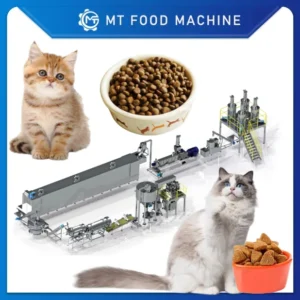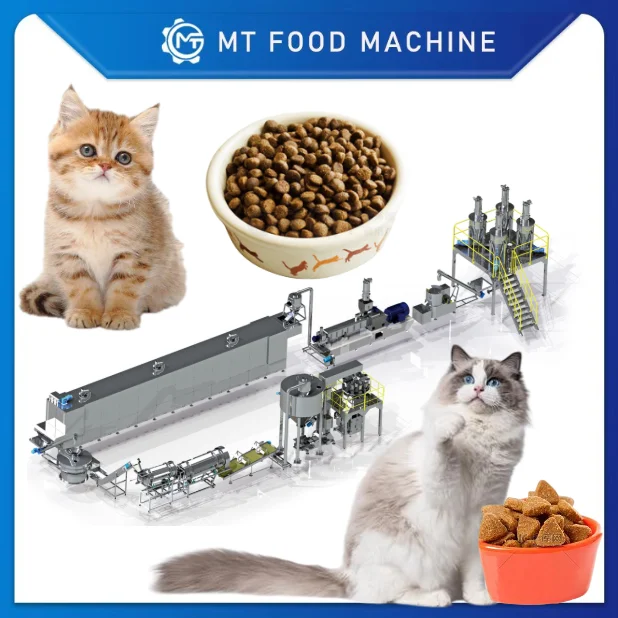
Screw and die configuration matched to your raw material — verified through in-house trial runs on your actual formulation before the extruder leaves the testing workshop.
Technical Specifications
| Parameter | Value |
|---|---|
| Model | MT135 |
| Product Type | Twin-Screw Pet Food Extrusion Line |
| Control System | PLC Controlled |
| Output Capacity | 2.5–3.0 t/h (basis not stated in source — confirm raw material, moisture content, and kibble size) |
| Alternative Capacity Claim | 550 kg/h (source conflict — verify against manufacturer catalog) |
| Screw Type | Twin-screw |
| Applicable Species | Cat, dog, fish, bird, cattle feed |
| Assembly State | Complete processing line (batching to packing configuration to be confirmed) |
| Line Stations | Mixing, extrusion, drying, coating, cooling, packing (confirm included stations) |
| Voltage & Frequency | Configurable (to be confirmed prior to production) |
| Certification | CE, ISO (confirm applicability to specific build) |
Application Suitability
| Application | Material or Output |
|---|---|
| Dry kibble production | Corn, meat meal, bone meal, poultry by-products, vitamin premix |
| Aquatic feed extrusion | Fish meal, soy protein, wheat gluten, starch binders for floating or sinking pellets |
| Multi-species feed runs | Reformulation across cat, dog, bird, and cattle feed through screw and die changes |
| High-protein formulations | Recipes with elevated meat and bone meal ratios requiring specific shear profiles |
Why "Nominal Capacity" Means Nothing Without Your Raw Material
Throughput is only real when measured against your exact recipe, moisture level, and target kibble density.
The MT135 twin-screw pet food extrusion line specifications often list an output range, but those numbers assume a baseline formulation. When your recipe shifts from standard corn starch to a high-meat, high-fat blend, the effective throughput can change significantly. Screw shear, barrel temperature zones, and die back-pressure all respond differently to varying protein and fat content, meaning a line that holds its rated capacity on one formulation may bottleneck on another [NEED_CITE: twin-screw extrusion throughput variation by formulation].
Barrel Temperature Profiling and Starch Gelatinisation
The MT135 twin-screw pet food extrusion line relies on multi-zone barrel heating to manage starch gelatinisation across the screw length. Each zone operates independently, allowing the process engineer to build a temperature gradient that matches the specific gelatinisation window of the starch source in the formulation. Corn, potato, and tapioca starches each require different thermal profiles to achieve consistent expansion at the die face without overcooking the product matrix.
Screw Configuration and Shear Management for High-Protein Recipes
Screw elements are selected and sequenced to control residence time and mechanical shear. High-protein formulations containing meat and bone meal demand a different screw profile than cereal-dominant recipes — typically fewer reverse elements and adjusted kneading block angles to prevent excessive shear heating that denatures protein before the die. The L:D ratio determines how much thermal and mechanical work the material receives before exiting, directly influencing kibble density and internal structure [NEED_CITE: screw element selection for protein-rich extrusion].
Reading the Capacity and Configuration Data
The listed capacity of 2.5–3.0 t/h requires confirmation against the buyer’s specific raw material, moisture content, and target kibble dimensions, as throughput on a high-fat aquatic feed differs from a lean dry dog kibble. The twin-screw design enables processing of formulations with higher fat and protein content than single-screw alternatives can handle, because the positive conveying action prevents material slip in the barrel. PLC control provides recipe storage and repeatable parameter recall across production runs, which maintains batch-to-batch consistency when operators change between formulations. The alternative capacity figure of 550 kg/h appearing in some source materials suggests testing on a different formulation or operational condition, reinforcing why trial runs on actual raw material are necessary before capacity commitments are made.
The Cost of Running a Generic Screw Build on a Specialty Formulation
When an extruder ships with a screw configuration designed for a standard corn-based test recipe and the buyer runs a high-meat formulation, the result is typically under-expanded, dense kibble that fails market expectations for texture and float characteristics. Reworking the screw profile and die geometry on site while the rest of the line sits idle represents lost production time, wasted raw material, and delayed market entry. That scenario is avoidable when the screw configuration and die design are specified against the buyer’s actual formulation from the outset, and verified through a documented trial run before shipment [NEED_CITE: extruder commissioning delays from screw mismatch].
Why This Approach to Extrusion Engineering Matters
Screw and die configuration is specified to the buyer’s raw material and target product rather than copied from a generic template build. Every line ships after a trial run on the customer’s actual formulation in the in-house testing workshop, so expansion, density, and texture are confirmed before the crate closes. The complete processing line — from batching through extrusion, drying, coating, and packing — is supplied under one configuration responsibility, eliminating throughput mismatches between stations. PLC control with recipe memory allows technical buyers to lock in validated parameters and replicate them across shifts and operators. Electrical schematics, voltage, frequency, and PLC language are confirmed with the buyer before production begins, preventing commissioning delays caused by mismatched utility supply or unreadable HMI screens.
Documentation & Verification
- Line layout and capacity calculation matched to your raw material and target output
- Screw and die configuration record documenting element sequence for your formulation
- Trial run report on your actual raw material showing expansion, density, and texture data
- Electrical schematic with voltage, frequency, and PLC language confirmed before build
- Factory test record and packing photographs for pre-shipment verification
Installation, Commissioning & Support
- Foundation and utility requirements mapped to the PLC-controlled MT135 line footprint and power draw
- Voltage and frequency verified against your facility supply before the electrical cabinet is wired
- Screw configuration and die setup validated against your formulation during on-site commissioning
- Operator training on PLC recipe recall, barrel temperature adjustment, and screw wear inspection
- Wear parts list covering screws, dies, and barrel liners with recommended replacement intervals
What We Need From You to Configure the Line
To build a meaningful line proposal, share your target formulation with raw material ratios, desired kibble size and density, and daily production volume. Confirm your facility voltage, frequency, and preferred PLC interface language. If you have existing upstream mixing or downstream drying and coating equipment that must integrate with the extruder, provide those specifications so throughput matching can be calculated across every station.
Frequently Asked Questions
Q: How is the MT135 output capacity verified against my specific raw material and moisture content?
A: Capacity is confirmed through a trial run on your actual formulation in the in-house testing workshop. The trial measures throughput, expansion ratio, and kibble density under controlled conditions, and the results are documented in a report that accompanies the shipment. This replaces reliance on generic capacity claims that may not hold on your recipe.
Q: How are screw configuration and die design selected for my target kibble density and texture?
A: The screw element sequence and die geometry are specified based on your formulation’s protein, fat, and starch ratios, along with the target kibble size and internal structure. The configuration is documented in a record sheet and validated during the pre-shipment trial run on your raw material.
Q: What barrel temperature zones and moisture-shear parameters are available for gelatinisation control?
A: The PLC-controlled barrel features independent heating zones that allow a custom temperature gradient. Moisture conditioning and screw speed are set during the trial run to achieve the gelatinisation degree your formulation requires, and those parameters are stored as a recallable recipe in the PLC.
Q: Can a trial run on my raw material be conducted before shipment, and what does the report cover?
A: Yes. The trial run uses your supplied raw material and measures expansion, density, texture, and throughput. The report documents screw configuration, barrel temperatures, moisture levels, and die selection used, providing a baseline for commissioning at your facility.
Q: What voltage, frequency, and PLC language options are confirmed before production begins?
A: Voltage, frequency, and PLC interface language are confirmed with the buyer during the specification review stage before production starts. This ensures the electrical cabinet and HMI match your facility’s utility supply and operator requirements, avoiding commissioning delays.