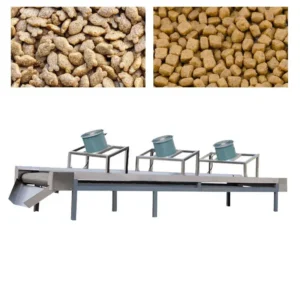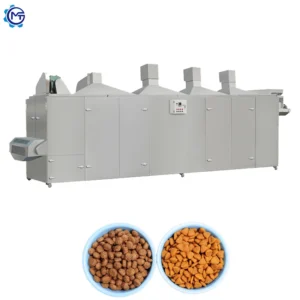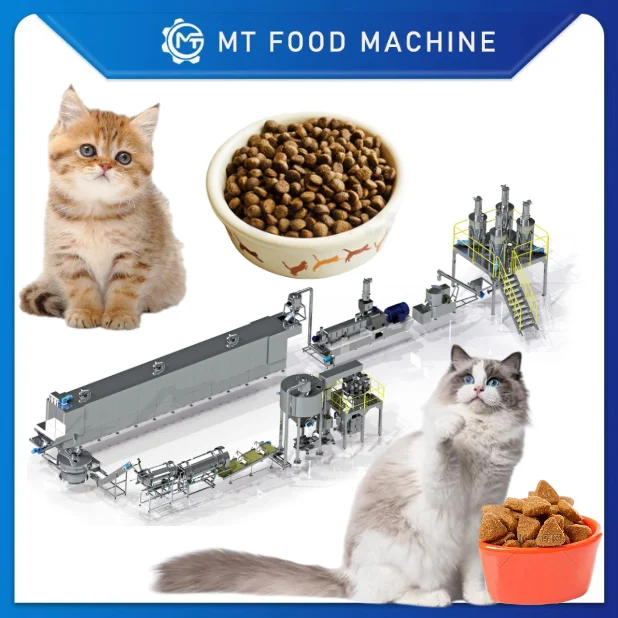
Matched Screw Geometry — Trial runs on customer raw material in our testing workshop verify actual output and kibble density before the twin-screw pet food extrusion line leaves the factory.
Technical Specifications
| Parameter | Value |
|---|---|
| Product Type | Twin-Screw Pet Food Extrusion Line |
| Output Capacity | 450–550 kg/h (basis not stated in source — confirm raw material formulation, moisture content and pellet size) |
| Control System | PLC controlled |
| Application Scope | Cat, dog, fish, bird, and cattle feed |
| Line Configuration | Complete processing line (specific stations to be confirmed — mixing, extrusion, drying, coating, cooling, packing) |
| Screw Type | Twin-screw |
| Certification | CE, ISO |
| Technical Support | Video technical support and online after-sales service |
Application Suitability
| Application | Material or Output |
|---|---|
| Dry dog kibble production | Corn, meat meal, bone meal, vitamin premix formulations |
| Cat food pellet extrusion | High-protein recipes with fresh meat slurry and starch binders |
| Floating aquatic feed | Fish meal, soy protein, wheat flour blends requiring controlled expansion |
| Sinking aquaculture pellets | Dense formulations for shrimp and bottom-feeding species |
| Bird and cattle feed | Grain-based multi-species formulations on shared line equipment |
What Nominal Capacity Figures Leave Out About Twin-Screw Pet Food Extrusion Line Technology
A rated output means nothing unless verified on the exact raw material blend the buyer will actually run.
I learned this the hard way. Early in my career, I specified a pet food line based on standard corn flour trials. The customer in the Middle East loaded fresh bone slurry at a high inclusion ratio on day one. The screws could not grab the material, throughput dropped by half, and the phone rang before the first shift ended. Since then, I never let a twin-screw pet food extrusion line ship without running the buyer’s actual formulation through the barrel first [NEED_CITE: raw material variability in extrusion throughput]. The screw configuration, barrel zone temperatures, and die geometry all shift when you move from a dry grain recipe to one loaded with animal fats and fresh protein. A capacity number quoted on one formulation tells you very little about what happens on another.
Barrel Temperature Profiling and Starch Gelatinisation
The twin-screw pet food extrusion line technology relies on precise barrel temperature management across multiple heating zones. Starch gelatinisation requires a specific thermal window that varies with moisture content and raw material composition. The PLC control system maintains these zone temperatures within tight tolerances, ensuring that each batch of kibble achieves consistent expansion regardless of ambient workshop conditions. When a recipe shifts from corn-dominant to rice-dominant, the gelatinisation onset temperature changes, and the barrel profile must follow.
Screw Configuration as a Process Variable
Screw elements are not interchangeable parts — they are process tools. Forward-flighting elements convey material, kneading blocks build shear for protein denaturation, and reverse elements create residence time for complete starch cookout. The twin-screw pet food extrusion line technology allows operators to rearrange these elements along the shaft to match each formulation. A high-fat kibble recipe needs a different screw build than a lean aquatic feed pellet, and the configuration record should document every element position against the target product specification [NEED_CITE: screw element arrangement principles in food extrusion].
How Moisture and Die Geometry Shape Kibble Density
Moisture content entering the barrel directly controls expansion ratio at the die face. Higher moisture delays flash-off, producing denser kibble that sinks. Lower moisture allows rapid steam expansion, creating the floating pellets that aquaculture markets demand. Die hole diameter and land length work together with moisture to set final pellet density. A floating fish feed and a sinking shrimp feed can run on the same extruder, but only if the die plate and moisture target are specified separately for each product.
Interpreting Core Specifications for Production Reality
The 450–550 kg/h output range carries an unstated basis that must be confirmed before the line is ordered. Capacity on a dry corn grit recipe at standard moisture differs significantly from output on a high-meat-slurry dog food formulation. The PLC-controlled system manages barrel temperature, screw speed, and feeder rates simultaneously, which maintains batch-to-batch consistency once the correct process window is established. Twin-screw geometry provides self-wiping action between the screws, preventing material stagnation that would burn protein-rich recipes. The complete line configuration — from mixing through extrusion to drying and coating — must be throughput-matched so that no single station creates a bottleneck. CE and ISO certification confirms that the electrical enclosure, guarding, and emergency stop circuits meet export market machinery directives [NEED_CITE: CE machinery directive requirements for food processing equipment].
The Cost of Skipping the Trial Run
Buyers who accept a generic screw build without a pre-shipment trial run on their own raw material face predictable consequences. The extruder may reach nominal speed but produce kibble with inconsistent density — some pellets float, others sink, and the market rejects the batch. A dryer sized for a lighter formulation cannot keep up when the actual recipe carries higher moisture, forcing the line to slow down. Coating drums calibrated for standard fat application rates cannot distribute viscous palatants evenly, leaving uneven flavour distribution across the batch. These problems surface after installation, when the supplier is thousands of kilometres away and the production schedule is already committed [NEED_CITE: post-installation commissioning challenges in extrusion lines].
Why This Line Is Built Differently
The screw configuration and die design are specified to the buyer’s raw material and target kibble density rather than copied from a generic template. The in-house testing workshop runs the buyer’s actual formulation before shipment, producing a trial run report that confirms real output and product specification. Every station from batching through extrusion to drying and packing is supplied under one responsibility, so throughput is matched across the line instead of assembled from separate vendors. PLC automation stores recipe parameters for each species and product format, allowing changeover without guesswork. Twin-screw expertise spans pet food, aquatic feed, and multi-species applications, meaning the process knowledge applies directly to the buyer’s product category.
Documentation & Verification
- Line layout and capacity calculation matching throughput across every station from mixer to packer
- Screw and die configuration record documented against the buyer’s specific formulation and target kibble density
- Trial run report on customer raw material confirming actual output before shipment
- Electrical schematic with voltage, frequency, and PLC control language confirmed before production begins
- CE declaration of conformity and ISO certificate included in the shipping documentation package
Installation, Commissioning & Support
- Foundation plan provided for the complete line footprint, accounting for extruder vibration and dryer weight
- Power supply specification listing dedicated circuit requirements for the PLC panel and barrel heaters
- Assembly sequence documented for twin-screw barrel sections and segmented heating zone connections
- First-run parameter logging with the buyer’s formulation to establish baseline PLC recipe settings
- Operator training covering screw element rearrangement and die plate changeover procedures
- Wear parts list identifying screws, barrel liners, and die plates with reorder part numbers
What We Need to Configure Your Line
To move from inquiry to line layout, we need your target species and kibble format, the raw material formulation including moisture range and fat inclusion percentage, and your daily production target. Confirm your workshop voltage, frequency, and preferred PLC display language. If you have existing upstream mixers or downstream packing equipment, share their throughput ratings so the new extrusion section integrates without bottlenecks.
Frequently Asked Questions
Q: How is the 450–550 kg/h capacity verified, and on which raw material formulation is it based?
A: That capacity range requires confirmation against the buyer’s specific formulation, moisture content, and target pellet size. We run a trial in our testing workshop using the customer’s actual raw material and document the verified output in a trial run report before the line ships.
Q: How are screw configuration and die design selected for different kibble densities?
A: Screw elements are arranged along the shaft to match the shear, residence time, and conveying requirements of each formulation. Die hole diameter and land length are selected to produce the target expansion ratio, whether the product is floating aquatic feed or dense dog kibble.
Q: What barrel temperature profile is used for starch gelatinisation in pet food extrusion?
A: The profile depends on the starch source and moisture level. The PLC system manages multiple barrel heating zones independently, and the correct profile for each recipe is recorded during the trial run so operators can recall it for repeat production.
Q: Can a trial run be performed on the buyer’s actual raw material before shipment?
A: Yes. The buyer ships a sample of their production formulation to our testing workshop. We run it through the configured extruder, verify output and kibble specification, and provide a trial run report documenting the results before dispatch.
Q: How is throughput balanced between the extruder, dryer, and coating drum?
A: Each station is sized during the line layout phase so that the extruder output rate matches the dryer evaporation capacity and the coating drum residence time. This prevents bottlenecks where one section forces the rest of the line to slow down.