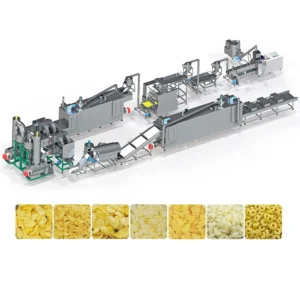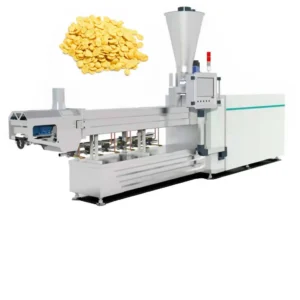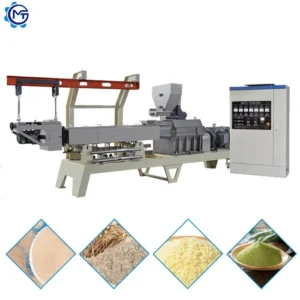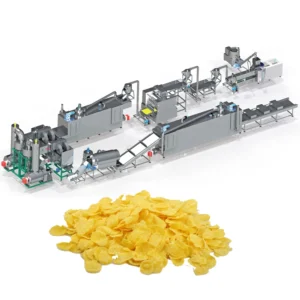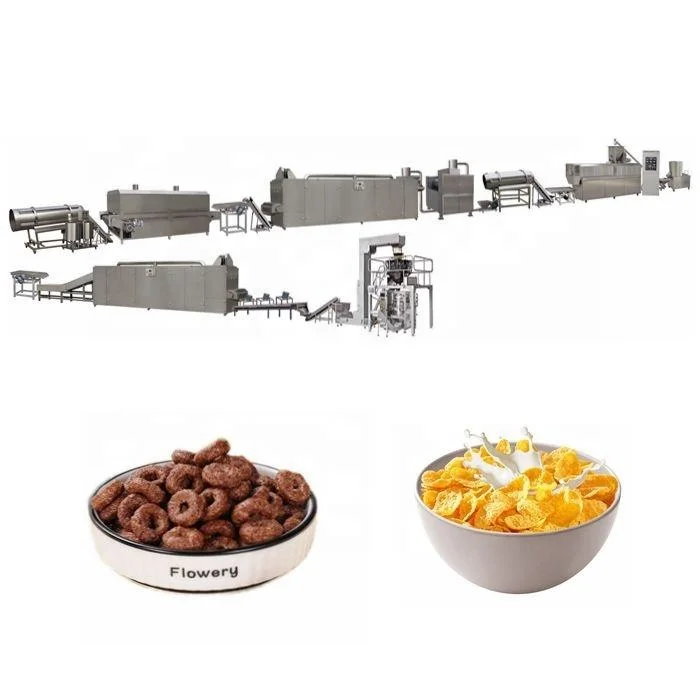
Extrusion Science Applied — twin-screw corn flakes extrusion line technology specifications define screw geometry, barrel profiling, and die design matched to your cereal blend, not copied from a generic build.
Technical Specifications
| Parameter | Value |
|---|---|
| Product Type | Corn Flakes Production Line with Twin Screw Extruder |
| Model Options | MT70 / MT75 / MT85 |
| Extruder Type | Twin-screw |
| Installed Power | 160 kW (MT70) / 210 kW (MT75) / 190 kW (MT85) |
| Power Consumption | 120 kW (MT70) / 150 kW (MT75) / 140 kW (MT85) |
| Output Capacity | 150–200 kg/h (MT70) / 300–500 kg/h (MT75) / 300–400 kg/h (MT85) (basis not stated in source — confirm raw material, moisture content, and product format) |
| Overall Dimensions (L×W×H) | 41×1.5×2.2 m (MT70) / 45×1.5×3.5 m (MT75) / 43×1.5×3.2 m (MT85) |
| Control System | PLC and MCC |
| Screw Material | Special wear-resistant alloy |
| Flaking Station | Hydraulic double-roller with PLC, dual motors, infrared temperature sensor |
| Dryer Heating Source | Gas or Electric |
| Roasting Oven | Hot air with vibrating pan, dual circulating fans, cyclone dust removal |
| Coating System | Double tumble sugar melting, elevator, coating drum, spraying nozzle |
| Lubrication | Automatic system with cooling function |
| Certification | CE, ISO |
Application Suitability
| Application | Material or Output |
|---|---|
| Natural corn flakes | Corn, rice, wheat, oat, or barley powder through extrusion, flaking, drying, roasting, and cooling |
| Sugar-coated corn flakes | Same cereal base with post-roasting sugar spraying, coating, and secondary drying |
| Shaped breakfast cereals | Ball, tube, ring, star, wheel, flower, heart, and fruit loop forms via interchangeable extruder dies |
| Expanded cereal snacks | Multi-grain blends processed through the same extrusion platform with adjusted die and moisture profiles |
Why the Die and Screw Question Beats the Capacity Question Every Time
When producers ask about corn flakes extrusion line technology specifications, the first number they want is output per hour. The honest answer is that a rated capacity means nothing until the screw configuration, die geometry, and barrel profile are matched to the exact cereal formulation running through the barrel. I once saw a line rated for a certain throughput on standard corn grits drop to roughly half that figure when the buyer switched to a coarser, higher-moisture corn flour. The extruder was not faulty; the configuration was generic. The screw pitch, compression ratio, and die orifice together determine how much starch gelatinises, how the dough expands, and whether the resulting pellet holds enough structure for the flaking rollers to press it into a uniform sheet [NEED_CITE: starch gelatinisation requirements for cereal extrusion]. Without that alignment, no amount of motor power compensates.
Screw Configuration as the Starting Point of Extrusion Control
The twin-screw design in the MT70, MT75, and MT85 models allows modular screw element arrangement along the barrel. Feed sections use deep-channel elements to draw cereal flour in, while compression and metering sections tighten the channel to build shear and pressure. For corn-based formulations with high starch content, the compression ratio must be aggressive enough to achieve full gelatinisation without scorching. For oat or wheat blends with higher fibre and fat, the profile shifts toward gentler shear to prevent oil separation inside the barrel. This is where corn flakes extrusion line technology specifications separate a purpose-built machine from an off-the-shelf unit.
Barrel Temperature Zones and Moisture Management
Each barrel section carries independent heating and cooling circuits, letting the operator set a temperature gradient from feed to die. Corn flour typically enters the extruder at a specific moisture range, and preconditioning with steam or water injection adjusts that before the material reaches the first screw element. The barrel profile then adds or removes heat zone by zone, controlling how quickly starch granules swell and rupture. Too much heat too early produces a sticky mass that clings to the screw flights; too little leaves raw starch that will not flake properly downstream [NEED_CITE: barrel temperature profiling in twin-screw cereal extrusion]. The PLC system logs each zone’s setpoint and actual temperature, giving process engineers a reproducible recipe across production runs.
What the Numbers Behind the Line Actually Mean
Installed power ratings across the three models range from 160 kW to 210 kW, but power consumption under load sits lower, between 120 kW and 150 kW, reflecting the difference between motor nameplate and real draw during steady-state extrusion. The hydraulic double-roller flaking station uses dual independent motors so each roller can be speed-matched to the other, and the infrared sensor monitors pellet surface temperature entering the nip — a detail that matters because corn flakes extrusion line technology specifications are only useful if the pellet arrives at the rollers within the correct thermal window. The roasting oven’s dual circulating fans and cyclone dust removal maintain even hot-air distribution across the vibrating pan, driving the surface blistering that gives corn flakes their characteristic crispness. Automatic lubrication with cooling extends screw and barrel life during continuous shifts.
What Happens When Extrusion Parameters Are Left to Chance
A screw configuration copied from a different cereal product produces pellets that either expand too much or too little. Over-expanded pellets shatter under the flaking rollers, yielding broken flakes and excessive fines. Under-expanded pellets resist flattening, producing thick, hard flakes that never achieve the crispness the market expects. Either outcome wastes raw material, forces unplanned downtime for screw element swaps, and delays the entire line while operators troubleshoot [NEED_CITE: effects of incorrect screw configuration on cereal flake quality]. The roasting oven then compounds the problem because uneven flake thickness means some pieces burn while others remain under-toasted.
Why Sourcing This Line Here Makes Sense
Every station from mixing through packing is supplied and throughput-matched by one manufacturer, so the flaking rollers are not undersized relative to the extruder output and the dryer capacity does not bottleneck the roasting oven. Screw and die configurations are specified to the buyer’s raw material blend and target flake texture rather than pulled from a generic template. The in-house testing workshop runs trial batches on the buyer’s actual cereal formulation before the line ships, so process parameters are documented before installation begins. PLC and MCC controls are programmed to the facility’s voltage, frequency, and preferred operator language. Twin-screw expertise spans corn, wheat, oat, and multi-grain cereal applications, meaning the same engineering team handles formulation questions from inquiry through commissioning [NEED_CITE: turnkey cereal extrusion line commissioning practices].
Documentation & Verification
- Line layout and capacity calculation matched to your cereal formulation and target flake format
- Screw and die configuration record specific to your raw material blend
- Electrical schematic with confirmed voltage, frequency, and control language
- Trial run report on your actual corn or multi-grain material from the testing workshop
- CE declaration of conformity and ISO certificate for customs and regulatory clearance
- Wear parts list with screw element and die specifications for reorder planning
Installation, Commissioning & Support
- Foundation and utility plan sized to the MT70, MT75, or MT85 footprint and power draw
- Dedicated electrical circuit matching the confirmed voltage and frequency for the PLC and MCC panel
- Extruder barrel sections and screw shafts arrive segmented for on-site assembly and alignment
- First-run parameter setting using the trial run report as the baseline recipe
- Operator training covering screw configuration swaps, die changes, and PLC recipe storage
- Wear parts inventory recommendation based on your planned production hours and raw material abrasiveness
Before You Request a Quote
To configure a line that holds its rated output on your actual material, share your cereal formulation details including grain type, particle size, and moisture range, along with the flake format you are targeting — natural, sugar-coated, or shaped variants. Confirm your facility’s voltage, frequency, and preferred control language so the electrical package arrives ready to run. If you plan to switch between corn, wheat, and oat blends on the same line, note that upfront so the screw configuration can accommodate the full range.
Frequently Asked Questions
Q: How is screw configuration and die design selected for my cereal blend?
A: The engineering team reviews your raw material data sheet — grain composition, particle size distribution, moisture, and fat content — then selects screw element types, compression ratios, and die orifice dimensions that achieve the target starch gelatinisation degree and pellet density needed for uniform flaking.
Q: What moisture range does the extrusion process target for corn flakes?
A: Cereal flour is preconditioned with steam or water before entering the barrel, and barrel zone temperatures are then adjusted to maintain the dough within the moisture window that supports full gelatinisation without surface sticking, producing a pellet that flakes cleanly under the hydraulic rollers.
Q: Can both natural and sugar-coated corn flakes run on the same line?
A: Yes. The natural line path ends after roasting and cooling. For sugar-coated variants, the process extends through sugar spraying and coating drums before a secondary drying stage. The extrusion and flaking stages remain identical; only the post-roasting stations change.
Q: How do I verify that quoted capacity holds on my actual raw material?
A: Before shipment, the testing workshop runs your specific cereal formulation through the configured extruder and documents output rate, pellet density, and flake quality in a trial run report, so capacity figures reflect your material rather than a generic benchmark.
Q: What barrel temperature profile is used for corn versus oat or wheat blends?
A: Corn’s high starch content typically requires a steeper barrel temperature gradient to drive complete gelatinisation, while oat and wheat blends with more fibre and fat use a flatter profile with gentler shear to prevent oil separation and maintain pellet integrity for flaking.