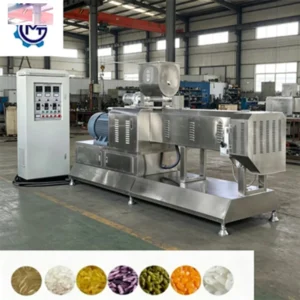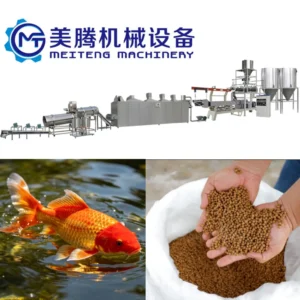
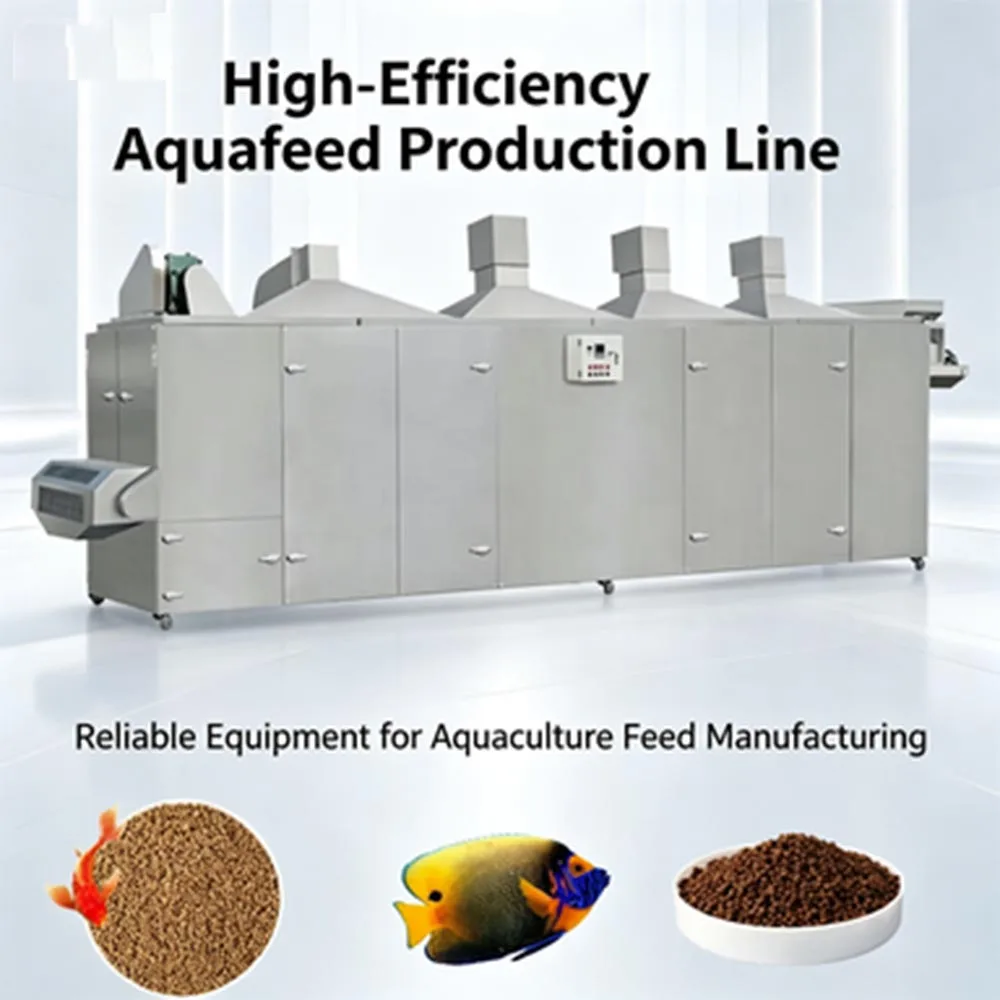
Matched screw geometry to formula density — trial runs on customer raw material in the testing workshop confirm floatability before the line ships, not after installation starts.
Technical Specifications
| Parameter | Value |
|---|---|
| Product Type | Twin Screw Aquatic Feed Extrusion Line |
| Extruder Type | Twin-screw |
| Output Capacity | 500 kg/h on floating fish feed pellets (basis not stated in source — confirm raw material formula, moisture content, pellet diameter) |
| Pellet Size Range | 0.5 mm – 12 mm (adjustable via die) |
| Control System | Simple control panel (PLC / MCC configuration to be confirmed) |
| Structure Material | Stainless steel (main contact parts) |
| Automation Level | Fully automatic, continuous production |
| Line Stations | Feeding, mixing, extruding, pelletizing (dryer, cooler, coating, packing scope to be confirmed) |
| Power / Voltage / Frequency | To be confirmed per target market electrical standard |
| Assembly State | Integrated line layout |
Application Suitability
| Application | Material or Output |
|---|---|
| Floating catfish and tilapia pellets | Starch-rich formulations requiring high expansion and low bulk density |
| Sinking shrimp feed | Fine-diameter pellets (0.5 mm – 2 mm) with controlled density and water stability |
| Grow-out feed for various aquaculture species | Mid-range pellet sizes (3 mm – 8 mm) from mixed grain, fish meal and protein concentrates |
| Fry and juvenile feed | Micro-pellets below 1 mm demanding precise die geometry and consistent extrusion pressure |
Why Pellets Sink When the Market Expects Them to Float
When aquatic feed leaves the die and drops straight to the bottom of the pond, the fault almost always sits inside the barrel — not in the dryer, not in the cooler, and certainly not in the packing station. The thermal history and shear profile that the material experiences during those few seconds of twin screw aquatic feed extrusion technology determine starch gelatinisation, cell structure and ultimately bulk density.
I spent three days in the workshop adjusting screw elements and barrel zones on a Southeast Asian line because the local cassava-based formula behaved nothing like the corn-based test material [NEED_CITE: starch gelatinisation behaviour across different carbohydrate sources in extrusion]. The pellets kept sinking. Once the screw profile was reconfigured for the actual raw material, floatability came within specification. A generic screw build copied from a reference project will not account for the gelatinisation temperature, amylose-to-amylopectin ratio and fat content of the buyer’s specific formula.
How Screw Configuration Controls Buoyancy
The arrangement of conveying, kneading and reverse elements along the screw shaft governs residence time, shear intensity and melt temperature inside each barrel zone. For floating pellets, the screw profile must generate enough internal steam expansion to create a porous cell structure before the pellet exits the die. Kneading blocks positioned too early compress the melt before starch has fully gelatinised; positioned too late, they fail to build the pressure differential needed for expansion. This is where twin screw aquatic feed extrusion technology separates from single-screw behaviour — the intermeshing screws create positive conveying and allow zone-by-zone thermal control that single-screw machines cannot match on high-moisture aquaculture formulas.
Barrel Temperature Zoning and Moisture Management
Each barrel section carries independent heating and cooling circuits. The feed zone stays cool to prevent premature gelatinisation and bridging, while the compression and metering zones ramp progressively to drive starch conversion. Moisture injection — whether liquid water or direct steam — must be matched to the formula’s baseline moisture and the target gelatinisation degree [NEED_CITE: moisture content thresholds for starch gelatinisation in twin-screw extrusion]. Too little moisture and the pellet exits dense and brittle; too much and expansion collapses as the pellet cools, sinking within minutes of hitting water.
Reading the Specs That Actually Matter for Pellet Quality
The pellet size range of 0.5 mm to 12 mm covers the full spectrum from fry feed to adult grow-out pellets, but switching across that range requires die changes and corresponding screw adjustments. A die with smaller orifices raises back-pressure, increasing shear and melt temperature — beneficial for fine sinking shrimp feed but potentially damaging to the cell structure needed for large floating pellets. Stainless steel contact parts resist the corrosive environment created by high-moisture, high-protein formulations running at elevated barrel temperatures. The line’s continuous automation level keeps feed rate, screw speed and barrel temperature synchronised, which matters because even brief fluctuations in any one parameter shift pellet density outside the narrow window that the market accepts [NEED_CITE: aquaculture feed bulk density specifications for floating and sinking grades].
What Happens When the Screw Build Is Copied, Not Configured
A twin-screw extruder shipped with a generic screw profile forces the buyer into a cycle of trial and error after installation. Raw material waste accumulates during commissioning. The production team adjusts feed rate and barrel temperature blindly, chasing density targets without understanding which screw element is causing the bottleneck. Market deadlines slip while the machine sits in adjustment mode instead of running production batches. I have seen lines of this class sit idle for weeks because the screw configuration was never matched to the buyer’s actual formula before the crate left the factory [NEED_CITE: extrusion line commissioning delays caused by unmatched screw profiles].
Why This Line Is Built Around Your Formula, Not a Catalogue Number
Screw configuration and die design are specified to the buyer’s raw material and target pellet density, not pulled from a standard build sheet. The in-house testing workshop runs trial extrusion on the customer’s actual formula before shipment, producing a trial run report that documents the screw profile, barrel temperatures and resulting pellet characteristics. Complete line stations — feeding through pelletizing — are throughput-matched under one supplier so that no single station bottlenecks the others. Electrical schematics, voltage and control language are confirmed with the buyer before production begins, avoiding commissioning delays on site. Twin-screw expertise spans floating feed, sinking feed, pet food and snack applications, meaning the screw design draws on cross-category process knowledge rather than a single-product reference.
Documentation & Verification
- Line layout drawing with capacity calculation based on your confirmed formula and pellet diameter
- Screw and die configuration record matched to your raw material trial results
- Trial run report on your actual raw material executed before shipment
- Electrical schematic with voltage, frequency and control language confirmed per your market
- Machine specification sheet detailing barrel zones, motor rating and line station throughput
Installation, Commissioning & Support
- Foundation plan matched to the integrated line footprint and extruder weight distribution
- Electrical supply specification confirming voltage, frequency and dedicated circuit requirements for the extruder motor
- On-site assembly of barrel sections, screw shaft and die plate by the commissioning engineer
- First-run parameter setting using your raw material to replicate trial run results
- Operator training covering screw element changes, die swaps and barrel temperature adjustment
- Wear parts list listing screws, dies and barrel liners with reorder codes for continuous supply
What to Include in Your Inquiry
Provide your raw material formula — including primary carbohydrate source, protein percentage and fat content — along with the target pellet diameter and whether the end product must float or sink. Confirm the electrical voltage, frequency and control language for your facility. If you already operate upstream mixing or downstream drying and coating stations, note their throughput so the line can be configured to match.
Frequently Asked Questions
Q: How is pellet floatability controlled through screw configuration and barrel temperature?
A: Floatability depends on the degree of starch expansion achieved inside the barrel before the pellet exits the die. Kneading element placement, screw speed and barrel zone temperatures together determine the melt’s internal steam pressure and cell structure. The configuration is tuned during pre-shipment trials on the buyer’s raw material to achieve the target bulk density.
Q: What moisture level is needed for a given aquatic feed formula?
A: The required moisture depends on the starch source, protein content and target pellet type. Cassava-based formulas gelatinise at different moisture thresholds than corn or wheat-based blends. Moisture injection rates are established during the trial run and documented in the configuration record so the line replicates them from the first production shift.
Q: Can the same line switch between floating fish feed and sinking shrimp feed?
A: Yes, but the switch requires hardware changes. Sinking pellets need a screw profile that compresses rather than expands the melt, a different die plate with smaller orifices and adjusted barrel temperatures. These changeover parameters are recorded during the trial phase and included in the operator training documentation.
Q: How is starch gelatinisation degree measured during extrusion trials?
A: Pellet samples taken during the trial run are analysed for expansion ratio, bulk density and water stability. These physical measurements correlate directly with gelatinisation degree. If results fall outside the target window, screw elements or barrel zone settings are adjusted and the run is repeated until specifications are met.
Q: How do you confirm that the quoted output is achievable on my material?
A: Output capacity is validated during the in-house trial run using the buyer’s actual raw material and target pellet size. The trial run report documents the sustained throughput achieved under stable operating conditions, providing a verified baseline rather than a nominal figure based on a reference formula.