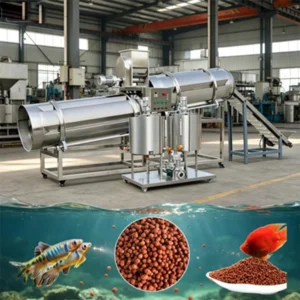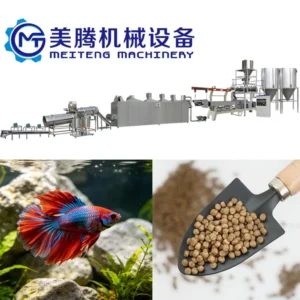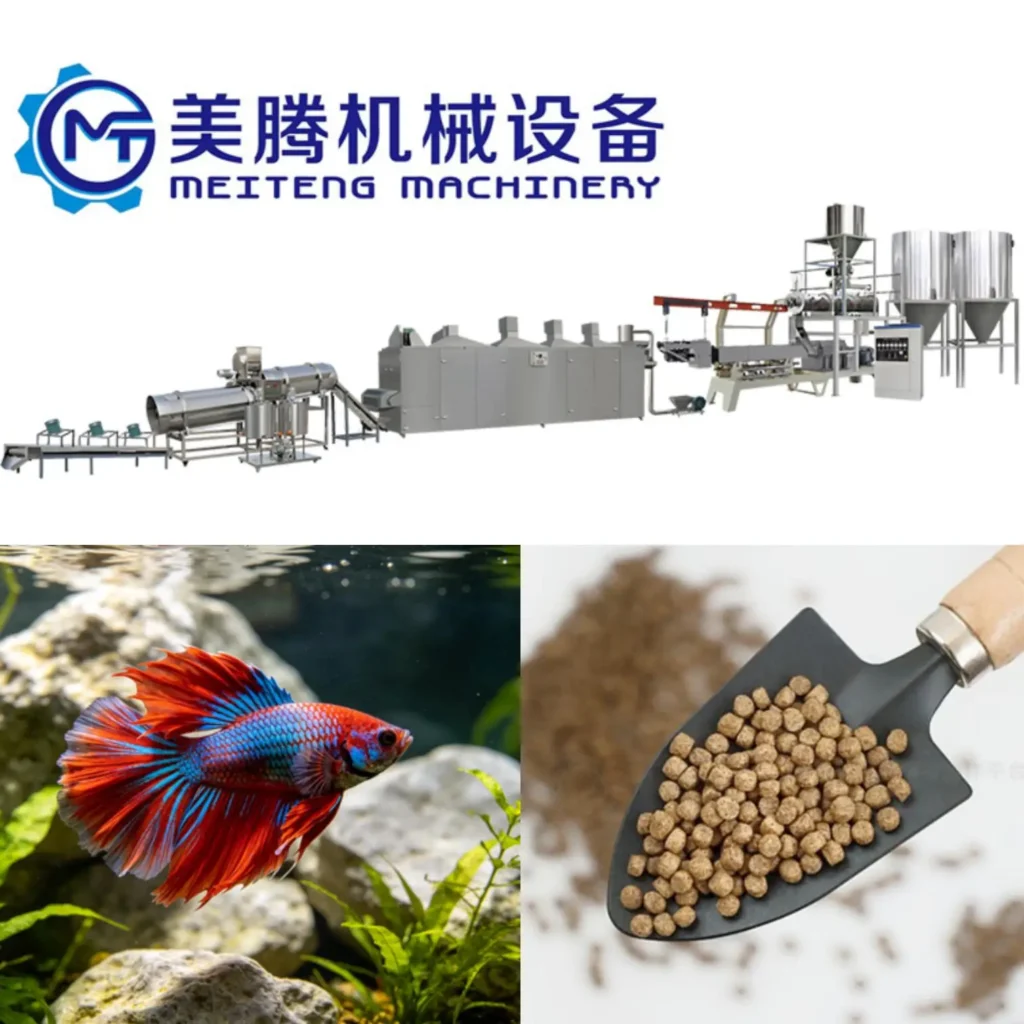
Extrusion Technology Matched to Formulation — Screw profiles and die geometry specified against the buyer’s actual protein and starch ratios, not copied from a generic catalogue build.
Technical Specifications
| Parameter | Value |
|---|---|
| Product Type | Fish Feed Extrusion Production Line |
| Output Capacity | 1.0–1.2 t/h (basis not stated in source — confirm raw material formulation, moisture content, and pellet diameter) |
| Extruder Type | Twin-screw extruder |
| Contact Material | 304 stainless steel in wet and heated zones |
| Control System | PLC / MCC configuration to be confirmed per site |
| Voltage & Frequency | Configurable to target market electrical standard |
| Pellet Format | Floating and sinking options via die changeover |
| Target Species | Trout, salmon, catfish, and bottom-feeding species |
Application Suitability
| Application | Material or Output |
|---|---|
| Floating pellets for trout and salmon | High-starch formulations requiring controlled expansion and low bulk density |
| Sinking pellets for catfish and bottom-feeders | Higher-protein mixes where denser extrudate is required |
| Multi-species production on a single line | Rapid die and screw changeover between floating and sinking runs |
| Aquaculture feed mills scaling commercial output | Formulations based on fish meal, soy, corn, and vitamin premix blends |
Why Generic Screw Builds Sink Your Floating Pellet
A floating pellet that sinks at the pond surface is almost always a screw configuration problem, not a raw material problem.
When a twin-screw extruder ships with a generic screw profile, the shear and residence time inside the barrel rarely match what the buyer’s specific formulation demands. I have seen lines where high-protein fish meal formulations were pushed through a standard screw build meant for corn-heavy recipes. The starch never fully gelatinised, expansion collapsed at the die face, and every pellet dropped straight to the bottom. The buyer blamed the raw material supplier before anyone checked the screw elements. [NEED_CITE: starch gelatinisation thresholds in aqua feed extrusion]
That misdiagnosis costs weeks of production and damages trust with the end farmer who expects feed to stay on the water surface long enough for the fish to consume it.
Shear Control Through Screw Element Sequencing
The degree of starch gelatinisation inside the barrel depends on how the conveying, kneading, and reverse-screw elements are arranged along the shaft. A formulation heavy in corn starch needs a different kneading block sequence than one dominated by fish meal or soy concentrate. The fish feed extrusion technology twin-screw configuration allows each element to be repositioned so that shear intensity and residence time align with the gelatinisation window of the actual recipe entering the hopper.
Barrel Temperature Zones and Moisture Conditioning
Each barrel section carries independent heating and, where needed, cooling channels. The temperature profile from the feed zone to the die face must ramp in stages that match how the specific blend absorbs moisture and builds viscosity. Steam or water injection at the preconditioner and barrel inlet sets the starting moisture, but the barrel zones determine whether that moisture penetrates the starch granule or simply evaporates before the die. [NEED_CITE: barrel temperature profiling for multi-ingredient aqua feed]
Die Geometry and Expansion Ratio
The die orifice diameter, land length, and face pattern dictate how much the extrudate expands as it exits atmospheric pressure. Floating pellets need a short land length and a wider orifice to trap enough air cell structure inside the pellet. Sinking pellets require the opposite — longer land, narrower orifice, denser extrudate. Swapping dies between runs is a physical changeover, but the screw profile behind that die must also shift to deliver the correct melt density to the die face in the first place.
Reading the Specification Sheet Beyond Capacity
The stated output of 1.0–1.2 t/h cannot be evaluated without knowing the pellet diameter, formulation moisture, and whether the target is floating or sinking. A 3 mm floating pellet will run at a different mass throughput than a 6 mm sinking pellet on the same extruder because expansion ratio changes the volumetric output per screw revolution. When reviewing any fish feed extrusion technology twin-screw proposal, the capacity line must state the exact formulation and pellet size it was calculated against — otherwise the number is not a capacity, it is a guess. Contact material being 304 stainless steel across wet and heated zones matters for corrosion resistance when formulations include salt, mineral premixes, or high-chloride ingredients common in marine species feed. The control system, whether PLC or MCC, determines whether barrel zone temperatures and screw speed can be logged per batch for traceability, which large aquaculture operations increasingly require from their feed suppliers.
The Hidden Cost of Skipping a Trial Run
When a line ships without a trial on the buyer’s actual raw material, the first weeks on site become an expensive experiment. Screw elements get swapped, barrel temperatures get pushed to extremes, and the dryer runs overtime trying to correct moisture that should have been managed inside the barrel. I have watched an install take three extra weeks of commissioning because the protein content in the local fish meal was higher than the generic test recipe the factory used. The dryer was undersized for the actual throughput, creating a bottleneck that the extruder could easily outpace. [NEED_CITE: commissioning delays from untested raw material in extrusion lines]
Why Procurement Should Start With the Formulation
Every configuration decision on this line — screw profile, die selection, dryer length, coating drum capacity — traces back to the buyer’s raw material sheet and target pellet specification. The twin-screw extruder is not sold as a standalone machine here; it is specified as part of a sequence where each station must match the throughput and moisture curve of the one before it. In-house testing on the buyer’s actual blend before shipment means the screw configuration record, the trial run report, and the die selection are all documented and verified before the crate leaves the factory floor. Electrical schematics are confirmed against the installation site’s voltage and frequency standard, eliminating the commissioning delays that happen when a 50 Hz motor meets a 60 Hz grid. Line layout calculations show the floor plan, utility drops, and material flow from mixer through extruder, dryer, coating drum, cooler, and packing station so the buyer can plan the building before the equipment arrives.
Documentation & Verification
- Line layout drawing with throughput matched across extruder, dryer, and coating stations
- Screw and die configuration record tied to the buyer’s formulation sheet
- Trial run report on buyer’s raw material confirming pellet density and float/sink ratio
- Electrical schematic with voltage and frequency confirmed for the installation site
- CE declaration of conformity covering the complete extrusion line assembly
Installation, Commissioning & Support
- Foundation plan accounting for extruder and dryer footprint and vibration isolation points
- Dedicated electrical circuit sized to the confirmed motor load and control panel draw
- Barrel and screw assembly verified on site against the configuration record from trial
- First-run parameter logging across all barrel zones to establish baseline batch settings
- Operator training covering die changeover procedure between floating and sinking formats
- Wear parts list identifying screw elements, die plates, and cutter bearings with reorder codes
What to Include in Your Inquiry
Send the raw material formulation with protein, starch, fat, and moisture percentages so the screw profile can be matched before quotation. Specify the target pellet diameter range and whether the line must produce both floating and sinking formats. Confirm the local voltage, frequency, and preferred control language for the PLC or MCC panel so electrical documentation aligns with the installation site from day one.
Frequently Asked Questions
Q: How is the 1.0–1.2 t/h capacity verified, and on which formulation?
A: That capacity range must be confirmed against a specific raw material blend, moisture level, and pellet diameter. Before quotation, we request the buyer’s formulation sheet and run a trial in the testing workshop. The resulting trial report documents the actual throughput achieved, the pellet density measured, and the float or sink behaviour observed under those exact conditions.
Q: How do screw configuration and barrel temperature control float or sink behaviour?
A: Floating pellets require high starch gelatinisation and trapped air cells, achieved through specific kneading block sequences and a barrel temperature ramp that holds moisture long enough for full expansion. Sinking pellets need denser extrudate with less expansion, which means a different screw profile and lower barrel moisture. The fish feed extrusion technology twin-screw setup allows both profiles on the same machine through element changeover.
Q: What die options are available for different species and feeding behaviours?
A: Die plates are selected based on target pellet diameter and the expansion ratio needed for the species. Trout and salmon typically require smaller floating pellets, while catfish operations often run larger sinking formats. Multiple die plates can be supplied with the line, and the changeover procedure is covered during on-site operator training.
Q: Is a trial run done on the buyer’s raw material before shipment?
A: Yes. The buyer ships a representative sample of their raw material to the testing workshop. The extruder is configured with the proposed screw and die build, and a production run is completed. The trial report includes throughput data, pellet density, moisture content after drying, and photographic evidence of float or sink performance.
Q: How are moisture and steam injection handled for varying starch and protein levels?
A: The preconditioner and barrel inlet accept steam or water injection, with flow rates adjustable to match the formulation’s absorption characteristics. High-protein formulations typically require less added moisture than starch-dominant blends. The barrel zone temperatures are then tuned to ensure the available moisture drives gelatinisation rather than flashing off before the die face.