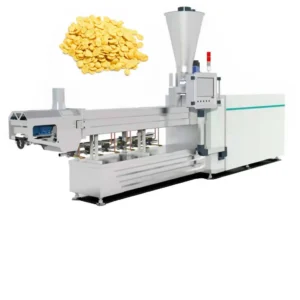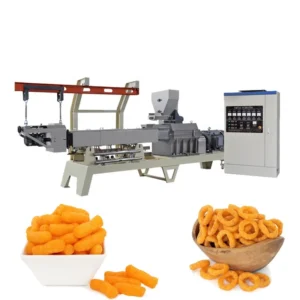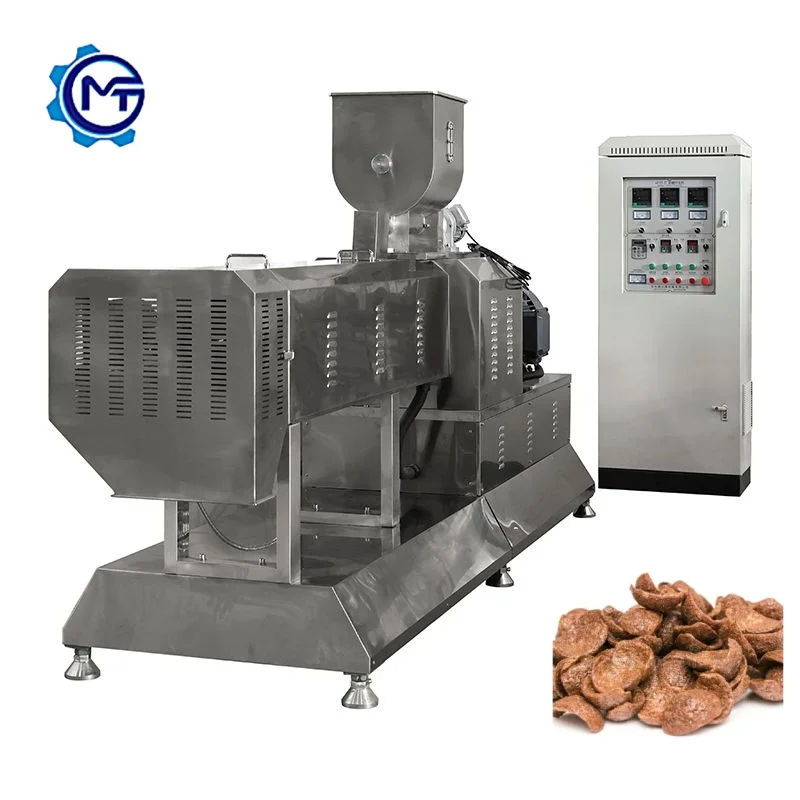
Customized Extrusion Profiling — Every screw element, barrel zone and die is matched to your grain blend and target flake density, verified through in-house trial runs on your actual raw material before the line ships.
Technical Specifications
| Parameter | Value |
|---|---|
| Product Type | Corn Flakes & Puffed Breakfast Cereal Production Line |
| Model Options | MT70 / MT85 / MT75 |
| Screw Type | Twin Screw |
| Installed Power | 160 kW (MT70) / 190 kW (MT85) / 210 kW (MT75) |
| Power Consumption | 120 kW (MT70) / 140 kW (MT85) / 150 kW (MT75) |
| Output Capacity | 150–200 kg/h (MT70, basis not stated in source — confirm raw material & moisture content) |
| Output Capacity | 300–400 kg/h (MT85, basis not stated in source — confirm raw material & moisture content) |
| Output Capacity | 300–500 kg/h (MT75, basis not stated in source — confirm raw material & moisture content) |
| Overall Dimensions | 41 × 1.5 × 2.2 m (MT70) / 43 × 1.5 × 3.2 m (MT85) / 45 × 1.5 × 3.5 m (MT75) |
| Control System | PLC (flaking machinery); extruder control configurable |
| Heating Source (Dryer) | Gas / Electric / Steam |
| Flaking Rollers | Hydraulic pressure, dual independent motors, infrared sensor temperature control |
| Roasting Oven | Vibrating pan, high-temperature spray tubes, two circulating fans, cyclone dust removal |
| Coating System | Double tumble sugar melter, elevator, coating drum, spray nozzles |
| Standards | CE (since 2014), ISO certified |
Application Suitability
| Application | Material or Output |
|---|---|
| Natural corn flake production | Corn grits, corn flour |
| Cocoa and multi-grain flakes | Cocoa flour blended with rice, wheat, oat, barley powders |
| Sugar-coated breakfast flakes | Corn or multi-grain flakes with sugar syrup coating |
| Puffed cereal shapes | Balls, tubes, sticks, rings, fruit loops, stars, wheels, flowers, hearts via die change |
| Fortified cereal formats | Vitamin- and mineral-enriched cereal flour blends |
Why Generic Screw Builds Destroy Your Flake Bowl-Life
A generic screw configuration produces corn flakes that turn soggy in milk within minutes — the correct screw element sequence, matched to your grain blend and target moisture, is what keeps a flake crisp from pour to last bite.
The issue usually starts upstream. Buyers receive a line spec’d on nominal capacity using standard corn grits, then switch to a recipe with higher fat content from cocoa powder or added wheat germ. The extruder barrel temperature profile that worked during factory testing no longer delivers adequate starch gelatinisation. Flakes come out hard, under-expanded, or unevenly blistered after roasting. [NEED_CITE: starch gelatinisation requirements for corn flake extrusion]
I spent years in our Jinan testing workshop running trial batches before moving into line planning. One cocoa-blend line for export passed every test on standard corn flour, then failed at the buyer’s facility when they introduced high-fat cocoa flour into the recipe. The gelatinisation degree dropped, the extrudate hardened, and an entire production run was scrapped. That is why every line we ship now runs on the buyer’s actual formulation before it leaves the factory floor.
Barrel Temperature Profiling and Starch Gelatinisation
Corn flake texture depends on controlled starch gelatinisation inside the extruder barrel. The twin-screw design on this line allows operators to build a multi-zone temperature profile across the feeding, mixing and cooking sections. Moisture content and shear forces must be balanced so the starch reaches full gelatinisation without over-cooking the extrudate surface. A correctly configured barrel profile gives the flake its structural backbone before it ever reaches the flaking rollers.
Die Geometry, Expansion Ratio and Flake Density
The die design directly controls how the extrudate expands as it exits the barrel. For breakfast cereals that must hold crunch in milk, the target is a specific expansion ratio that produces a flake with enough internal porosity for crispness, yet sufficient density for bowl stability. Adjusting die aperture and land length on this corn flakes production line extrusion technology lets processors dial in the exact texture their market demands — from light, airy puffed shapes to dense, crunchy flakes.
Screw Configuration Across Grain Blends
Different raw materials behave differently under shear and heat. Corn, rice, wheat, oat and barley flours each have distinct starch compositions and gelatinisation temperatures. The screw element arrangement — kneading blocks, reverse elements, conveying segments — must be specified to the buyer’s actual grain blend. This is not a one-size-fits-all build. [NEED_CITE: twin-screw element arrangement for varied cereal flours] When cocoa flour or other high-fat ingredients enter the recipe, the screw configuration must compensate for reduced friction and altered moisture absorption.
What the Power and Dimension Specs Mean for Your Floor
The three model options span installed power from 160 kW to 210 kW, with overall line lengths from 41 m to 45 m. These are not compact systems. Each station — mixing, extruding, flaking, drying, roasting, coating, cooling and packing — must have matched throughput so no single machine bottlenecks the entire line. The multi-fuel dryer (gas, electric or steam) is sized to handle the extruder output without creating a backlog upstream. The roasting oven uses a vibrating pan with two independent circulating fans and cyclone dust removal to maintain even surface blistering across the full pan width, which matters when you run high-sugar recipes that scorch easily.
What Happens When Stations Are Mismatched
An extruder running at full throughput feeds a dryer that cannot keep pace. Half-cooked flakes pile up, stick together, and lose their surface texture before reaching the roasting oven. The roasting oven then receives an inconsistent product load, producing batches where some flakes are properly blistered and others are pale and under-toasted. Downstream, the coating drum receives flakes at irregular intervals, resulting in uneven sugar distribution. [NEED_CITE: throughput matching across extrusion line stations] These are not defects in individual machines — they are failures in line-level capacity planning.
Why This Line Is Built Differently
Every station on this line is throughput-matched from batching through packing under one supplier, eliminating the gaps that appear when equipment is sourced from separate vendors. The screw configuration and die design are specified to the buyer’s raw material and target flake density, not copied from a generic build template. Before shipment, the line runs a trial on the customer’s actual formulation in our in-house testing workshop, generating a documented report on expansion, flake integrity and roasting outcome. The flaking rollers use hydraulic pressure with independent dual-motor drive and infrared sensor temperature control, ensuring uniform flake thickness across the full roller width. Electrical schematics with voltage and frequency confirmation for the target market are finalised before production begins, so the control system and power supply are ready on day one of commissioning.
Documentation & Verification
- Line layout drawing with capacity calculation across all stations from extruder to packer
- Screw and die configuration record specific to your grain blend and target flake density
- Trial run report on your raw material covering expansion, flake integrity and roast outcome
- Electrical schematic with confirmed voltage and frequency for your facility
- CE declaration of conformity and ISO certificate included with shipment documentation
- Operation and maintenance manual with wear parts list for screws, dies and roller surfaces
Installation, Commissioning & Support
- Line footprint spans 41–45 m depending on model, requiring level concrete flooring with utility trenches
- Power supply must match confirmed voltage and frequency; dedicated circuit for extruder motor up to 210 kW
- Stations ship as modular sections for on-site assembly, with flaking and roasting units positioned to extruder height
- First-run parameter setting covers barrel temperature profile, flaking pressure and roasting oven fan speed
- Operator training includes screw changeover, die replacement and infrared sensor calibration on flaking rollers
- Wear parts list covers screws, dies, roller surfaces and spray nozzles for scheduled replacement
Before You Request a Quote
To configure a line that actually holds your target output on your recipe, we need your grain blend composition and any non-standard ingredients such as cocoa flour or added fats. Specify your target daily output so we can match the correct model and size every downstream station accordingly. Confirm your facility’s voltage, frequency and control language preference so the electrical system is built correctly from the start.
Frequently Asked Questions
Q: How is screw configuration and die design matched to my specific grain blend and target flake density?
A: We start with your raw material composition, including any high-fat or non-standard ingredients. The screw element sequence and die aperture are then configured to achieve the correct starch gelatinisation and expansion ratio for your target flake texture. A trial run on your actual recipe verifies the result before shipment.
Q: What barrel temperature profile and moisture range produce correct expansion for crispy corn flakes?
A: The profile depends on your grain blend and target moisture at the die exit. Corn typically requires higher barrel temperatures than rice or oat-based recipes. We establish the optimal zone-by-zone profile during the in-house trial run, documenting moisture levels and temperature settings for your specific formulation.
Q: Can a trial run be performed on my raw material before shipment, and what does the report cover?
A: Yes. We run your actual formulation through the extruder, flaking rollers, dryer and roasting oven in our testing workshop. The trial report documents expansion ratio, flake thickness uniformity, surface blistering quality and any adjustments made to screw configuration or barrel temperature during the test.
Q: How are dryer and roasting oven capacities matched to extruder output to avoid bottlenecks?
A: Each station is calculated against the extruder’s confirmed output on your raw material. The dryer and roasting oven are sized so residence time and throughput align with the upstream feed rate, preventing product backlog and ensuring consistent moisture reduction and surface finish across every batch.
Q: What documentation is provided with the line?
A: You receive a complete line layout with capacity calculations, screw and die configuration record, electrical schematic with confirmed voltage, trial run report on your raw material, CE and ISO certificates, operation manual, and a wear parts list covering screws, dies and roller components.