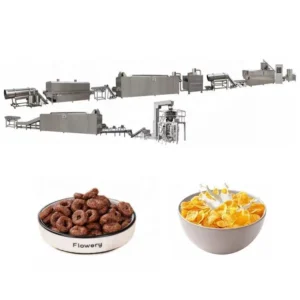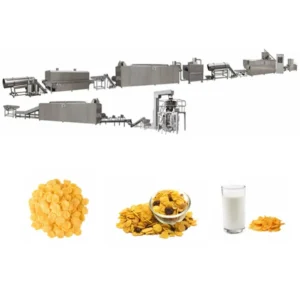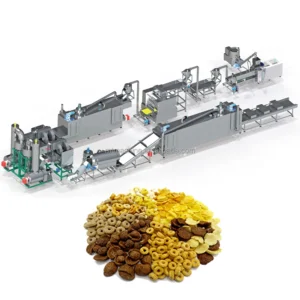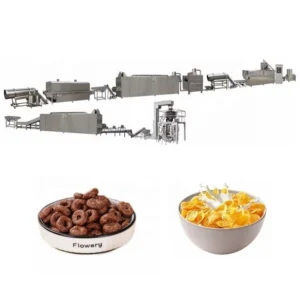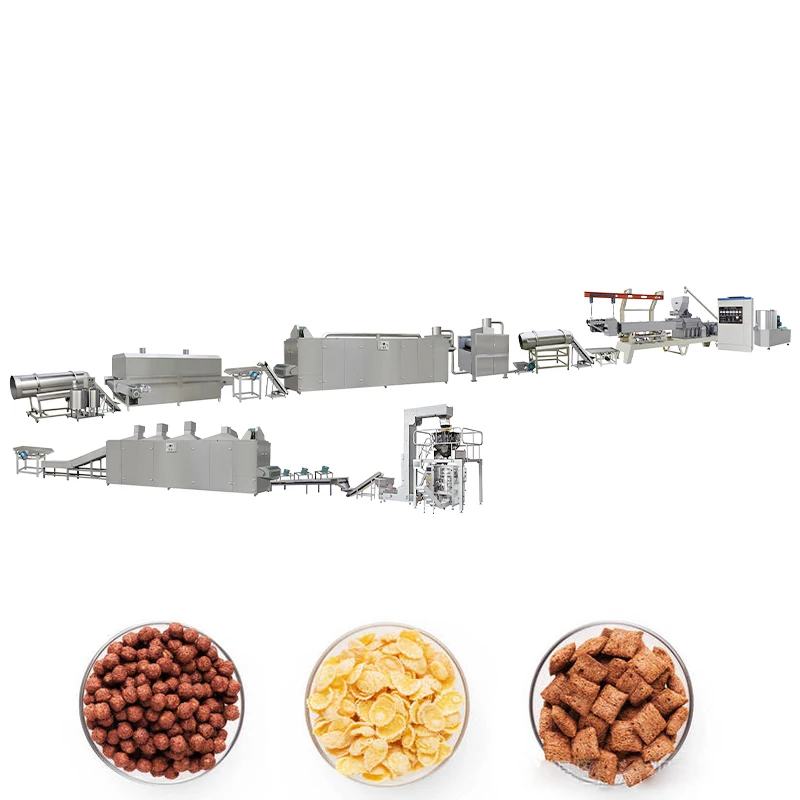
Screw Configuration Matched to Grain — Each MT-65 processing line ships with a screw profile and die plate engineered to the buyer’s specific corn, wheat, or multi-grain formulation, preventing the density and expansion errors that generic builds cause.
Technical Specifications
| Parameter | Value |
|---|---|
| Product Type | Corn Flakes Breakfast Cereal Production Line |
| Screw Type | Twin-screw extruder |
| Extruder Models Available | MT-65 / MT-70 / MT-85 / MT-75 |
| Installed Power (MT-65 / MT-70 / MT-85 / MT-75) | 84 kW / 132 kW / 239 kW / 186 kW |
| Real Power Consumption (MT-65 / MT-70 / MT-85 / MT-75) | 59 kW / 92 kW / 167 kW / 140 kW |
| Output Capacity (MT-65) | 120–150 kg/h (basis to be confirmed) |
| Output Capacity (MT-70) | 200–250 kg/h (basis to be confirmed) |
| Output Capacity (MT-85) | 300–400 kg/h (basis to be confirmed) |
| Output Capacity (MT-75) | 400–500 kg/h (basis to be confirmed) |
| Overall Dimensions (MT-65 / MT-70 / MT-85 / MT-75) | 21000×1200×2200 mm / 23000×1500×2200 mm / 28000×3500×4300 mm / 24000×1500×2800 mm |
| Control System | PLC / MCC centralized control with real-time monitoring, data storage, and alarm |
| Extruder Design Method | 3D software design with analogue simulation and computer testing |
| Flaking Roller Material | Cast iron roller, 45# steel shaft, carbon steel frame |
| Flaking Roller Gap | Adjustable for flake thickness control |
| Flaking Roller Cooling | Water cooling system |
| Flaking Machine Capacity | 100–400 kg/h (basis to be confirmed) |
| Hot Air Roaster Max Temperature | Up to 400 °C |
| Hot Air Roaster Heating Source | Electric or gas |
| Hot Air Roaster Capacity | 100–400 kg/h (basis to be confirmed) |
| Dryer Heating Method | Electric or gas |
| Dryer Configuration | Three, five, or seven layers |
| Dryer Mesh Belt Speed | Adjustable |
| Dryer Capacity | 100–500 kg/h (basis to be confirmed) |
| Sugar Spraying System Total Power | 28.75 kW |
| Sugar Spraying System Dimensions | 4000×1900×1880 mm |
| Sugar Spraying Roller Size | Approx. Ø600 × 2700 mm |
| Packing Machine Options | 420 / 520 / 620 / 720 vertical packing models |
| Raw Material Form | Powder (flour) or grits |
| Certification | CE |
Application Suitability
| Application | Material or Output |
|---|---|
| Corn flakes breakfast cereal production | Degermed corn grits or corn flour |
| Maize flakes and multi-grain flakes | Corn, rice, millets, wheat, oat, barley in powder or grits form |
| Sugar-coated breakfast cereal variants | Corn flakes with sugar spraying and coating |
| Vegan breakfast cereal manufacturing | Plant-based grain formulations without animal-derived additives |
| Fortified breakfast cereal production | Grain blends with added nutritional premix |
Why Corn Flakes Extrusion Production Line Specifications Must Start With Your Raw Material
A capacity number without a raw material basis is a guess, not a guarantee.
I spent two weeks on a plant floor in Colombia rebuilding a screw profile because the trial back at the workshop used standard corn flour, while the buyer’s actual degermed corn grits carried different moisture and starch levels. The corn flakes extrusion production line specifications looked correct on paper, but flake thickness was inconsistent and expansion rate fell outside the target range. Generic build sheets do not account for the specific gelatinisation behaviour of your grain blend [NEED_CITE: starch gelatinisation temperature variation across corn, wheat, and oat cultivars]. When the screw configuration and barrel temperature zones are copied from a reference project rather than matched to your formulation, the extruder produces pellets that are either too dense to blister properly in the roaster or too fragile to survive the flaking rollers intact.
Barrel Temperature Profiling and Starch Gelatinisation Control
The twin-screw extruder uses a multi-zone barrel with independent heating and cooling channels to maintain precise temperature gradients along the screw length. For corn flakes, the barrel profile must bring the dough through gelatinisation without triggering premature expansion before the die plate. Each zone is monitored and adjusted through the PLC system in real time, keeping the thermal window tight enough to handle variations in incoming grain moisture. The corn flakes extrusion production line specifications define the zone-by-zone temperature set points that correspond to the buyer’s specific formulation.
Screw Element Arrangement and Shear Management
The 3D-designed screw elements are arranged in conveying, kneading, and mixing sections whose sequence and length determine residence time and shear intensity. For degermed corn grits, a longer kneading section generates the mechanical shear needed to fully hydrate and gelatinise the starch granules. For finer corn flour, the kneading intensity is reduced to prevent over-working the dough, which would produce pellets too elastic to flatten cleanly through the flaking rollers. This is where computer-simulated screw configuration pays off — the element arrangement is validated before metal is cut [NEED_CITE: twin-screw extrusion screw element design for cereal processing].
Reading the Numbers That Matter Most
Installed power and real power consumption figures reveal how much energy the extruder actually draws under load. The MT-65 draws 59 kW in real operation against an 84 kW installed capacity, leaving headroom for harder formulations or higher moisture corrections. The dryer layers — three, five, or seven — directly determine residence time and final moisture content; a five-layer dryer paired with the MT-70 allows sufficient drying without bottling the line at higher throughputs. The flaking roller gap, adjustable on the water-cooled cast iron rollers, sets the flake thickness that ultimately controls roasting behaviour and bowl-life crispness. Hot air roaster temperatures up to 400 °C provide the thermal shock needed for surface blistering and puffing that defines a corn flake’s character.
The Cost of Overlooking Extrusion Parameters
When a line is assembled from separate vendors without matching throughput across stations, the extruder may produce pellets faster than the dryer can handle, forcing operators to slow the screw speed and lose the gelatinisation profile the screw was designed around. When voltage and frequency are not confirmed before shipment, the PLC and motor drives may not communicate correctly on arrival, delaying commissioning while replacement components are sourced [NEED_CITE: voltage and frequency standards by export market]. These are not theoretical risks — they are the most common reasons a breakfast cereal line underperforms in its first month of operation.
Why Procurement Through a Single Extrusion Supplier Changes the Outcome
The screw configuration and die design are specified to the buyer’s raw material formulation and target flake density rather than copied from a generic reference build. An in-house testing workshop runs trial extrusion on the buyer’s actual grain flour or grits before shipment, generating a trial run report with measured expansion ratio and pellet density. Every station — mixer, extruder, dryer, flaking machine, hot air roaster, sugar spraying system, packing — is matched for throughput so that no single unit bottlenecks the line. The PLC and MCC centralized control system holds barrel zone temperatures, screw speed, and feed rate within tight windows across each production run. Pre-sales consultation covers line layout and utility planning, with on-site installation, commissioning, and operator training included in the project scope.
Documentation & Verification
- Screw and die configuration record matched to your grain formulation and target flake density
- Trial run report on your corn grits or flour with measured expansion ratio and pellet moisture
- Barrel temperature profile and zone-by-zone set points documented before shipment
- Electrical schematic with confirmed voltage, frequency, and control language for your plant
- Factory test record covering flaking roller gap tolerance and roaster temperature uniformity
- CE declaration of conformity and operation manual with wear parts list
Installation, Commissioning & Support
- Foundation and utility planning based on the line’s 21–28 meter footprint and selected extruder power draw
- Dedicated electrical circuit sized for the extruder’s real power consumption and the 28.75 kW sugar spraying system
- Complete line arrives as matched stations requiring on-site assembly, alignment, and utility connection
- First-run commissioning includes barrel zone calibration, flaking roller gap setting, and roaster temperature profiling
- Operator training covers PLC interface navigation, alarm response, and screw speed adjustment for formulation changes
- Wear parts inventory including replacement screw elements, die plates, and flaking roller assemblies
What to Include in Your Inquiry
To generate an accurate line configuration and layout proposal, provide your target grain type and form (flour or grits), the specific formulation including any nutritional premix, and your target daily or hourly output. Include your facility’s available floor area and ceiling height, local voltage and frequency, preferred control language, and whether you require a trial run on your raw material before shipment.
Frequently Asked Questions
Q: How is screw configuration selected for different grain formulations and target flake density?
A: The screw element sequence — conveying, kneading, and mixing sections — is arranged based on the starch content, particle size, and moisture behaviour of your specific grain. Corn grits require different kneading intensity than oat flour. The configuration is validated through computer simulation and confirmed by a physical trial run on your material before the extruder is shipped.
Q: What barrel temperature profile is needed for proper starch gelatinisation?
A: Each barrel zone is set independently to guide the dough through gelatinisation without premature expansion. The profile depends on your grain blend and incoming moisture. The PLC monitors and adjusts each zone in real time, and the set points are documented in the machine specification sheet provided before shipment.
Q: How does flaking roller gap affect final corn flake quality?
A: The adjustable gap on the water-cooled cast iron rollers determines flake thickness, which directly controls how the flake blisters in the hot air roaster and how it holds crispness in milk. Too thick and the centre stays soft; too thin and the flake shatters. Gap tolerance is verified in the factory test record.
Q: Can the same line produce both plain and sugar-coated corn flakes?
A: Yes. The sugar spraying system with its Ø600 × 2700 mm roller is an integrated station in the line. Switching between plain and coated production involves activating or bypassing the sugar coating drum and adjusting the downstream drying parameters. No extruder reconfiguration is required for this changeover.
Q: What trial run data should I expect before shipment?
A: The in-house testing workshop runs your actual raw material through the extruder and produces a report documenting expansion ratio, pellet density, moisture content at each stage, and flake integrity after roasting. This data confirms that the screw configuration and barrel profile match your formulation before the line leaves the factory.