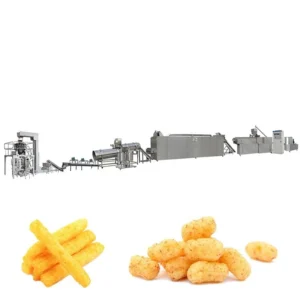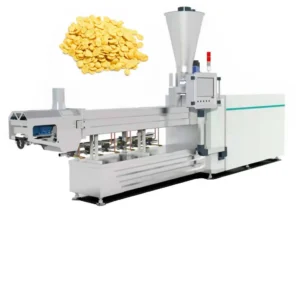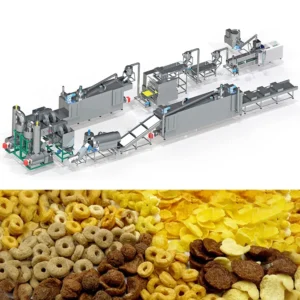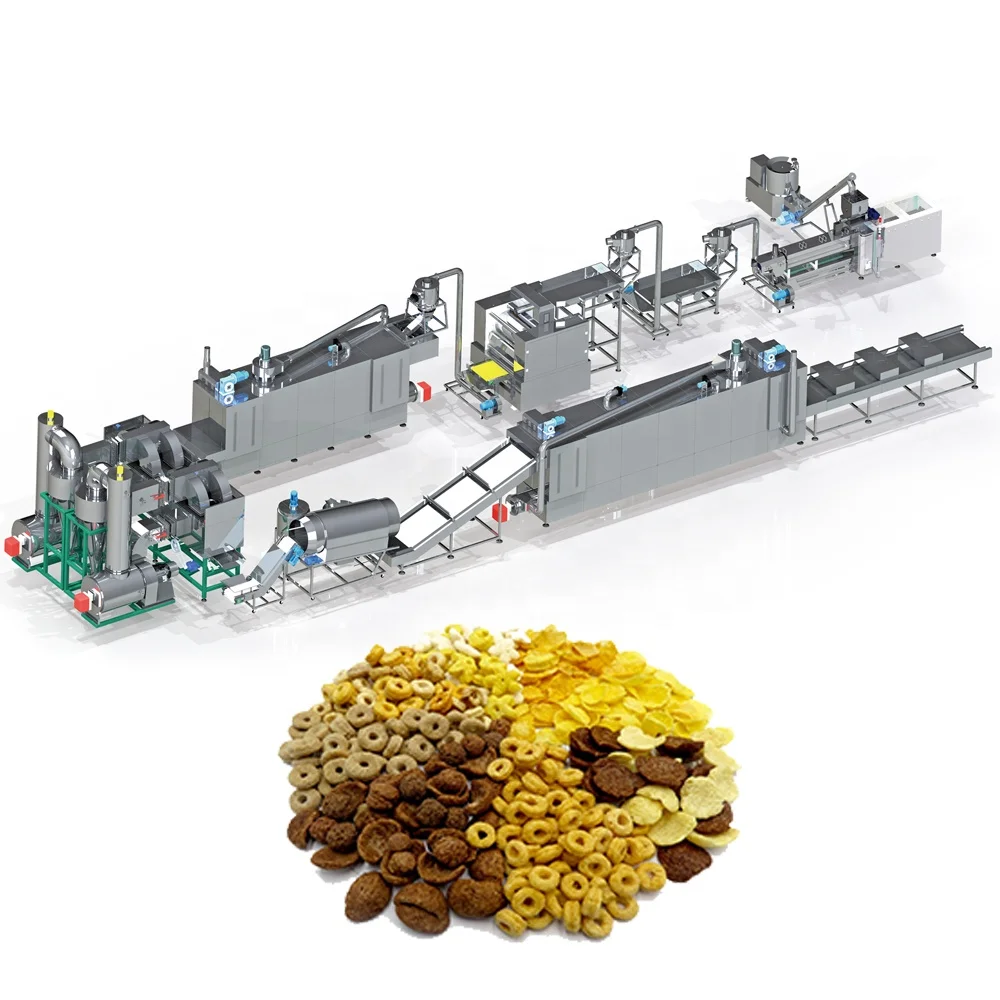
Screw Configuration Matched to Grain — every MT-65 build starts with the buyer’s actual formulation, not a copied template, ensuring starch gelatinisation and expansion behave as predicted at the die face.
Technical Specifications
| Parameter | Value |
|---|---|
| Product Type | Corn Flakes Production Line |
| Model | MT-65 |
| Screw Type | Co-rotating twin-screw, sectional modules |
| Installed Power | 84 kW |
| Real Power Consumption | 59 kW |
| Output Capacity | 120–150 kg/h (basis not stated in source — confirm raw material and moisture) |
| Overall Dimensions | 12000 × 1200 × 2200 mm |
| Control System | PLC and MCC |
| Gear Box Lubrication | Oil forced automatic lubrication |
| Cutting System | Non-stop cutting |
| Self-Cleaning | Twin-screw self-cleaning function |
| Mixer Tank Size | φ600 × 500 mm |
| Mixer Power | 4 kW |
| Screw Conveyor Power | 0.75 kW |
| Corn Flakes Press Power | 16.12 kW |
| Press Roller Size | 510 × 310 × 1050 mm |
| High-Temperature Oven Heating | Gas, both-side baking |
| Sugar Spraying System Power | 28.75 kW |
| Sugar Spraying Roller Size | φ600 × 2700 mm |
Application Suitability
| Application | Material or Output |
|---|---|
| Traditional corn flakes | Corn grits and corn flour at controlled moisture |
| Multi-grain breakfast flakes | Blends of corn, rice, wheat and oat flour |
| Fortified breakfast cereals | Grain base with added vitamin and mineral premix |
| Sweetened flaked cereal | Corn base with sugar or chocolate coating |
| High-fibre cereal formats | Soya bean and peanut blended with corn grits |
What "Nominal Capacity" Leaves Out About Corn Flake Extrusion
A quoted output figure means nothing if the screw profile was never matched to your grain blend.
Many breakfast cereal lines ship with a generic screw and die setup that works on standard corn grits but fails once the buyer introduces oat, wheat or fortified premix into the recipe. The extruder runs, but starch gelatinisation is incomplete, expansion at the die face is inconsistent, and the flake press downstream cannot produce uniform thickness. I have walked into plants in West Africa where the line was technically operational yet the product did not meet local market expectations for bowl life and crispness. The corn flakes extrusion line screw configuration die design must be specified against the exact raw material the buyer will run, not a reference sample [NEED_CITE: starch gelatinisation behaviour across grain types]. Without a trial run on the actual formulation before shipment, commissioning becomes an expensive experiment on the factory floor.
Barrel Temperature Profiling for Starch Gelatinisation
Corn flakes demand a precise gelatinisation window. The co-rotating twin-screw on the MT-65 uses sectional barrel zones, each with independent heating and cooling, so the temperature profile can be stepped to match how corn starch absorbs moisture and shear along the barrel length. Getting this profile wrong means either under-cooked dough that tears at the press or over-cooked dough that loses expansion potential.
Die Geometry and Flake Density Control
The die face is where the extruded rope takes its final cross-section before cutting. Die hole diameter, land length and face plate thickness together determine the rope density entering the flake press. For corn flakes, the target is a rope dense enough to hold together through the rollers but open enough to expand during the high-temperature bake. Our corn flakes extrusion line screw configuration die design is documented per buyer recipe so that die geometry is never a guess.
Reading the Specs That Actually Matter
The 84 kW installed power and 59 kW real consumption gap tells a buyer how much headroom the motor has under normal load versus peak startup. The φ600 × 500 mm mixer tank and 4 kW motor indicate batch size per mix cycle, which must align with the extruder feed rate to avoid starvation or surge. The 16.12 kW flake press with 510 × 310 × 1050 mm rollers and adjustable roller distance gives direct control over flake thickness — a critical variable for bowl life. The gas-heated oven with both-side baking addresses the uneven crispness problem common in single-pass dryers [NEED_CITE: cereal drying uniformity standards]. Oil-forced automatic lubrication on the gear box reduces the risk of bearing failure during continuous shifts.
The Hidden Cost of Skipping Wear Parts
I once commissioned a corn flake line in Nigeria where the buyer declined spare screws and dies at order stage. Three months into production, wear on the forward-flight screw elements caused output to drop and expansion to become erratic. The line sat idle for weeks waiting for international shipping. When wear parts are not on site from day one, a routine replacement turns into an unplanned shutdown. This is why every quotation now includes a wear parts list matched to the screw configuration being shipped.
Why Source This Line Here
The screw configuration and die design are specified to the buyer’s raw material and target flake density before production begins, not copied from a standard build. An in-house testing workshop runs trial production on the buyer’s actual grain blend so that gelatinisation and expansion are verified before the line ships. Throughput is balanced across mixer, extruder, flake press, oven and sugar spraying stations so no single station bottlenecks the line. PLC and MCC control with full electrical schematic documentation means the buyer’s electrician can trace every circuit during commissioning. Pre-sales consultation extends through on-site installation, operator training and ongoing maintenance support [NEED_CITE: twin-screw extrusion commissioning best practices].
Documentation & Verification
- Screw and die configuration record matched to your grain formulation
- Trial run report on your raw material from our testing workshop
- Line layout with capacity calculation across all stations
- Electrical schematic with voltage and frequency confirmation
- CE declaration of conformity for the complete line
- Factory test record with dimensional and functional checks
Installation, Commissioning & Support
- Foundation plan based on 12000 × 1200 × 2200 mm line footprint
- Power supply check against 84 kW installed load and local voltage
- Modular assembly sequence for extruder barrel and screw elements
- First-run parameter setting for barrel temperature and die pressure
- Operator training on PLC interface and MCC safety interlocks
- Wear parts list covering screws, dies and press roller surfaces
Preparing Your Inquiry
Share your grain formulation, including the ratio of corn to secondary grains and any fortification premix. Specify the target flake thickness and the bowl-life expectation for your market. Confirm the voltage, frequency and control language at your facility so that the electrical package is aligned before production starts.
Frequently Asked Questions
Q: How is the screw configuration matched to my grain blend?
A: We review your raw material data sheet, including particle size, moisture and starch content, then select screw element types — forward flight, kneading block, reverse flight — and their sequence along the barrel. A trial run in our testing workshop confirms gelatinisation and expansion before the final configuration is locked.
Q: What barrel temperature profile is used for corn flakes?
A: Corn flakes typically require a stepped profile with lower feed-zone temperatures to prevent premature gelatinisation and higher mid-barrel temperatures to complete starch cooking. The exact set points depend on your corn variety and moisture level, verified during the workshop trial.
Q: Can I run a trial on my raw material before shipment?
A: Yes. Our in-house testing workshop runs your actual grain blend through the configured extruder and flake press. You receive a trial run report documenting expansion ratio, flake thickness and density so that product development starts from a known baseline.
Q: How is throughput balanced across the line?
A: The mixer batch cycle, extruder feed rate, flake press speed, oven residence time and sugar spraying drum rotation are all calculated against the same target output. This prevents any station from starving or surging during continuous operation.
Q: What barrel temperature profile is set for corn flakes versus other cereal formats?
A: Corn flakes require a narrower and higher mid-barrel range compared to puffed snacks, which rely on rapid expansion at the die. Flaked cereals need a denser, more fully cooked rope that can withstand roller compression without tearing, so the thermal profile is adjusted accordingly [NEED_CITE: extrusion thermal profiling for flaked versus puffed cereal formats].