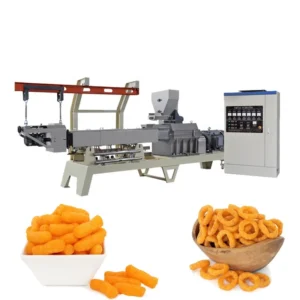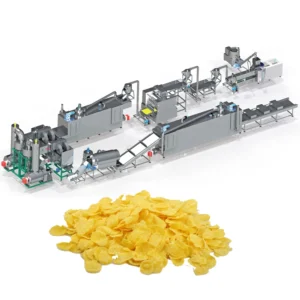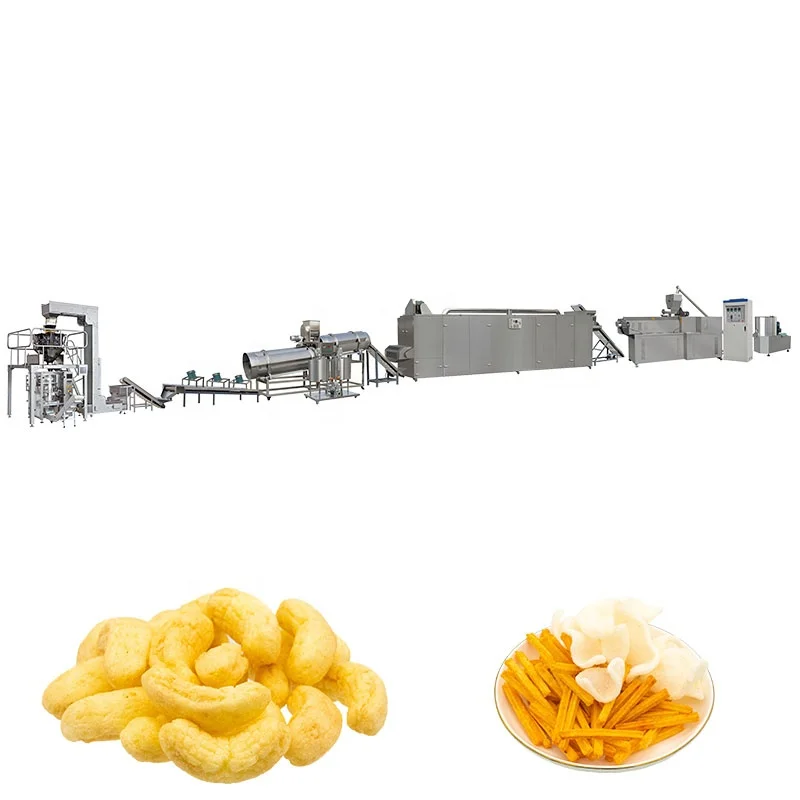
Screw Geometry Matched to Grain — Every barrel section and die orifice specified after testing your actual corn, rice or barley blend, not copied from a generic breakfast cereal build.
Technical Specifications
| Parameter | Value |
|---|---|
| Product Type | Corn Flakes Production Line |
| Models Available | MT70 / MT85 / MT75 |
| Screw Configuration | Twin-screw |
| Control Architecture | PLC with automated MCC integration |
| MT70 Installed Power | 160 kW |
| MT70 Power Consumption | 120 kW |
| MT70 Output Capacity | 150–200 kg/hr (basis not stated in source) |
| MT70 Overall Dimensions | 41 × 1.5 × 2.2 m |
| MT85 Installed Power | 190 kW |
| MT85 Power Consumption | 140 kW |
| MT85 Output Capacity | 300–400 kg/hr (basis not stated in source) |
| MT85 Overall Dimensions | 43 × 1.5 × 3.2 m |
| MT75 Installed Power | 210 kW |
| MT75 Power Consumption | 150 kW |
| MT75 Output Capacity | 300–500 kg/hr (basis not stated in source) |
| MT75 Overall Dimensions | 45 × 1.5 × 3.5 m |
| Flaking Machinery Control | PLC with hydraulic double-roller system and infrared temperature sensor |
| Dryer Heating Source | Gas or Electric (configurable) |
| Roasting Oven | Hot air with conciliation burner, dual circulating fans, cyclone dust removal |
| Coating System | Double tumble sugar melting, elevator, coating drum, spray nozzle |
| Lubrication | Automatic lubricating and cooling function |
| Screw Material | Wear-resistant alloy, proprietary treatment |
| Basic Raw Materials | Corn, rice, wheat, oat, barley powder |
| Assembly State | Complete line from batching to packing |
Application Suitability
| Application | Material or Output |
|---|---|
| Natural corn flakes for retail breakfast cereal | Corn grits and maize flour, target density for bowl stability |
| Sugar-coated and flavoured corn flakes | Corn base with sucrose, honey or chocolate coating |
| Multi-grain extruded breakfast shapes (balls, rings, loops, stars) | Blends of rice, wheat, oat and barley powder |
| Foodservice bulk cereal supply | High-volume natural flake formats for hospitality sector |
| Fortified breakfast cereal production | Grain blends with added vitamin and mineral premix |
What "300 kg/hr" Actually Means for Your Corn Flake Density
A capacity number without the raw material basis and moisture content is a guess, not a guarantee.
I once watched a Middle Eastern client run a lab-scale corn formulation straight onto a full production line without recalculating the screw element arrangement. The flakes came out dense, turned to mush in milk, and the entire trial batch was scrapped. Extrusion capacity figures only hold when matched to your specific grain blend, particle size and conditioning moisture. The same corn flakes extrusion production line that processes 300 kg/hr on coarse corn grits at a given moisture level may behave completely differently on a fine oat-barley blend [NEED_CITE: raw material variability in twin-screw extrusion throughput].
That gap between quoted output and actual yield is where breakfast cereal projects stall. The density, bowl life and surface blistering of your flakes depend on screw geometry and barrel temperature as much as on raw throughput.
Shear, Moisture and Starch Gelatinisation
The twin-screw configuration allows precise control over shear energy and residence time inside the barrel. Corn flakes extrusion production line performance depends on balancing mechanical shear against thermal input to achieve full starch gelatinisation without over-expanding the dough. Barrel sections are zoned with independent heating and cooling so the temperature profile can be adjusted to your grain formulation. Moisture injection points and venting ports let the operator fine-tune the dough plasticity before it reaches the die.
Die Geometry and Flake Formation
The die orifice shape and land length determine the cross-section of the extrudate before it hits the flaking rollers. For traditional corn flakes, a flat ribbon die produces the right thickness for the hydraulic double-roller flaking unit to compress without cracking. For extruded shapes like rings, stars and fruit loops, interchangeable die plates change the product profile in minutes. Infrared sensors on the flaking machinery monitor roller surface temperature to keep flake thickness uniform across the full web width [NEED_CITE: die land length effect on extrudate expansion].
Reading the Specification Sheet
The installed power of 160 kW on the MT70, 190 kW on the MT85 and 210 kW on the MT75 covers the main extruder drive plus auxiliary motors. Power consumption figures — 120 kW, 140 kW and 150 kW respectively — reflect typical running load rather than peak draw. The flaking station uses separate dual motors for independent roller driving, which matters when one roller needs different surface speed to prevent flake tearing. The hot air roasting oven relies on a conciliation burner with two separate circulating fans, giving even heat distribution and consistent surface blistering across the full belt width. Cyclone dust removal on the roaster captures fine particulate before it accumulates in the ductwork.
The Cost of Skipping the Trial Run
Running an untested formulation on a line that was configured for a different grain blend wastes raw material, burns energy and produces off-spec product that cannot be sold. Dense flakes that disintegrate in milk, under-roasted flakes that lack crispness, or sugar coatings that crystallise unevenly all trace back to process parameters set without real material data. When screw elements and die design are specified generically, the operator spends weeks adjusting on-site instead of producing saleable inventory [NEED_CITE: commissioning delays from mismatched screw configuration].
Why Source This Line From Jinan
Screw element arrangement and die design are calculated against your specific raw material blend, not pulled from a standard library. The in-house testing workshop runs your actual corn, rice or barley formulation before the line ships, so the trial run report documents real output and real flake quality. Every station — extruder, dryer, flaking rollers, roasting oven and coating drum — is sized to match, preventing bottlenecks that occur when stations are sourced from separate vendors. PLC and MCC control language, voltage and frequency are confirmed before production starts. CE and ISO certification covers the full line assembly.
Documentation & Verification
- Screw and die configuration record listing exact element arrangement for your grain blend
- Trial run report on your raw material documenting flake density, expansion and texture
- Line layout with capacity calculation showing throughput balance across every station
- Electrical schematic and voltage confirmation matched to your factory supply
- CE declaration of conformity and ISO certificate for the complete line assembly
Installation, Commissioning & Support
- Floor plan review confirming the 41–45 m line length fits your facility with utility clearances
- Power supply verification for 160–210 kW installed load before the extruder is energised
- Hydraulic system commissioning on the flaking rollers with pressure set to your target flake thickness
- PLC parameter upload in your preferred language covering all barrel zones and roasting temperatures
- Wear parts list specifying screw elements, die plates and roller shells with reorder intervals
- Operator training on moisture adjustment and barrel temperature profiling for different grain blends
Before You Request a Quote
Share your raw material formulation including grain type, particle size distribution and target moisture content at the extruder inlet. Specify whether your market expects natural flakes, sugar-coated variants or both, along with the bowl-life performance your retail or foodservice customers require. Confirm your factory voltage, frequency and the control language your operators need.
Frequently Asked Questions
Q: How is the screw configuration decided for my grain blend?
A: We run your actual raw material through our testing workshop before finalising the build. The screw element arrangement, barrel temperature profile and die orifice are all adjusted based on trial data — starch gelatinisation degree, expansion ratio and flake density are measured and documented in the trial run report.
Q: Can I test my own formulation before the line ships?
A: Yes. The in-house testing workshop accepts your raw material for trial runs before dispatch. You receive a documented report covering output rate, flake density, texture and roasting behaviour, so process parameters are locked in before the line reaches your factory.
Q: How do you prevent bottlenecks between stations?
A: Every station — extruder, dryer, flaking unit, roasting oven and coating drum — is capacity-matched during line layout design. The throughput calculation ensures no single station restricts the others, which is a common problem when equipment is sourced from separate vendors.
Q: What electrical details are confirmed before production starts?
A: Voltage, frequency, plug type and PLC control language are confirmed during the specification review. The electrical schematic is matched to your factory supply, so there are no rewiring delays during commissioning [NEED_CITE: industrial voltage standards by region].