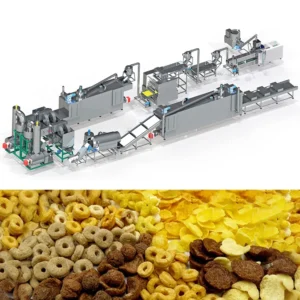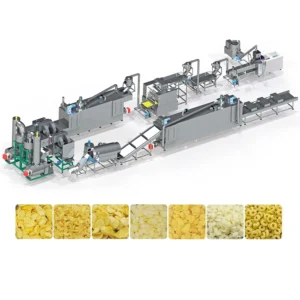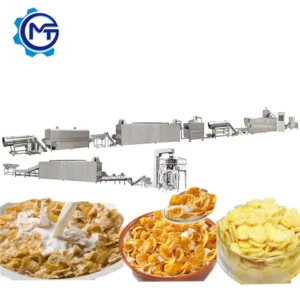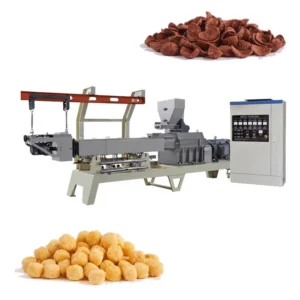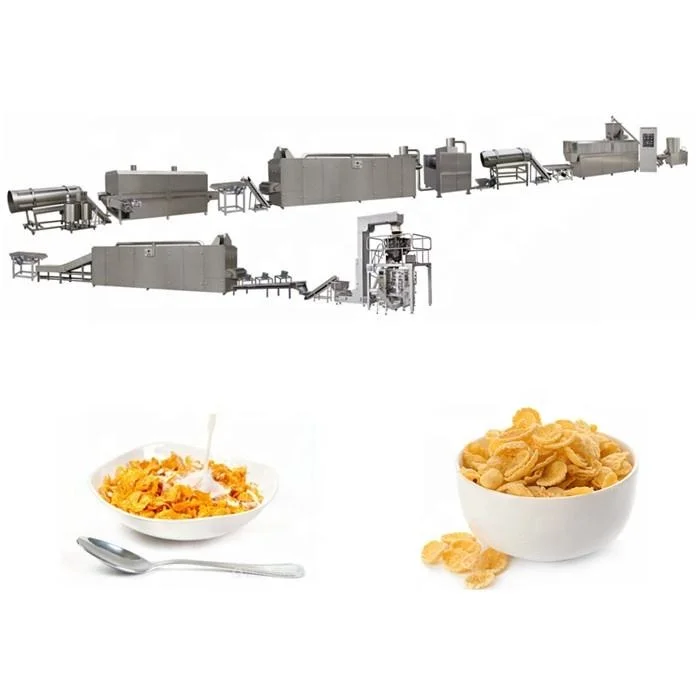
Extrusion Process Mastery — screw configuration and barrel temperature profiles are specified to your raw material, ensuring target starch gelatinisation and flake density before the line ships.
Technical Specifications
| Parameter | Value |
|---|---|
| Product Type | Corn Flakes Production Line |
| Model Options | MT70 / MT85 / MT75 |
| Screw Type | Twin-screw |
| Installed Power | 160 kW (MT70) / 190 kW (MT85) / 210 kW (MT75) |
| Power Consumption | 120 kW (MT70) / 140 kW (MT85) / 150 kW (MT75) |
| Output Capacity | 150–200 kg/h (MT70) / 300–400 kg/h (MT85) / 300–500 kg/h (MT75) (basis not stated in source) |
| Overall Dimensions | 41 × 1.5 × 2.2 m (MT70) / 43 × 1.5 × 3.2 m (MT85) / 45 × 1.5 × 3.5 m (MT75) |
| Control System | PLC (flaking machinery); MCC (extruder) |
| Flaking Machinery | Hydraulic double-roller system with separate dual-motor drive and infrared temperature sensing |
| Dryer Heating Source | Gas or electric (selectable) |
| Roasting Oven | Hot air roasting with vibrating pan, conciliation burner, dual circulating fans, cyclone dust removal |
| Coating System | Double tumble sugar melter, elevator, coating drum, spraying nozzle |
| Lubrication | Automatic lubricating and cooling function |
| Certification | CE |
Application Suitability
| Application | Material or Output |
|---|---|
| Natural corn flakes | Corn grits, corn flour, blended cereal meals |
| Sugar-coated corn flakes | Corn-based pellets with sugar or honey glaze |
| Multi-shape breakfast cereals | Rice, wheat, oat, barley powder via die change (balls, tubes, rings, stars, fruit loops) |
| Fortified cereal flakes | Vitamin- and mineral-enriched grain formulations |
What "Rated Capacity" Hides About Your Actual Grain Formulation
A line that runs corn grits at 300 kg/h on the factory floor may drop to half that throughput when your local maize has different particle size and moisture content.
This gap between nameplate capacity and real output is the single most common reason breakfast cereal producers face delays after commissioning. The twin-screw extruder, flaking rollers, dryer, and roasting oven must each be configured for the specific starch behaviour of the buyer’s grain. I have stood beside extruders in tropical mills watching operators push feed rates higher only to see the flakes emerge under-gelatinised and brittle, because the barrel temperature zones were set for a completely different raw material [NEED_CITE: starch gelatinisation thresholds vary across corn varieties and moisture levels].
Matching Screw Geometry to Starch Gelatinisation Behaviour
The degree of starch gelatinisation inside the barrel determines whether a corn flake holds together during pressing and roasting or crumbles into fines. A corn flakes extrusion production line turnkey installation must use a screw configuration that delivers the correct residence time, shear intensity, and moisture distribution for the specific cereal blend entering the feed hopper. The MT70, MT85, and MT75 models accommodate different throughputs, but screw element sequencing is adjusted per formulation — not copied from a generic build.
Barrel Zone Profiling and Moisture-Shear Balance
Each barrel section is independently heated, allowing the temperature curve to be shaped from the feed zone through the metering and high-shear cooking zones to the die plate. On one installation in South Asia, the buyer’s locally milled corn had lower moisture and finer particle size than the standard test grits. The flakes cracked under the roller because gelatinisation was incomplete at the die. After three days of reconfiguring screw elements and adjusting the barrel temperature profile zone by zone, the target crispness and bowl-life were restored. That kind of parameter tuning is why an in-house trial run on the buyer’s actual raw material is non-negotiable before the corn flakes extrusion production line turnkey system leaves the workshop [NEED_CITE: barrel temperature profiling for cereal extrusion].
Reading the Specs That Matter for Flake Consistency
The hydraulic double-roller flaking station uses separate motors for each roller, which means roller gap and differential speed can be adjusted independently to achieve uniform flake thickness without tearing. Infrared temperature sensors on the roller surfaces prevent overheating that would cause sticking or surface scorching. The roasting oven’s conciliation burner, combined with two independent circulating fans, produces the surface blistering that gives corn flakes their characteristic texture while the cyclone dust removal keeps fines out of the product stream. Installed power ranges from 160 kW on the MT70 to 210 kW on the MT75, and actual consumption during steady-state running is lower — 120 kW to 150 kW depending on model and thermal load. The PLC governing the flaking machinery maintains roller pressure and temperature within set tolerances across long production runs, which directly affects batch-to-batch flake density consistency.
The Downstream Bottleneck Nobody Quoted For
An extruder that delivers consistent output means nothing if the dryer cannot remove moisture fast enough or the roasting oven cannot handle the volumetric flow. When the flaking station, dryer, and roaster are sourced from separate vendors, throughput mismatches emerge only during commissioning. On a line I helped start up in West Africa, a roaster with a single circulating fan created an uneven heat distribution that left flakes on one side of the pan under-toasted while the other side scorched. The dual-fan design with independent air circuits in the roasting oven specified here prevents that failure mode, but it must be sized correctly against the extruder’s actual output from the start [NEED_CITE: thermal load balancing in cereal drying and roasting].
Why Procure the Extrusion Process From One Source
The screw configuration and die design are specified against the buyer’s raw material sample and target flake density, not pulled from a generic template. Every station — mixing, extrusion, flaking, drying, roasting, coating, cooling, packing — is throughput-matched so that no single machine constrains the line below its designed capacity. An in-house testing workshop conducts trial runs on the buyer’s actual grain formulation before dispatch, generating a documented trial run report. Pre-sales engineering covers line layout and capacity calculation, and post-delivery support includes on-site installation, commissioning, and operator training. Voltage, frequency, and control language are confirmed against the destination market before production begins, preventing the commissioning delays that arise when electrical systems do not match local supply [NEED_CITE: industrial voltage and frequency standards by region].
Documentation & Verification
- Line layout drawing with throughput matched across every station from mixer to packer
- Screw and die configuration record specific to your grain formulation and target flake density
- Trial run report on your raw material documenting expansion, moisture, and texture data
- Electrical schematic confirming voltage, frequency, and control language for your facility
- Factory test record with running parameters logged before crating
- CE declaration of conformity covering the complete production line
Installation, Commissioning & Support
- Foundation plan accounting for the full line length up to 45 m with vibration isolation at the flaking station
- Dedicated power circuits sized for the installed load up to 210 kW with the confirmed local voltage and frequency
- MCC and PLC panels pre-wired and labelled; field connections limited to inter-station cabling
- First-run parameter setting including barrel zone temperatures, roller gap, and roasting oven air balance
- Operator training covering screw element inspection, hydraulic system maintenance, and infrared sensor calibration
- Wear parts list with replacement intervals for screws, dies, and roller surfaces
What to Include With Your Inquiry
To prepare an accurate line configuration, share your raw material specification including grain type, particle size distribution, and typical moisture content. Provide your local voltage and frequency, the control language your operators require, and the target daily output in finished product weight. If you are replacing or expanding an existing line, note the upstream and downstream equipment that must be integrated.
Frequently Asked Questions
Q: How is output capacity verified against my raw material formulation?
A: Capacity figures are established during a trial run using your actual grain sample in our testing workshop. We document the achievable throughput at the target moisture, texture, and flake density rather than quoting a generic nameplate figure. The trial run report accompanies the shipment so your team has the validated parameters from day one.
Q: How are screw configuration and die design chosen for my product?
A: The screw element sequence is designed around your grain’s starch gelatinisation temperature and the moisture content at the feed point. Die aperture and land length are then matched to produce the pellet shape and density required before flaking. This configuration is recorded and provided as part of the line documentation.
Q: What barrel temperature profile is used for corn flakes?
A: The profile is zone-specific and set during the trial run. Typically, feed zones run cooler to prevent premature gelatinisation and bridging, while metering and cooking zones ramp progressively higher. The exact curve depends on your corn variety, particle size, and moisture, which is why running your actual material is essential before locking in the profile.
Q: How is throughput balanced across the extruder, flaking mill, dryer, and roaster?
A: Each station is selected so its maximum sustained throughput matches or slightly exceeds the extruder’s verified output on your material. The flaking roller width, dryer belt area, and roasting oven pan volume are all calculated against the same target capacity, preventing bottlenecks that arise when equipment is sourced separately.
Q: Can a trial run be performed before shipment?
A: Yes. We run your raw material through the extruder and flaking station in our testing workshop before the line ships. The trial confirms screw configuration, barrel profile, roller gap, and resulting flake texture. You receive the trial run report with all recorded parameters for your production team to reference during commissioning.