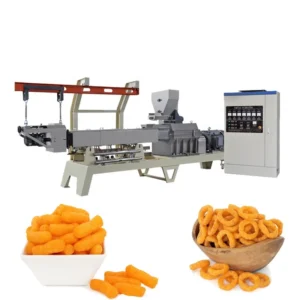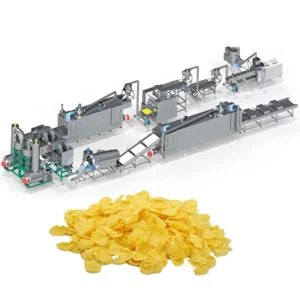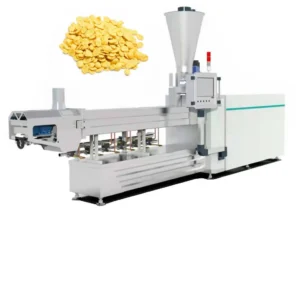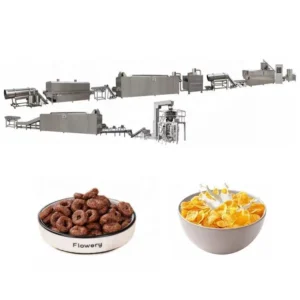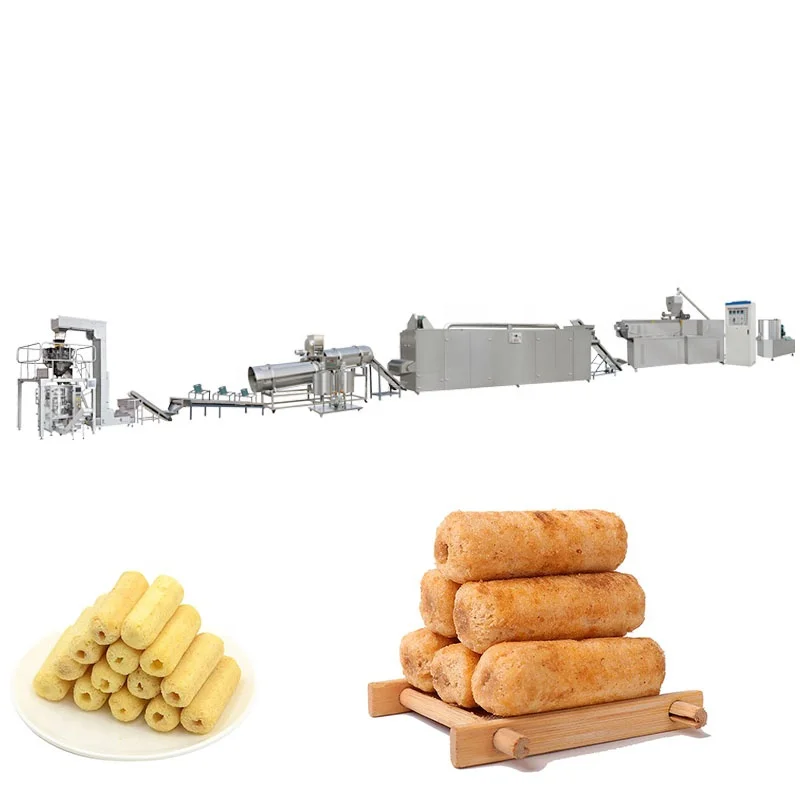
Screw Configuration Matched to Raw Material — Our in-house testing workshop verifies corn flakes expansion and density on your exact cereal blend before the extruder ships, preventing texture failures on the production floor.
Technical Specifications
| Parameter | Value |
|---|---|
| Model | MT70 / MT85 / MT75 |
| Product Type | Corn Flakes Making Machine / Breakfast Cereal Extruder |
| Screw Type | Twin-screw |
| Installed Power | 160 kW (MT70) / 190 kW (MT85) / 210 kW (MT75) |
| Power Consumption | 120 kW (MT70) / 140 kW (MT85) / 150 kW (MT75) |
| Capacity | 150–200 kg/h (MT70) / 300–400 kg/h (MT85) / 300–500 kg/h (MT75) (basis not stated in source) |
| Basic Material | Powder of corn, rice, wheat, oat, barley |
| Overall Dimensions | 41 × 1.5 × 2.2 m (MT70) / 43 × 1.5 × 3.2 m (MT85) / 45 × 1.5 × 3.5 m (MT75) |
| Control System | PLC control system |
| Flaking Machinery Capacity | 200–300 kg/h |
| Dryer Heating Source | Gas, Electric |
| Production Procedure | Mixing, Extruding, Flaking, Roasting, High temperature inflating, Sugar-coating, Roasting, Cooling, Packing |
| Key Features | Automatic lubricating, cooling function, hydraulic system for double rollers, double motors for separate roller driving, infrared sensor temperature control |
Application Suitability
| Application | Material or Output |
|---|---|
| Natural corn flakes production | Corn grits and corn flour blends |
| Sugar-coated breakfast cereals | Corn, rice, and wheat base with syrup coating |
| Multi-grain cereal flakes | Blends of oat, barley, wheat, and corn |
| Shaped breakfast cereals | Ball, tube, ring, star, and fruit loop formats via die changes |
| Fortified cereal lines | Cereal powder with added vitamin and mineral premix |
Why Corn Flakes Extrusion Technology Demands More Than a Generic Screw Profile
The wrong screw configuration turns a cereal line into a scrap conveyor.
I spent four days on a factory floor in Southeast Asia watching a breakfast cereal line produce nothing but broken flakes. The trial runs back at the vendor’s workshop used pure corn flour, and the output looked perfect. But the actual production recipe included oat and barley, which changed the starch gelatinisation behaviour entirely. The expansion dropped, the sheet density went out of spec, and every flake that came off the roller shattered during roasting. We replaced the full screw combination and die set before the line could produce sellable product [NEED_CITE: starch gelatinisation behaviour across different cereal grains during twin-screw extrusion]. This is the gap that corn flakes extrusion technology has to close — matching the mechanical shear and residence time to the specific raw material blend the buyer will actually run, not a laboratory ideal.
Screw Configuration and Starch Gelatinisation Control
The twin-screw design in the MT70, MT85, and MT75 series allows modular screw element arrangement along the barrel. Each zone can be set for conveying, kneading, or metering, which directly controls how thoroughly the cereal starch gelatinises before the material reaches the die. Corn flour gelatinises at a different temperature and moisture threshold than oat or wheat, so the corn flakes extrusion technology must be tuned through screw pitch and kneading block angle rather than relying on a fixed profile. Getting this wrong means under-cooked starch that won’t flake properly, or over-sheared material that loses all structure.
Barrel Temperature Profile and Moisture Management
Barrel heating zones work together with steam or water injection to manage the dough moisture through each section of the extruder. Corn-based recipes generally need a steady temperature climb to achieve full gelatinisation without premature expansion inside the barrel. When the recipe shifts to multi-grain blends containing oat or barley, the moisture absorption rate changes and the temperature profile needs adjustment [NEED_CITE: barrel temperature profiling for multi-grain breakfast cereal extrusion]. The PLC control system on these models allows operators to store and recall temperature sets for different recipes, reducing the changeover guesswork between natural corn flakes and sugar-coated variants.
Die Design and Flake Density Specification
The die plate determines the cross-section of the extruded rope before it passes through the flaking rollers. For natural corn flakes, the die opening and rope diameter must produce a sheet that compresses to the target thickness without cracking at the edges. Sugar-coated cereals demand a slightly different density because the coating adds weight and changes the bowl-life expectation. The breakfast cereal extruder process relies on die geometry matched to the roller gap and roasting temperature, not a one-size-fits-all opening. We specify die design based on the buyer’s target flake dimension and final packaging weight.
Reading the Power and Capacity Figures
The installed power ranges from 160 kW on the MT70 to 210 kW on the MT75, with power consumption rated proportionally lower. These numbers reflect the motor load needed to maintain screw RPM under the viscous resistance of cereal dough. The flaking machinery runs at 200–300 kg/h capacity, which must be matched to the extruder output to prevent bottlenecks [NEED_CITE: throughput balancing between extrusion and flaking stations in cereal lines]. The hot air roasting oven uses vibrating pans with high-temperature spraying tubes and cyclone dust removal, meaning the thermal capacity must also align with the upstream throughput. Any mismatch between these stations shows up as either idle roaster time or extruder back-pressure.
The Hidden Cost of Skipping the Trial Run
Buying an extruder on paper capacity without a trial run on your actual raw material is where most cereal line failures start. The screw configuration that works on pure corn flour can produce completely different expansion and density results when oat, rice, or barley enters the recipe. I have seen lines shipped overseas with a generic screw build that required a full reconfiguration after installation, costing weeks of lost production and air-freighted replacement parts [NEED_CITE: post-installation screw reconfiguration costs in food extrusion projects]. The breakfast cereal extruder process only stabilises when every element — screw profile, die geometry, barrel temperature, and moisture injection — is validated against the real production blend.
Why Source This Line From Meiteng
Complete line throughput matching from mixing through extrusion, flaking, roasting, coating, and packing means no station bottlenecks the next. Screw configuration and die design are specified to the buyer’s raw material and target flake characteristics rather than copied from a standard build. The in-house testing workshop runs trial production on customer-supplied cereal blends before the equipment leaves the factory. Twin-screw expertise covers corn flakes, multi-grain cereals, and shaped breakfast cereal formats across the same platform. Pre-sales engineering through on-site installation, commissioning, and operator training ensures the line reaches stable production under local conditions.
Documentation & Verification
- Line layout and capacity calculation matching extruder output to flaking and roasting throughput
- Screw and die configuration record specific to your cereal blend and target flake density
- Trial run report on customer raw material conducted in the testing workshop before dispatch
- Electrical schematic with voltage and frequency confirmed for the destination market
- CE declaration of conformity and ISO certificate for import clearance
- Operation and maintenance manual covering screw replacement intervals and barrel cleaning procedures
Installation, Commissioning & Support
- Foundation planning based on the 41–45 m overall line length and individual station weight distribution
- Dedicated electrical circuit sized for 160–210 kW installed power depending on the selected extruder model
- Modular extruder and flaking station delivery allowing assembly in workshops with standard ceiling clearance
- First-run parameter setting covering barrel temperature zones, screw speed, and moisture injection rates
- Operator training on PLC recipe storage for switching between natural and sugar-coated corn flakes production
- Wear parts list specifying screw elements, die plates, and flaking roller surfaces with recommended replacement intervals
- Scheduled maintenance plan aligned with automatic lubricating system intervals and hydraulic roller inspections
What We Need to Quote Your Line Accurately
Send us your cereal recipe with the percentage breakdown of corn, rice, wheat, oat, or barley in the blend. Confirm your target flake dimensions, final packaging weight, and whether the line needs to produce both natural and sugar-coated variants. We also need your workshop voltage and frequency, available floor space with ceiling height, and the preferred control language for the PLC interface so commissioning goes smoothly on arrival.
Frequently Asked Questions
Q: How does screw configuration affect corn flakes expansion and final density?
A: The arrangement of conveying, kneading, and metering elements along the twin-screw determines how much mechanical shear and heat the cereal dough receives before reaching the die. More kneading blocks increase starch gelatinisation, which raises expansion at the die exit. We configure the screw profile based on your specific grain blend and the target flake density your market requires.
Q: What barrel temperature zones are needed for proper starch gelatinisation?
A: Corn-based recipes typically need a progressive temperature increase across the barrel zones to achieve full gelatinisation without premature expansion. Multi-grain blends with oat or barley absorb moisture differently and need adjusted zone settings. The PLC control system stores separate temperature profiles so operators can switch recipes without manual recalibration.
Q: How does die design differ between natural and sugar-coated corn flakes?
A: Natural corn flakes require a die opening that produces a rope compressing to the target thickness without edge cracking during flaking. Sugar-coated variants need a slightly different density to account for the coating weight and maintain acceptable bowl-life. Die geometry is selected based on your flake dimension and the roasting temperature profile.
Q: Why is a trial run on my raw material important before shipment?
A: Generic screw builds tested on pure corn flour may produce different expansion and density results when your actual recipe includes oat, barley, or rice. Our testing workshop runs your supplied raw material through the configured extruder, verifying flake quality and line throughput before the equipment ships. This prevents costly reconfiguration after installation.
Q: How do I verify the extruder capacity matches my cereal blend?
A: Published capacity figures are based on standard conditions and may not reflect your specific raw material behaviour. We confirm throughput by running your blend in the testing workshop and documenting the actual output alongside screw speed, barrel temperature, and moisture parameters. This report accompanies the machine specification sheet.