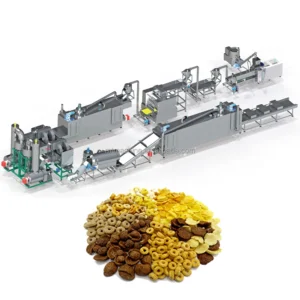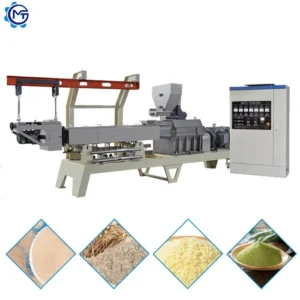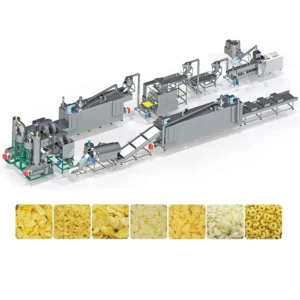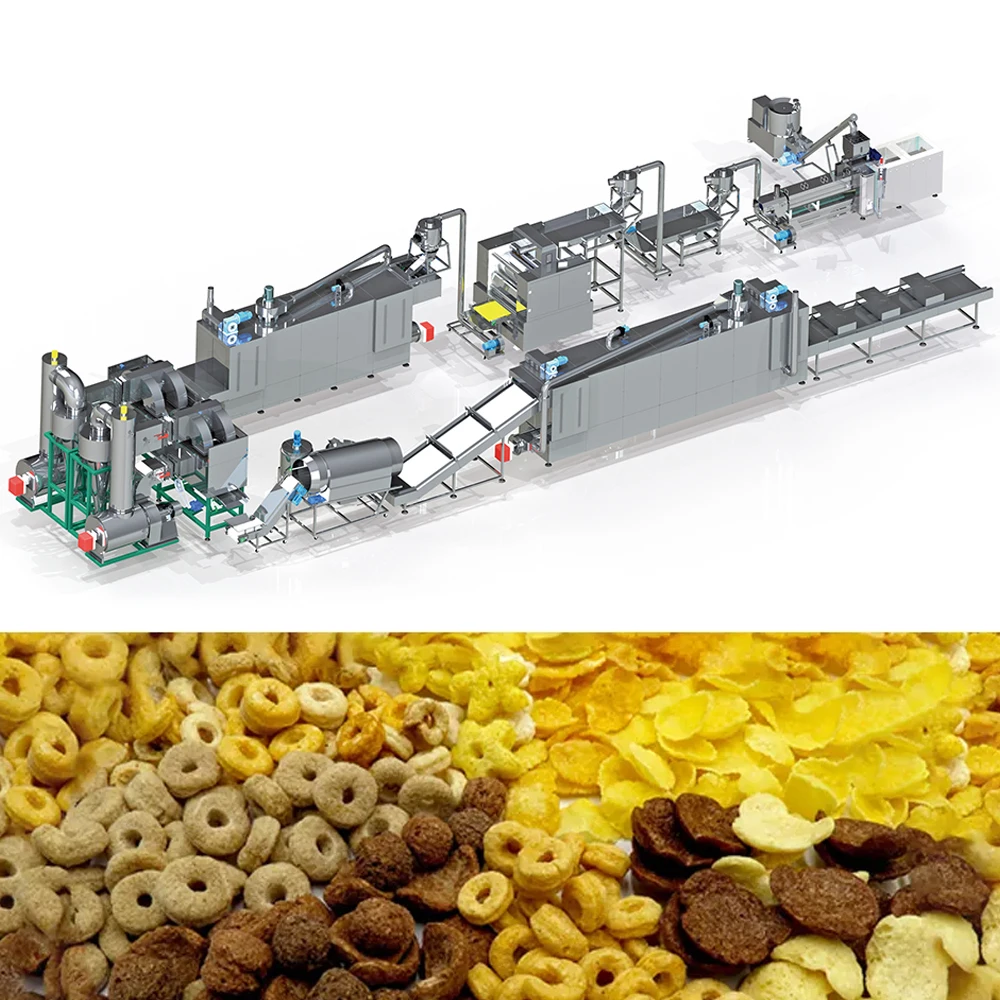
Screw Geometry Specified to Your Grain — Every barrel zone, flight depth, and die land length is calculated from your corn grits formulation rather than copied from a generic breakfast cereal build, ensuring the twin-screw extruder achieves full starch gelatinisation on your specific raw material.
Technical Specifications
| Parameter | Value |
|---|---|
| Product Type | Corn Flakes Breakfast Cereal Production Line |
| Model Options | MT70 / MT85 / MT75 |
| Installed Power (MT70 / MT85 / MT75) | 160 kW / 190 kW / 210 kW |
| Power Consumption (MT70 / MT85 / MT75) | 120 kW / 140 kW / 150 kW |
| Output Capacity (MT70) | 150–200 kg/h (basis not stated in source — confirm raw material formulation and moisture content) |
| Output Capacity (MT85) | 300–400 kg/h (basis not stated in source — confirm raw material formulation and moisture content) |
| Output Capacity (MT75) | 300–500 kg/h (basis not stated in source — confirm raw material formulation and moisture content) |
| Overall Dimensions (MT70 / MT85 / MT75) | 41 × 1.5 × 2.2 m / 43 × 1.5 × 3.2 m / 45 × 1.5 × 3.5 m |
| Extruder Type | Twin Screw |
| Screw Material | Wear-resistant special alloy |
| Control System | PLC with automatic lubricating and cooling |
| Flaking Machinery | Hydraulic double-roller system, dual motors, infrared sensor temperature control |
| Dryer Heating Source | Gas or electric (configurable) |
| Roasting Oven | Hot air, vibrating pan, dual circulating fans, cyclone dust removal |
| Coating System | Double tumble drum with sugar melting, elevator, spraying nozzle |
| Line Sequence | Mixing → Extrusion → Molding/Cutting → Drying → Flaking → Hot Air Roasting → Sugar Coating → Seasoning |
| Warranty | 24 months with lifetime service |
| Certification | CE |
Application Suitability
| Application | Material or Output |
|---|---|
| Traditional corn flakes | Degermed corn grits, plain or sugar-coated |
| Chocolate breakfast cereal | Corn and cocoa-blended grain formulations (e.g., Chocapic-style) |
| Multi-grain extruded cereal shapes | Blends of corn, rice, wheat, or oat flour |
| Fortified breakfast flakes | Grain base with vitamin and mineral premix additions |
When "300 kg/h" Means Nothing on Your Raw Material
The capacity figure only holds if the screw configuration and barrel temperature profile match the specific grain formulation and moisture content running through the extruder.
I have watched a line stall for three days because the corn grits arriving at the hopper were coarser than the flour used during the factory test. Starch gelatinisation dropped, the extrudate came out under-expanded, and the flakes cracked at the flaking rolls. The rated throughput became irrelevant when half the output was rejected. This is why corn flakes extrusion technology demands a material-specific screw build and a documented trial before any capacity claim means anything [NEED_CITE: starch gelatinisation degree and residence time correlation in twin-screw extrusion].
Barrel Temperature Mapping Across Zones
Starch gelatinisation in a corn flakes breakfast cereal extrusion line is not a single temperature event. It unfolds across multiple barrel zones, each set to a different profile point. Feed intake zones stay cooler to prevent premature gelation and bridging, while the mid-barrel zones climb to initiate starch breakdown. The final metering zone drops slightly to stabilise melt viscosity before the die. Automatic lubricating and cooling on the MT75, MT70, and MT85 extruders keeps these zone boundaries stable during long production runs, preventing heat creep that would otherwise shift the expansion ratio.
Die Geometry and Expansion Control
The die land length and orifice diameter determine how much the extrudate expands as it exits into ambient pressure. For corn flakes destined for a flaking station, you need a controlled, moderate expansion — enough to create a porous internal structure but not so much that the pellet shatters under the hydraulic double-roller system. Die design must account for your specific moisture content and grain particle size. A coarser degermed corn grit typically requires a longer die land to build sufficient back-pressure and uniform expansion across every strand [NEED_CITE: die land length and melt pressure relationship in food extrusion].
Reading the Spec Sheet Against Your Process
The installed power figures — 160 kW for the MT70, 190 kW for the MT85, 210 kW for the MT75 — tell you the thermal and mechanical energy budget available. Higher installed power gives the screw more shear energy to impart into denser or higher-moisture formulations, which matters when you switch from standard corn grits to a multi-grain blend. The L:D ratio and screw element arrangement determine residence time, which directly governs the degree of starch conversion. PLC control logs zone temperatures and screw speed, giving process engineers repeatable batch data rather than relying on operator intuition.
The Cost of Skipping the Raw Material Trial
When a line ships without a documented trial run on your actual grain formulation, the first week of production becomes an expensive experiment. Screw elements get swapped, barrel zones re-mapped, and flaking pressure adjusted — all while raw material accumulates as waste. I have seen operators burn through days of corn grits before dialling in a configuration that should have been locked down at the factory. The downstream stations — the dryer, the roasting oven, the coating drum — all assume a consistent pellet density arriving from the extruder, and when that density varies, every station drifts off specification simultaneously [NEED_CITE: throughput mismatch between extrusion and downstream drying in cereal lines].
What Separates a Configured Line from a Catalogue Build
Screw configuration and die design are matched to your raw material and target flake density, not pulled from a template used across every cereal line that leaves the factory. The in-house testing workshop runs your actual corn grits or grain blend before shipment, producing a trial report that documents expansion ratio, moisture loss, and pellet integrity at the die exit. Every station — from the batching mixer through the hot air roasting oven to the double tumble coating drum — has its throughput calculated to match the extruder output, so no single station bottlenecks the line. The PLC-controlled flaking machinery uses infrared sensor temperature regulation to keep roller surface conditions stable, protecting flake thickness consistency throughout a shift. Pre-sales engineering covers line layout, utility planning, and voltage confirmation before production begins, reducing the chance of commissioning delays tied to electrical mismatches.
Documentation & Verification
- Screw and die configuration record specifying element arrangement for your grain formulation
- Trial run report on customer-supplied raw material documenting expansion and moisture data
- Line layout with capacity calculation matching every station from mixer to packing
- Electrical schematic with voltage and frequency confirmed for destination market
- Machine specification sheet listing barrel zone count, L:D ratio, and die geometry
- CE declaration of conformity for export compliance
Installation, Commissioning & Support
- Foundation plan accounts for the MT75 line length reaching up to 45 metres with utility trench routing
- Dedicated electrical circuit sized for the 210 kW installed power draw on the MT75 extruder
- Modular station delivery allows phased assembly matching your workshop access constraints
- First-run commissioning includes barrel zone calibration and flaking roller pressure setting
- Operator training covers PLC interface navigation and automatic lubricating system monitoring
- Wear parts list identifies screw elements and die plates with replacement intervals
What to Share With Your Inquiry
To size the screw configuration and match downstream station capacity, we need your raw material specification including grain type, particle size distribution, and target moisture content at the hopper. Share your intended daily output volume and the flake format you are producing — plain, sugar-coated, or chocolate-enroached — so the coating drum and roasting oven can be scaled accordingly. Local voltage, frequency, and preferred control language determine the electrical build and PLC configuration before production starts.
Frequently Asked Questions
Q: How is screw configuration selected for different grain formulations and target flake densities?
A: The screw element sequence — conveying flights, kneading blocks, and reverse elements — is arranged based on your grain type, particle size, and the starch gelatinisation degree required. Coarser grits need longer residence and more shear energy, while fine flours require gentler handling to avoid over-gelatinisation. Each configuration is documented and validated during the in-house trial run.
Q: What barrel temperature profile and moisture range are required for proper starch gelatinisation in corn flakes?
A: Corn flakes typically require barrel zones ramping from around 40°C at the feed section up through the mid-barrel, with moisture content at the barrel between 25% and 32%. The exact profile depends on your specific corn variety and particle size. The PLC system records and holds these parameters for batch-to-batch repeatability.
Q: How do you verify that the extruder’s nominal capacity holds on my specific raw material?
A: Before shipment, your raw material runs through the extruder in the testing workshop. The trial report documents actual throughput, expansion ratio, moisture loss, and pellet integrity. This data confirms whether the screw and die configuration delivers the rated output on your formulation rather than on a generic reference material.
Q: What is the relationship between die design, expansion ratio, and final flake thickness after the flaking station?
A: The die orifice diameter and land length control how much the extrudate expands at exit. Moderate expansion produces a pellet that flattens evenly under the hydraulic double rollers into a uniform flake. Over-expansion makes the pellet too fragile, causing it to crack rather than flatten. Die geometry is selected to match your target flake thickness and texture.
Q: How does the hot air roasting stage affect surface bubble formation and crispness?
A: The roasting oven uses high-temperature air circulated by dual fans to rapidly dry the flake surface, creating characteristic micro-bubbles that define crispness. Temperature, air velocity, and residence time on the vibrating pan are tuned so the surface blisters without scorching, while the cyclone dust removal keeps fines from recirculating and contaminating the product bed.