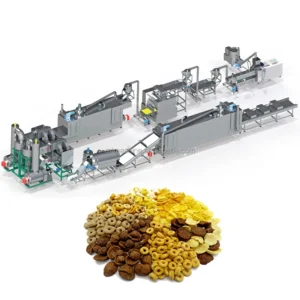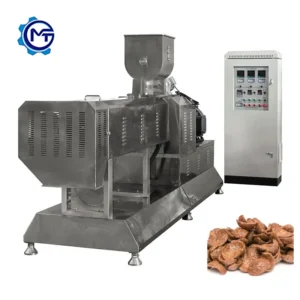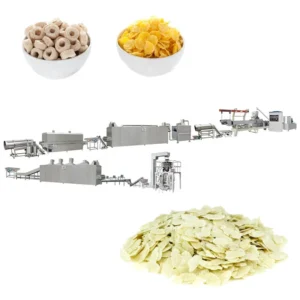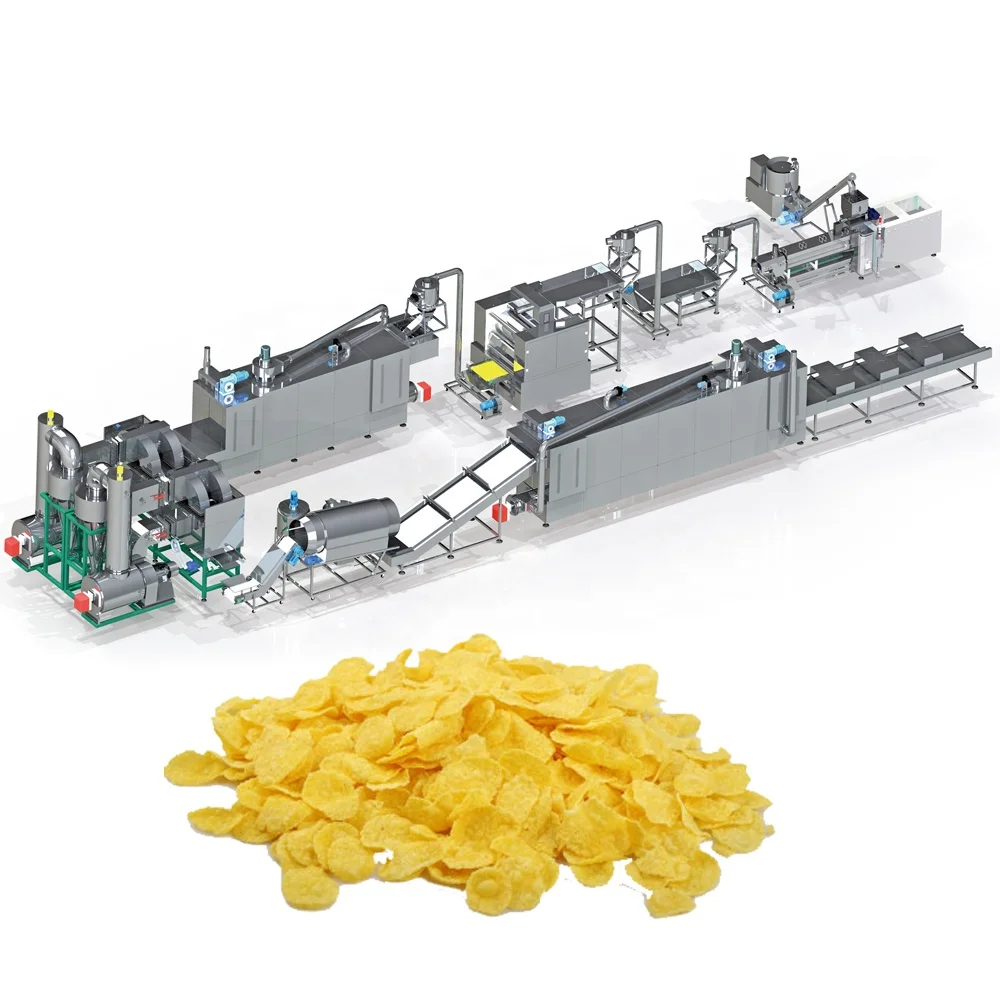
Matched Screw and Die Configuration — Every MT70, MT85, and MT75 unit is set up with screw elements and die geometry aligned to the buyer’s actual grain blend and target flake density, not a generic build.
Technical Specifications
| Parameter | Value |
|---|---|
| Product Type | Twin Screw Extruder for Corn Flakes and Breakfast Cereal Production Line |
| Model Options | MT70, MT85, MT75 |
| Screw Type | Twin screw (double screw extruder) |
| Control System | PLC control system; MCC for line integration |
| MT70 Installed Power | 160 kW |
| MT70 Power Consumption | 120 kW |
| MT70 Capacity | 150–200 kg/hr (basis not stated in source — confirm raw material, moisture content and pellet size) |
| MT70 Overall Dimensions | 41 × 1.5 × 2.2 m |
| MT85 Installed Power | 190 kW |
| MT85 Power Consumption | 140 kW |
| MT85 Capacity | 300–400 kg/hr (basis not stated in source — confirm raw material, moisture content and pellet size) |
| MT85 Overall Dimensions | 43 × 1.5 × 3.2 m |
| MT75 Installed Power | 210 kW |
| MT75 Power Consumption | 150 kW |
| MT75 Capacity | 300–500 kg/hr (basis not stated in source — confirm raw material, moisture content and pellet size) |
| MT75 Overall Dimensions | 45 × 1.5 × 3.5 m |
| Flaking Machinery | Hydraulic double-roller system with separate motor drives; infrared sensor for temperature pipe control |
| Dryer Heating Source | Gas or Electric |
| Roasting Oven | Hot air with conciliation burner; dual circulating fans; cyclone dust removal |
| Coating System | Double tumble sugar melting, elevator, coating drum, spraying nozzle |
| Lubrication | Automatic lubricating and cooling |
| Line Stations | Mixing → Extrusion → Molding → Cutting → Drying → Flaking → Roasting → Coating → Seasoning |
| Warranty | 24 months, lifetime service |
Application Suitability
| Application | Material or Output |
|---|---|
| Corn flakes with sugar coating | Corn grits or corn flour through extrusion, flaking and coating stages |
| Plain corn flakes without coating | Corn-based raw materials processed to target flake density and bowl-life |
| Multigrain breakfast cereals | Grain blends requiring controlled starch gelatinisation and expansion |
| Puffed cereal snacks | Grain-based raw materials shaped through die configuration and cut at the faceplate |
| Fortified breakfast cereals | Grain and nutrient premixes where starch behaviour must be managed precisely |
What a Generic Screw Configuration Costs You Down the Line
A copied screw and die setup will produce corn flakes with inconsistent density, poor bowl-life, and uneven surface blistering.
I watched a producer in South America struggle for two weeks because the screw combination was pulled from a standard build that assumed fine corn flour. Their actual raw material had a coarser particle size, so starch gelatinisation inside the barrel never reached the target level. The flakes came out dense, the roasting oven could not develop proper surface bubbles, and bowl-life dropped below what their retail buyer required. The corn flakes extruder extrusion technology only performs when the screw elements are arranged for the material that actually enters the hopper [NEED_CITE: starch gelatinisation temperature ranges for coarse vs fine corn grits].
How Screw Element Sequencing Controls Gelatinisation
Twin-screw extrusion relies on alternating conveying, kneading, and reverse-screw elements to manage shear and residence time inside the barrel. For corn flakes, the goal is partial starch gelatinisation — enough to bind the pellet but not so much that expansion becomes uncontrollable during roasting. The corn flakes extruder extrusion technology demands a screw map that balances forward conveyance against kneading intensity, adjusted to the moisture content and particle size of the incoming grain blend. Change the raw material and the entire element sequence may need to shift.
Barrel Temperature Profile and Moisture Shear Balance
Each barrel zone operates at a set temperature that interacts with mechanical shear from the screw elements. Early zones precondition the mix with moderate heat and low shear, allowing moisture to penetrate the starch granules. Mid-barrel zones raise shear through kneading blocks, generating the internal friction that completes gelatinisation without over-expanding the matrix. Late zones stabilise the melt before the die. If any zone runs too hot or too cool relative to the material’s gelatinisation window, the pellets exit with uneven internal structure, which shows up later as inconsistent flake thickness after the hydraulic rollers [NEED_CITE: barrel temperature profiling in twin-screw cereal extrusion].
Die Aperture and Pellet Geometry for Flaking
The die plate determines pellet diameter and length at cut-off, which directly sets the flake dimensions after the hydraulic double-roller station. A die with too-large apertures produces pellets that flatten into flakes beyond the target bowl-life specification — they absorb milk too fast. Too-small apertures yield thin flakes that fracture during roasting and coating. Die design must be specified alongside the screw configuration so that pellet density entering the flaking rollers matches the hydraulic pressure and roller gap settings programmed in the PLC.
Reading the Spec Sheet Against Your Production Target
The three available models — MT70, MT85, and MT75 — span different installed power levels from 160 kW to 210 kW, with power consumption ranging from 120 kW to 150 kW. Installed power governs the torque available at the screw shaft, which determines how aggressively the kneading blocks can work a high-moisture or high-fat grain blend. The physical footprint ranges from 41 m to 45 m in line length, which affects workshop layout and utility routing. When comparing these models, match the power envelope to the shear demand of your specific formulation rather than selecting solely on a capacity figure that has not been confirmed against your raw material and pellet size.
The Hidden Cost of Mismatched Station Throughput
An extruder running at full output means nothing if the dryer cannot remove enough moisture before the flaking station, or if the roasting oven lacks the thermal capacity to develop surface blistering at that throughput. I have seen lines where pellets queued between the cutter and the dryer, absorbing ambient moisture and producing flakes with soft centres that collapsed under the hydraulic rollers. Balancing throughput across every station — from mixing through extrusion, drying, flaking, roasting, and coating — prevents these cascading defects [NEED_CITE: throughput balancing across cereal production line stations].
Why Process Engineers Specify Lines Here
Screw configuration and die design are documented against the buyer’s raw material before build begins, not assumed from a catalogue standard. The in-house testing workshop runs trial production on the customer’s actual grain blend, recording barrel temperatures, screw speed, moisture addition, and pellet density before the machine ships. Line layout calculations match throughput between the extruder, dryer, hydraulic flaking rollers, and hot air roasting oven so that no station bottlenecks the next. Voltage, frequency, and PLC language are confirmed for the target facility before electrical panels are wired, which avoids commissioning delays on site.
Documentation & Verification
- Screw and die configuration record matched to your grain blend and target flake density
- Trial run report on your raw material confirming pellet density and throughput before dispatch
- Line layout and capacity calculation showing station-by-station throughput balance
- Electrical schematic with voltage, frequency, and control language confirmed for your market
- Operation and maintenance manual with wear parts list for screws, dies, and roller surfaces
- CE declaration of conformity and ISO certificate for import and compliance
Installation, Commissioning & Support
- MT75 footprint at 45 × 1.5 × 3.5 m requires level concrete floor with anchor points at each station
- Power supply must match confirmed voltage and frequency, with dedicated circuits for 150 kW consumption
- Hydraulic flaking station arrives pre-assembled; roller gap and infrared sensor calibrated during commissioning
- PLC parameters from trial run loaded before first production run; operator training covers recipe changes
- Automatic lubrication system serviced per schedule; spare screw elements and die plates stocked on site
What We Need to Configure Your Line
Share the specific grain blend or raw material formulation, including particle size distribution and moisture content, along with your target flake dimensions and bowl-life requirement. Provide the workshop floor dimensions and ceiling height so we can arrange the line layout. Confirm local voltage and frequency, preferred PLC interface language, and whether the dryer should be gas or electric fired.
Frequently Asked Questions
Q: How is screw configuration and die design determined for my specific raw material?
A: We review your grain blend composition, particle size, and moisture content, then select screw elements and die apertures that deliver the target starch gelatinisation level and pellet density. This configuration is recorded and tested with your actual material in our workshop before shipment, so you receive a documented setup rather than a generic build.
Q: Can a trial run be performed on my raw material before shipment?
A: Yes. Our testing workshop processes your shipped raw material through the configured extruder, recording barrel temperatures, screw speed, moisture addition, and pellet density. You receive a trial run report with all parameters, and your machine ships with these settings pre-loaded into the PLC.
Q: How do barrel temperature and shear settings affect final flake crispness?
A: Barrel zones are set to guide starch through partial gelatinisation — enough heat and shear to bind the pellet matrix without over-expanding it. If any zone drifts outside the gelatinisation window for your grain blend, the pellets exit with uneven internal structure, causing inconsistent blistering and reduced crispness after roasting.
Q: How is throughput balanced across the extruder, dryer, and roasting oven?
A: Line layout calculations match each station’s capacity so that pellet output from the extruder does not exceed dryer moisture removal rate or roasting oven thermal capacity. This prevents material queuing between stations, which causes moisture reabsorption and flake density defects.
Q: What documentation supports process validation on my line?
A: You receive a screw and die configuration record, trial run report on your raw material, line layout with throughput calculations, electrical schematic with confirmed voltage and language, and operation manual with wear parts list. These documents support your internal quality validation and regulatory compliance.