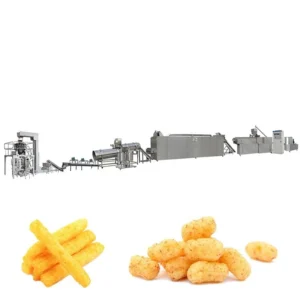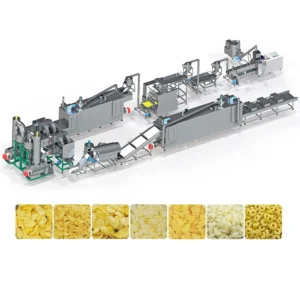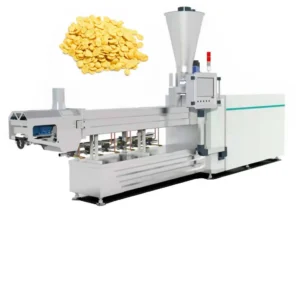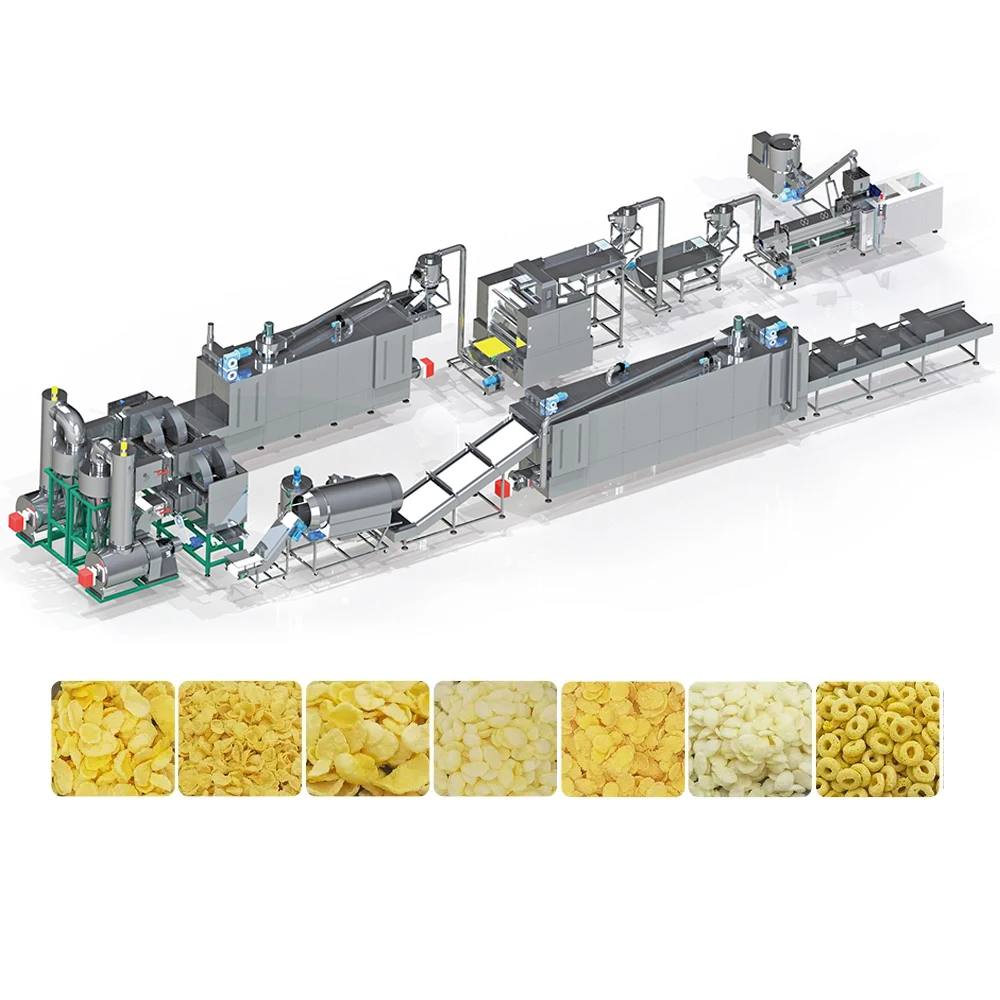
Screw and Die Matching — Every MT70, MT85, and MT75 build starts with your actual grain formulation before barrel zones and die geometry are locked in.
Technical Specifications
| Parameter | Value |
|---|---|
| Product Type | Corn Flake and Breakfast Cereal Production Line |
| Models Available | MT70, MT85, MT75 |
| Screw Type | Twin Screw |
| MT70 Installed Power | 160 kW |
| MT70 Power Consumption | 120 kW |
| MT70 Capacity | 150–200 kg/hr (basis not stated in source — confirm raw material and moisture content) |
| MT70 Overall Dimensions | 41 × 1.5 × 2.2 m |
| MT85 Installed Power | 190 kW |
| MT85 Power Consumption | 140 kW |
| MT85 Capacity | 300–400 kg/hr (basis not stated in source — confirm raw material and moisture content) |
| MT85 Overall Dimensions | 43 × 1.5 × 3.2 m |
| MT75 Installed Power | 210 kW |
| MT75 Power Consumption | 150 kW |
| MT75 Capacity | 300–500 kg/hr (basis not stated in source — confirm raw material and moisture content) |
| MT75 Overall Dimensions | 45 × 1.5 × 3.5 m |
| Control System | PLC for flaking machinery; MCC/PLC for extruder line |
| Flaking Drive | Double motors with separate roller driving, hydraulic system |
| Flaking Temperature Control | Infrared sensor for even temperature pipe regulation |
| Dryer Heating Source | Gas or electric |
| Roasting Oven | Hot air with vibrating pan, high-temperature spraying tubes, two circulating fans, cyclone dust removal, conciliation burner |
| Coating System | Double tumble for sugar melting, elevator, coating drum, spraying nozzle |
| Key Features | Automatic lubricating and cooling function on extruder |
Application Suitability
| Application | Material or Output |
|---|---|
| Natural corn flake production | Corn grits and corn flour blends |
| Sugar-coated corn flakes | Corn base with sugar spray and tumble coating |
| Multi-grain breakfast cereals | Rice, wheat, oat, and barley powder formulations |
| Shaped cereal formats | Ball, tube, stick, ring, fruit loop, star, wheel, flower, heart profiles via interchangeable dies |
| Fortified breakfast cereal lines | Grain blends with added vitamin and mineral premix |
Why Generic Screw Builds Fail on Real Corn Flake Runs
A corn flake extrusion production line specifications sheet means little if the screw elements were chosen without seeing your grain blend first.
I spent two days on a plant floor in the Middle East watching corn mash refuse to pass through a die plate. The line had been ordered on paper capacity alone, and the local corn flour carried higher moisture than the original build assumed. The screw combination was pulling starch forward too aggressively, packing the barrel instead of conveying it [NEED_CITE: raw material moisture variation in grain extrusion]. We swapped the kneading block arrangement, adjusted feed moisture targets, and the line finally held steady output. That experience sits behind every corn flake extrusion production line specifications review we now do — the screw profile must follow the flour, not the other way around.
Barrel Temperature Zones and Starch Gelatinisation Control
Corn starch gelatinises within a narrow thermal window, and the barrel must hold that window across every zone from feed to die. The twin-screw design on the MT70, MT85, and MT75 allows independent heating segments so process engineers can set a rising profile that matches the gelatinisation curve of corn, wheat, or oat. When barrel heat overshoots, the melt fractures at the die face and flakes tear during rolling. Undershoot leaves raw starch cores that never crisp properly in the roasting oven, no matter how long the residence time.
Die Geometry and Flake Expansion Behaviour
The die orifice diameter and land length together decide how much the extrudate swells as it exits the barrel. For corn flakes, you need restrained expansion — enough to open the starch matrix for flaking, but not so much that the sheet balloons and collapses into a brittle shell. The corn flake extrusion production line specifications must record die land length alongside orifice count because a 1 mm change in land length shifts the exit pressure noticeably. Die plates are specified after the trial run confirms expansion ratio on the buyer’s actual blend, not from a catalogue default.
Reading the Power and Capacity Figures Correctly
Installed power on the MT70 sits at 160 kW with working consumption around 120 kW, while the MT75 pulls 210 kW installed and draws roughly 150 kW under load. These numbers reflect motor rating and typical thermal draw; actual amperage depends on formulation viscosity and screw back-pressure [NEED_CITE: motor load calculation for twin screw extrusion in food processing]. Capacity ranges listed for each model are nominal and shift with raw material density, feed moisture, and target flake thickness. A corn grit blend at lower moisture runs denser through the barrel and may reduce throughput compared to a pre-conditioned rice flour mix. The flaking station downstream also sets a hard ceiling — if the hydraulic double-roller gap is set tight for thin flakes, the line speed must match the roller surface area available.
When Flaking and Roasting Capacity Fall Behind the Extruder
Mismatched downstream stations are the most common reason a breakfast cereal line never reaches its rated rhythm.
I watched a cereal plant in the Gulf run the extruder at comfortable output while the flaking rollers choked. The gap was set for paper-thin flakes, but the roller width could not swallow the extrudate ribbon fast enough, so operators kept slowing the extruder feed to compensate [NEED_CITE: throughput bottleneck analysis in cereal flaking lines]. The roasting oven then ran half-empty because the flaker was the constraint. A corn flake extrusion production line specifications document should show throughput matching across every station — extruder mass flow, flaker surface coverage, dryer belt loading, and roasting pan residence — so no single machine dictates the pace.
Why Procure the Extrusion Technology From One Source
Screw configuration and die design are specified against the buyer’s grain formulation and target flake density before the barrel is assembled, not pulled from a standard build sheet. The in-house testing workshop runs trial batches on customer-supplied raw material so expansion, sheet integrity, and blister formation are confirmed before the line ships. PLC control on the flaking machinery and MCC/PLC integration on the extruder line mean one control language and one set of alarm protocols across the entire floor. Line layout and capacity calculation cover every station from batching through packing, so throughput is matched rather than assembled from independent vendor quotes. Pre-sales consultation carries through to on-site installation, commissioning, and operator training with wear parts documentation from day one.
Documentation & Verification
- Line layout showing throughput balance across extrusion, flaking, drying, and roasting stations
- Screw and die configuration record matched to your grain formulation and target flake density
- Trial run report on your raw material covering expansion ratio, sheet integrity, and blister formation
- Electrical schematic with voltage, frequency, and PLC language confirmed before production
- CE declaration of conformity and ISO certificate included in shipment documentation
- Wear parts list with screw elements, die plates, and roller sleeves itemised for first reorder
Installation, Commissioning & Support
- Foundation plan accounts for the MT75 footprint of 45 × 1.5 × 3.5 m with utility trench routing
- Dedicated power circuit sized for the model’s installed power, from 160 kW on MT70 to 210 kW on MT75
- Flaking machinery delivered with hydraulic system pre-filled; roller gap calibrated during on-site commissioning
- PLC language and MCC labelling verified against operator requirements before first powered run
- Infrared sensor on flaking station calibrated to target roller surface temperature during initial production
- Spare screw elements, die plates, and roller sleeves handed over with part numbers for reorder
What We Need to Size Your Line
Send us your primary grain formulation with proximate analysis and typical moisture range, the flake thickness and bowl-life target your market expects, and the daily output you plan to sustain. Include local voltage and frequency, preferred PLC language, and whether you need sugar coating integrated or added later. If you can ship a sample batch of your raw material, we will run a trial before finalising the screw and die build.
Frequently Asked Questions
Q: How is screw configuration and die design specified to my grain formulation?
A: We review your flour or grit analysis, then select kneading block angles, conveying element pitch, and die land length to match the starch gelatinisation behaviour of your blend. A trial run in our testing workshop confirms expansion and sheet quality before the configuration is locked for production.
Q: What barrel temperature profile works for corn versus wheat or oat?
A: Corn typically needs a stepped rise across barrel zones to push starch through full gelatinisation without scorching at the die face. Wheat and oat have different gelatinisation onsets and moisture tolerance, so zone setpoints shift accordingly based on trial run data from your specific blend.
Q: How is the trial run on my raw material conducted before shipment?
A: You supply a representative sample batch and we run it through the configured extruder, flaker, and roasting oven in our testing workshop. The trial run report documents expansion ratio, flake thickness uniformity, blister formation, and throughput at steady state.
Q: How do I verify that flaking and roasting capacity match the extruder output?
A: The line layout we provide shows mass flow calculations at every station. Roller surface area, dryer belt loading, and roasting pan residence time are all sized against the extruder’s confirmed throughput on your material, so no station becomes a bottleneck.
Q: What control system language and PLC options are confirmed before commissioning?
A: We verify PLC display language, MCC labelling, and alarm descriptions with your engineering team before the control panels are wired. This prevents rework on site and ensures operators can read every parameter in their working language from the first shift.