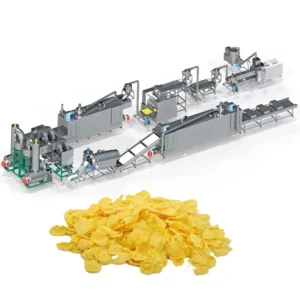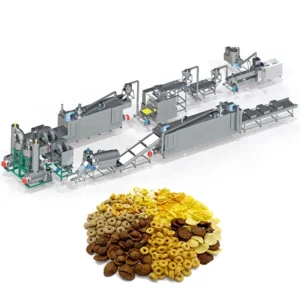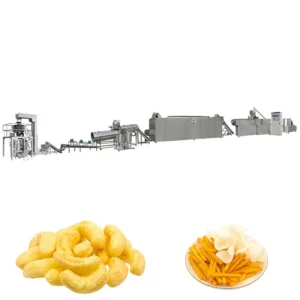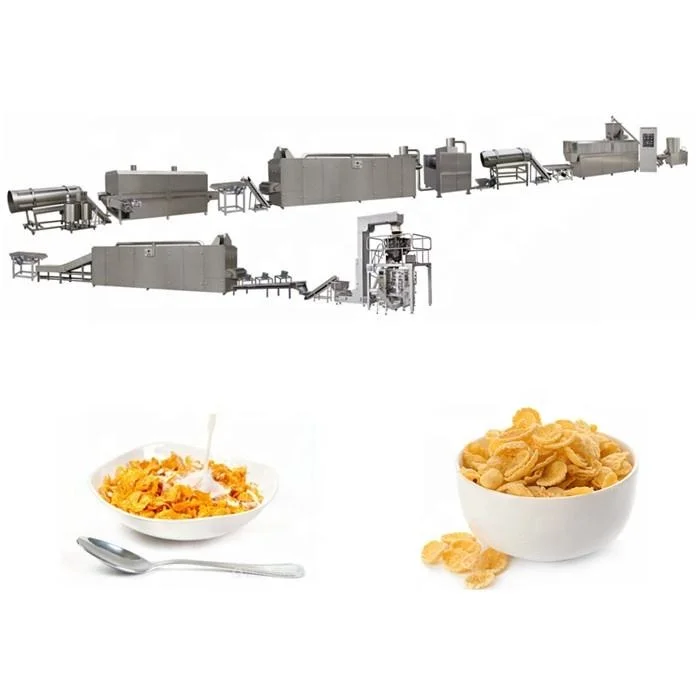
Matched Screw Geometry — Every barrel zone and die orifice is specified against the buyer’s grain formulation and moisture input, validated in our testing workshop before the line ships.
Technical Specifications
| Parameter | Value |
|---|---|
| Product Type | Breakfast Cereals Corn Flakes Production Line |
| Models Available | MT70, MT85, MT75 |
| Extruder Type | Twin Screw |
| Installed Power (MT70) | 160 kW |
| Installed Power (MT85) | 190 kW |
| Installed Power (MT75) | 210 kW |
| Power Consumption (MT70) | 120 kW |
| Power Consumption (MT85) | 140 kW |
| Power Consumption (MT75) | 150 kW |
| Output Capacity (MT70) | 150–200 kg/h (basis not stated in source — confirm raw material formulation and moisture content) |
| Output Capacity (MT85) | 300–400 kg/h (basis not stated in source — confirm raw material formulation and moisture content) |
| Output Capacity (MT75) | 300–500 kg/h (basis not stated in source — confirm raw material formulation and moisture content) |
| Overall Dimensions (MT70) | 41 × 1.5 × 2.2 m |
| Overall Dimensions (MT85) | 43 × 1.5 × 3.2 m |
| Overall Dimensions (MT75) | 45 × 1.5 × 3.5 m |
| Raw Materials | Corn, rice, wheat, oat, barley powder |
| Control System | PLC (flaking machinery); MCC available per company profile |
| Dryer Heating Source | Gas or Electric |
| Certifications | CE, ISO |
Application Suitability
| Application | Material or Output |
|---|---|
| Natural corn flake manufacturing | Corn grits and corn flour blends |
| Sugar-coated breakfast cereals | Corn, wheat, or oat base with syrup coating |
| Shaped cereal production | Rice, wheat, and multi-grain formulations for rings, balls, stars, loops |
| Fortified breakfast cereal processing | Grain powders blended with nutritional additives |
| Aquatic and snack pellet variants | Barley and oat formulations for 2D/3D pellet snacks |
Why the Screw Profile Matters More Than the Nameplate Capacity
A twin-screw extruder rated at a given throughput will only hold that number when the screw elements, barrel temperatures, and moisture input match the actual grain formulation running through it.
I learned this the hard way on a corn flake installation in South Asia. The line ran standard corn grits perfectly during factory testing, but the client’s local pre-mix carried a different moisture profile and starch composition. Flake thickness drifted, expansion ratios fell outside spec, and we spent two weeks reconfiguring the screw combination and die temperature zones on-site [NEED_CITE: starch gelatinisation behaviour varies by grain source and moisture content]. That delay is what drives the insistence on running every buyer’s actual raw material through the testing workshop before shipment. A breakfast cereals corn flakes extrusion production line that has not been validated on your specific grain blend is an untested machine, regardless of what the brochure says.
Starch Gelatinisation and the Barrel Temperature Profile
The transformation from raw grain powder to a cooked, expandable dough happens inside the extruder barrel. Each heating zone must reach the threshold where starch granules absorb moisture and swell — a temperature window that shifts depending on whether you are running corn, oat, wheat, or a multi-grain blend. The twin-screw design allows configurable screw elements that control shear intensity and residence time, giving process engineers the ability to fine-tune gelatinisation degree across the barrel length. A breakfast cereals corn flakes extrusion production line without zone-specific temperature control leaves flake texture to chance.
Die Geometry and Expansion Control
The die plate is where the extrudate takes its final cross-section before cutting. Orifice diameter, land length, and face pattern determine how much the dough expands as it exits the pressurised barrel into ambient conditions. For corn flakes, the goal is a controlled, moderate expansion that the downstream flaking rollers can then compress into uniform sheets. For shaped cereals like rings or fruit loops, the die geometry shifts entirely — requiring different land lengths and cut-off mechanisms [NEED_CITE: die land length and expansion ratio relationship in twin-screw extrusion]. The screw configuration record documents which die and screw combination was validated for your target product, so you can reproduce it on every production run.
How Moisture, Shear, and Screw Pitch Shape the Final Flake
Three variables interact continuously inside the barrel: moisture input, mechanical shear from the screw flights, and thermal energy from the barrel heaters. Higher moisture lowers the viscosity of the dough mass, reducing shear and producing a denser, less expanded extrudate — suitable for thin, crisp flakes after rolling and roasting. Lower moisture increases shear and expansion, which may be desirable for shaped cereals but will cause corn flakes to blister unevenly during roasting. The automatic lubricating and cooling function on the screw assembly helps maintain consistent friction characteristics across long production runs, preventing drift in these parameters as wear accumulates.
What Happens When Extrusion Parameters Are Guesswork
The most common failure mode on corn flake lines is not mechanical breakdown — it is inconsistent product that the market rejects. Flakes that are too dense sink in milk. Flakes that expanded too much shatter during packing. When the screw configuration is copied from a generic build rather than specified to the buyer’s grain formulation, these defects appear within the first production shift and persist until someone with extrusion expertise arrives on-site [NEED_CITE: extrusion parameter mismatch and product defect rates in cereal manufacturing]. The cost is not just wasted raw material; it is lost shelf space while the line sits idle waiting for a fix.
Why the Engineering Support Model Is Built Around Your Material
Every element of this supply process traces back to one principle: the line must be proven on your grain before it leaves the factory. The screw configuration and die design are documented against your raw material sample, not a generic default. The in-house testing workshop runs your formulation and produces a trial report showing expansion ratio, flake density, and texture before you approve shipment. Line layout and capacity calculations match throughput between the extruder, flaking rollers, dryer, and roasting oven so no station bottlenecks another. Electrical schematics confirm voltage, frequency, and control language for the target market before production begins. Thermal profiles from extrusion through hot air roasting are tuned to the starch behaviour of your specific grain blend, with the roasting oven’s vibrating pan and conciliation burner calibrated to trigger the surface bubbling that gives corn flakes their characteristic crunch.
Documentation & Verification
- Screw and die configuration record matched to your grain formulation
- Trial run report on your raw material showing expansion and density data
- Line layout with throughput matching across every station
- Electrical schematic confirming voltage and frequency for your market
- Factory test record documenting all parameters before dispatch
Installation, Commissioning & Support
- Foundation planning based on the MT70/MT85/MT75 overall dimensions and weight distribution
- Dedicated electrical circuit sized to the model’s installed power rating up to 210 kW
- PLC control panel configured with operator language for the installation site
- Flaking machinery hydraulic system calibrated to target sheet thickness on first run
- Hot air roasting oven burner tuned to local gas composition or electric supply
- Wear parts list covering screws, dies, and roller surfaces with replacement intervals
What to Include in Your Inquiry
Process engineers evaluating a breakfast cereals corn flakes extrusion production line should provide the grain formulation and moisture content of the intended raw material, along with target flake thickness and density specifications. Factory planners should confirm available floor space and ceiling height to accommodate line dimensions up to 45 metres in length. Buyers in export markets need to specify local voltage and frequency standards so that motor ratings and control systems are configured before manufacturing begins.
Frequently Asked Questions
Q: How is screw configuration selected for different grain raw materials?
A: Each grain — corn, oat, wheat, barley — has a distinct starch gelatinisation temperature and moisture absorption curve. Screw elements are arranged to control shear and residence time accordingly, with die orifice geometry matched to the expansion behaviour of that specific grain. The configuration is validated on your material sample in the testing workshop before the extruder ships.
Q: What barrel temperature and moisture range produce crispy corn flakes?
A: The target is partial gelatinisation where starch granules swell without fully rupturing, typically requiring precise moisture input and zone-specific barrel heating. The exact range depends on your corn variety and grind size. Trial runs document the temperature profile and moisture percentage that yielded the correct flake density and crunch for your formulation.
Q: How is flake density controlled across the extruder, flaker, and roaster?
A: Density is set in three stages: expansion at the die determines initial dough structure, hydraulic flaking rollers compress the extrudate to target sheet thickness with infrared temperature monitoring, and the hot air roasting oven triggers surface bubbling through controlled high-temperature exposure. Each station’s parameters are tuned together during the trial run.
Q: Can the line switch between natural corn flakes and shaped cereals?
A: Yes, but the change requires different die geometry and screw element arrangements. Shaped cereals like rings or loops need dies with specific land lengths and cut-off mechanisms, while corn flakes require a die that produces a ribbon suitable for flaking. Both configurations are documented so changeovers are repeatable.
Q: How does the pre-shipment trial run work?
A: You send a representative batch of your raw material to the testing workshop. The extruder is configured with the proposed screw and die setup, and a production run is conducted through extrusion, flaking, and roasting. The trial report documents expansion ratio, flake density, texture, and any adjustments made, so you approve the line based on your product — not a generic test.