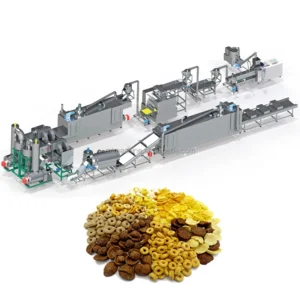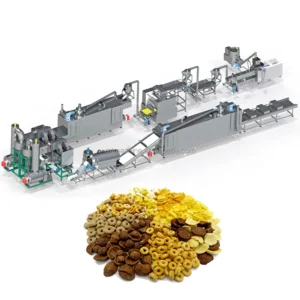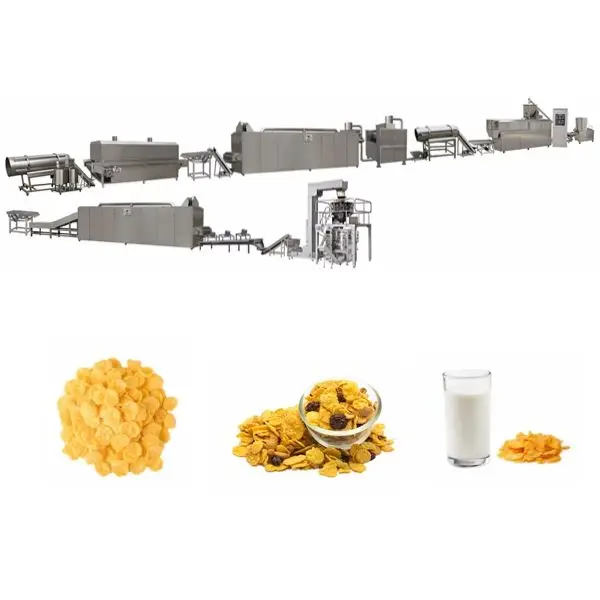
Engineered Extrusion Profiles — Every screw element and die plate on the MT70 line is selected against your specific grain blend and target flake density, not copied from a generic breakfast cereal build.
Technical Specifications
| Parameter | Value |
|---|---|
| Product Type | Corn Flake Production Line |
| Models Available | MT70 / MT85 / MT75 |
| Extruder Type | Twin Screw |
| MT70 Installed Power | 160 kW |
| MT70 Power Consumption | 120 kW |
| MT70 Output Capacity | 150–200 kg/h (basis not stated in source — confirm raw material and moisture content) |
| MT70 Overall Dimensions | 41 × 1.5 × 2.2 m |
| MT85 Installed Power | 190 kW |
| MT85 Power Consumption | 140 kW |
| MT85 Output Capacity | 300–400 kg/h (basis not stated in source — confirm raw material and moisture content) |
| MT85 Overall Dimensions | 43 × 1.5 × 3.2 m |
| MT75 Installed Power | 210 kW |
| MT75 Power Consumption | 150 kW |
| MT75 Output Capacity | 300–500 kg/h (basis not stated in source — confirm raw material and moisture content) |
| MT75 Overall Dimensions | 45 × 1.5 × 3.5 m |
| Control System | PLC |
| Screw Feature | Automatic lubricating and cooling; wear-resistant material |
| Flaking Machine Drive | Double motors, separate roller driving; hydraulic system |
| Flaking Machine Control | PLC with infrared sensor for temperature pipe control |
| Dryer Heating Source | Gas or Electric |
| Roasting Oven | Hot air roasting, vibrating pan, conciliation burner, two circulating fans, cyclone dust removal |
| Coating System | Double tumble sugar melting, elevator, coating drum, spraying nozzle |
| Die Configuration | Adjustable mould for multiple shapes (ball, tube, stick, ring, fruit loop, star, wheel, flower, heart) |
| Raw Materials | Corn, rice, wheat, oat, barley powder |
| Standards | CE, ISO |
Application Suitability
| Application | Material or Output |
|---|---|
| Natural corn flakes | Corn grits or corn flour, dried and hot-air roasted for traditional breakfast cereal |
| Sugar-coated corn flakes | Corn-based extrudate with sugar syrup spraying and tumble coating |
| Multi-grain breakfast flakes | Blends of rice, wheat, oat, or barley powder with adjusted extrusion parameters |
| Shaped cereal snacks | Fruit loops, stars, rings, and other forms via interchangeable die plates |
What "Nominal Capacity" Leaves Out in Corn Flake Extrusion
A rated output figure means nothing until it is validated on your actual grain lot, at your moisture level, running through your die plate.
I have watched lines that performed perfectly on standard corn grits fall apart when a buyer switched to a coarser local supplier. Starch gelatinisation dropped, the flakes came out uneven in thickness, and expansion collapsed on the cooling belt. Two weeks of parameter resets followed. The corn flakes extrusion technology on paper looked identical; the real-world result was a different story. This is why every purchase should begin with a sample shipment, not a brochure [NEED_CITE: starch gelatinisation thresholds vary by grain particle size and moisture].
How Screw Configuration Shapes the Flake
The twin-screw extruder sits at the heart of breakfast cereal extrusion process control. Each screw element — conveying, kneading, reverse — is positioned along the barrel to manage shear, residence time, and temperature in distinct zones. For corn flakes, the goal is complete starch gelatinisation without over-expansion at the die face. A misconfigured screw profile will either leave raw starch pockets inside the pellet or cause the extrudate to puff too aggressively, producing a flake that shatters during roasting rather than holding its structure.
Barrel Temperature and Moisture Interaction
Barrel zones are heated independently so the operator can build a temperature ramp from feed intake to die exit. In the corn flakes extrusion technology workflow, the moisture content of the incoming mix — typically preconditioned with steam or water — works in tandem with barrel heat. Too much moisture and the pellets are gummy heading into the flaking rollers; too little and starch conversion remains incomplete. The PLC system logs each zone setting, giving process engineers a repeatable baseline across production runs [NEED_CITE: twin-screw barrel zone profiling for cereal applications].
Reading the Numbers That Matter
Installed power on the MT70 sits at 160 kW with actual consumption around 120 kW, which indicates headroom for harder grain blends that demand higher torque. The flaking station uses double motors driving each roller independently, paired with a hydraulic gap adjustment — this combination lets the operator set precise flake thickness without shutting down for mechanical changes. The roasting oven runs two separate circulating fans alongside a cyclone dust removal device, which keeps hot-air distribution even across the vibrating pan and pulls fines out before they scorch. Die plates are interchangeable, covering shapes from simple rings to complex fruit loops, so a single extruder can support multiple SKU formats on the same line.
When the Dryer Becomes the Bottleneck
An extruder running at steady output is only as productive as the station downstream that cannot keep pace. If the dryer or roasting oven is sized for a lighter load than the extruder delivers, wet pellets pile up, moisture migrates into already-dried flakes, and the packing station receives product outside specification. I have seen buyers focus entirely on extruder capacity and then discover the coating drum cannot cycle fast enough to match sugar-coated demand [NEED_CITE: line throughput balancing across extrusion and downstream stations].
Why Source the Line From One Supplier
Screw and die design are documented against your raw material before metal is cut, not borrowed from a previous customer’s build. The testing workshop runs your grain through the extruder so extrusion parameters — temperature profile, moisture ratio, screw speed — are confirmed before the line ships. Every station from mixing to packing is throughput-matched by one engineering team, which removes the blame-shifting that happens when separate vendors supply individual machines. PLC control language and electrical schematics are finalised against your site voltage before assembly begins. Operator training covers screw changes, roller gap calibration, and roaster fan balancing so the crew is competent from the first production shift.
Documentation & Verification
- Line layout drawing showing station spacing and throughput balance for your target flake output
- Screw element layout and die plate selection record matched to your grain blend
- Trial run report produced on your raw material in the testing workshop prior to dispatch
- Electrical schematic with voltage, frequency, and PLC language confirmed for your facility
- CE declaration of conformity and ISO certificate included in the shipping document set
Installation, Commissioning & Support
- Foundation plan provided for the MT70 line footprint (41 × 1.5 × 2.2 m) including flaking station load points
- Dedicated circuit sizing based on 160 kW installed power with start-up surge allowance
- Extruder barrel and screw elements shipped partially assembled for on-site joining and alignment
- First-run parameter setting covers barrel zone temperatures, feed rate, and roller gap calibration
- Operator training includes die plate changeover, hydraulic roller adjustment, and roaster fan balancing
- Wear parts list covers screw elements, die plates, and roller surfaces with reorder intervals
Before You Send an Inquiry
To give you a line configuration that actually holds rate on your material, we need to know the grain type or blend you plan to run, the target flake thickness and density, and whether you intend to produce sugar-coated or natural variants. Send a sample of your raw material — even a few kilograms — so a trial run can confirm extrusion behaviour before quotation. Include your site voltage and frequency so the electrical package is matched from day one.
Frequently Asked Questions
Q: How do you match screw configuration and die design to my grain blend?
A: We start with your raw material sample and target flake specification. The screw element sequence — conveying, kneading, and reverse sections — is arranged to control shear and residence time for your specific starch type. Die plate orifice diameter and land length are selected to produce the pellet size your flaking rollers need. A configuration record documents every decision.
Q: Can I send my raw material for a trial run before the line ships?
A: Yes. The testing workshop runs your grain through the extruder under production-representative conditions. We measure expansion ratio, moisture loss, and pellet density, then adjust screw speed and barrel temperatures until the output meets your flake specification. You receive a trial report before the machine leaves the factory.
Q: How are barrel temperature and moisture controlled for consistent gelatinisation?
A: The PLC system manages independent heating zones along the barrel, each logged and adjustable. Moisture is introduced at the preconditioner and monitored before the feed inlet. Together these controls maintain a stable gelatinisation window across shifts, and all settings are saved as recipes for quick changeover between products.
Q: What happens if extruder output exceeds downstream dryer or roaster capacity?
A: That mismatch is eliminated during line design. Each station — flaking, drying, hot-air roasting, cooling — is calculated against the extruder’s confirmed throughput on your material. The layout proposal shows throughput at every stage so no single unit becomes a bottleneck during continuous production.
Q: How are voltage, frequency, and control language confirmed before delivery?
A: During the specification stage we collect your site electrical data and preferred PLC interface language. The electrical schematic is drawn and approved before assembly, so motors, heaters, and control panels arrive configured for your grid — no rewiring or reprogramming delays during commissioning.