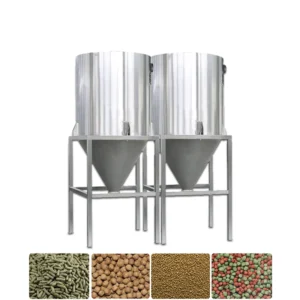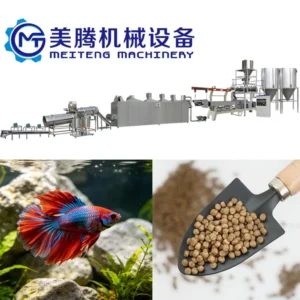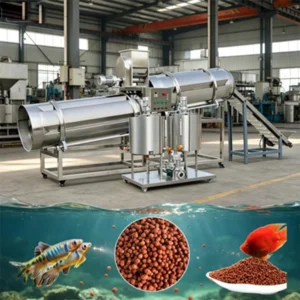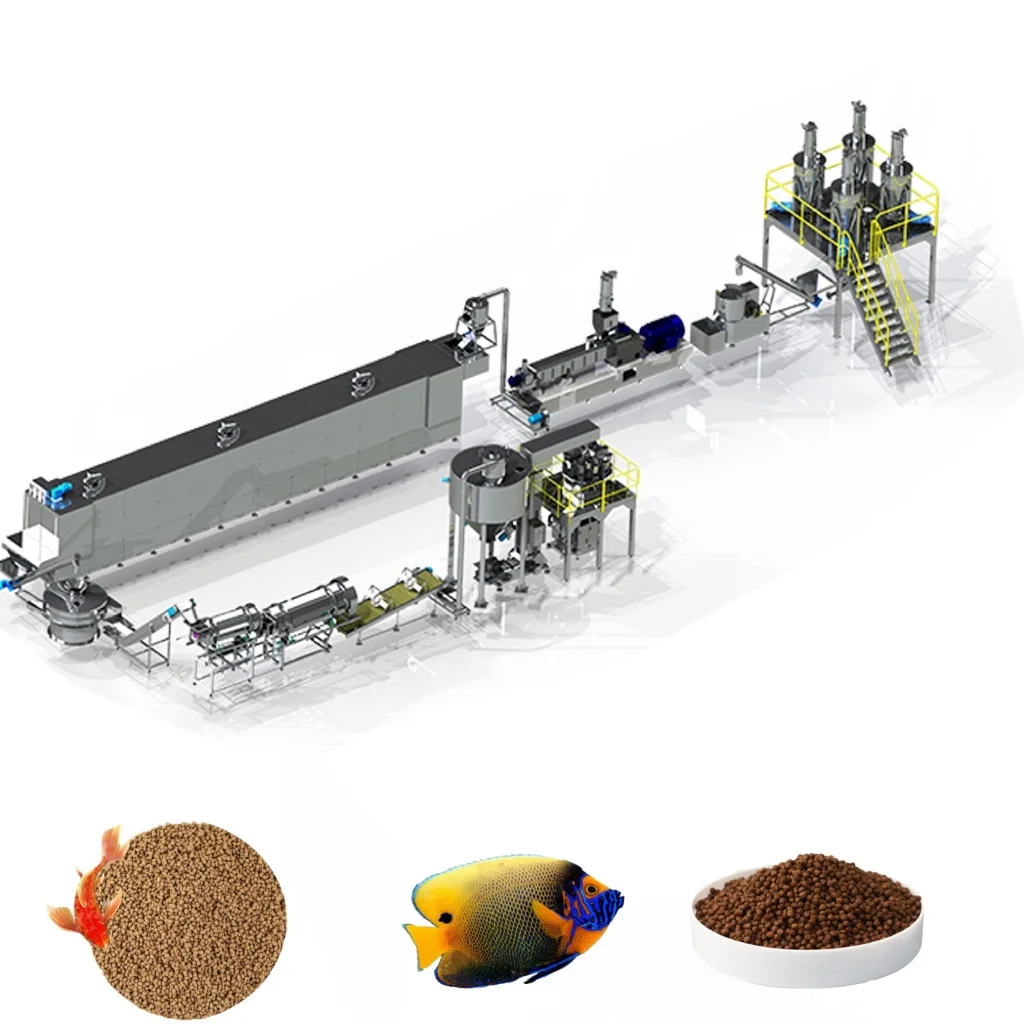
Precision-Engineered Extrusion — Every screw element and die opening is matched to your aquatic feed formulation, verified through in-house trial runs before the line ever leaves the factory.
Technical Specifications
| Parameter | Value |
|---|---|
| Product Type | Twin-Screw Fish Feed Extrusion Production Line |
| Screw Type | Twin-screw configuration |
| Control System | Full-automatic operation (PLC/MCC details to be confirmed) |
| Contact Material | Food-grade stainless steel |
| Voltage | 380V (frequency and phase to be confirmed) |
| Pellet Formats | Floating and sinking aquatic pellets |
| Assembly State | Complete line with extrusion and supporting stations |
| Energy Design | Power consumption reduction features (percentage to be confirmed) |
| Certifications | CE, ISO |
Application Suitability
| Application | Material or Output |
|---|---|
| Floating feed for catfish and tilapia | High-starch formulations requiring controlled expansion and low bulk density |
| Sinking shrimp pellets | High-protein mixes demanding precise gelatinisation without excessive puffing |
| Dry kibble and pet food | Corn, meat meal, and grain blends processed through adjustable die geometry |
| Multi-species aquaculture operations | Single-line production switching between buoyancy targets via screw and barrel adjustments |
What Generic Screw Configurations Cost Aquatic Feed Producers
A pellet that sinks when the market expects it to float is not a recipe problem — it is a screw geometry problem.
When a twin-screw fish feed extrusion technology specifications package arrives with a generic screw build copied from a standard template, the barrel shear profile rarely matches the buyer’s actual protein-to-starch ratio. I have seen lines where high-protein aquatic formulations absorbed far less mechanical energy than the configuration assumed, leaving starch under-gelatinised and pellet density drifting well above the floating threshold [NEED_CITE: starch gelatinisation thresholds in high-protein extrusion]. The downstream dryer then runs at full capacity trying to remove moisture that should never have been trapped inside the pellet matrix.
Barrel Zone Mapping for Aquatic Buoyancy Control
The barrel on a twin-screw extruder is segmented into independent heating and cooling zones. For aquatic feed production, the temperature gradient across these zones determines whether starch granules fully rupture before the melt reaches the die face. A profile that ramps too aggressively in the early compression section can cause premature gelatinisation, locking moisture into the core and producing a pellet that refuses to float regardless of downstream drying time.
Shear Energy and Protein-Starch Interaction
Twin-screw extrusion relies on intermeshing screw elements to generate the shear energy needed for starch conversion. High-protein aquatic formulations — common in shrimp and juvenile fish diets — behave differently under shear than starch-dominant mixes. The screw configuration must account for this by adjusting the ratio of conveying elements to kneading blocks, ensuring the material receives enough thermal and mechanical input without over-working the protein matrix [NEED_CITE: shear sensitivity of protein-rich extrusion feeds].
Die Geometry and Pellet Expansion at the Cut
The moment the extrudate exits the die plate, pressure drops to atmospheric and trapped steam flashes outward. Die hole diameter, land length, and face-plate thickness all govern how rapidly that expansion occurs. For floating pellets, a shorter land length allows faster radial expansion and lower bulk density. Sinking pellets require the opposite — a longer land that restricts expansion and compresses the pellet structure before the cutter engages.
Reading the Specification Sheet Beyond Capacity Claims
Output capacity figures quoted without raw material context are meaningless for aquatic feed production. A twin-screw fish feed extrusion technology specifications document should list throughput alongside the exact formulation — protein percentage, fat content, moisture at the preconditioner, and target pellet diameter — that produced that number. The motor power rating tells you the mechanical headroom available; the screw speed range tells you how much flexibility the line offers when formulations change between seasons or species [NEED_CITE: motor sizing and screw speed range for variable aquatic formulations]. Without these anchors, a capacity number is a guess.
When Extruder Output and Downstream Capacity Diverge
A line where the extruder outpaces the dryer creates a bottleneck that no amount of overtime shifts can fix. Wet pellets pile up on the conveyor, surface moisture fails to evaporate uniformly, and the flavouring drum receives product that is still too damp for even coating adhesion. This mismatch typically surfaces only after installation, when the buyer discovers the dryer was quoted on ambient air assumptions while the actual production environment runs hotter and more humid than the spec sheet anticipated [NEED_CITE: dryer capacity matching in extrusion line design]. The extruder itself may be performing exactly as designed — the failure is in the throughput balance across stations.
Why the Testing Workshop Matters Before Shipment
Every aquatic feed producer works with locally sourced raw materials that vary in starch content, particle size, and residual moisture. A screw configuration that produces perfect floating pellets on one supplier’s corn meal may fail entirely on another’s. Running the buyer’s actual formulation through the extruder before dispatch — documenting barrel temperatures, screw speed, die pressure, and pellet buoyancy — eliminates the most expensive variable in any line installation. The trial run report becomes the baseline for commissioning, meaning the first hour of production at the buyer’s facility starts from a known setpoint rather than blind adjustment.
Documentation & Verification
- Screw and die configuration record matched to your aquatic feed formulation
- Trial run report documenting pellet buoyancy on your raw material before dispatch
- Electrical schematic confirming voltage, frequency, and PLC language for your facility
- Line layout showing throughput balance across extruder, dryer, and coating stations
- CE declaration of conformity and ISO certificate for customs and regulatory clearance
Installation, Commissioning & Support
- Foundation load plan accounting for extruder weight and vibration isolation requirements
- Dedicated circuit specification for the full-automatic PLC control panel and motor drives
- Barrel and screw assembly sequence with torque values for food-grade stainless steel fasteners
- First-run parameter logging across all barrel zones to establish your baseline temperature profile
- Operator training covering screw configuration changes for switching between floating and sinking formats
- Wear parts inventory list with lead times for replacement screws, die plates, and cutter blades
Before You Request a Quote
Provide your target pellet diameter, buoyancy requirement, and the protein-to-starch ratio of your primary formulation. Confirm your facility’s voltage, frequency, and preferred control language so the electrical package matches your grid from day one. If you operate an existing dryer or coating drum, share its throughput rating so the extruder output can be balanced against downstream capacity.
Frequently Asked Questions
Q: How are screw configuration and die design matched to produce floating versus sinking pellets?
A: Floating pellets require a screw profile that maximises starch gelatinisation and a die with short land length for rapid expansion. Sinking pellets use more kneading blocks to compress the melt and a longer die land that restricts expansion. Both formats are achievable on the same twin-screw platform by swapping screw elements and die plates.
Q: What barrel temperature profile and moisture range are needed for proper starch gelatinisation in aquatic feed?
A: The profile depends on your formulation’s starch source and protein content. Generally, barrel zones ramp from preconditioning temperatures in the feed section through peak gelatinisation in the metering zone. Moisture at the barrel inlet typically ranges from 20% to 30%, but the exact window is confirmed during the trial run on your raw material.
Q: Can a trial run be conducted on the buyer’s actual raw material before shipment?
A: Yes. The testing workshop runs your formulation through the extruder, logging barrel temperatures, screw speed, die pressure, and pellet buoyancy data. You receive a full trial run report before the line ships, giving you a documented baseline for commissioning at your facility.
Q: How is extruder output matched to downstream dryer and coating capacity?
A: The line layout calculates throughput at every station — extruder, dryer, cooling conveyor, and coating drum — based on your target output and pellet moisture content. This ensures no single station creates a bottleneck. The capacity calculation is included in the documentation package before production begins.