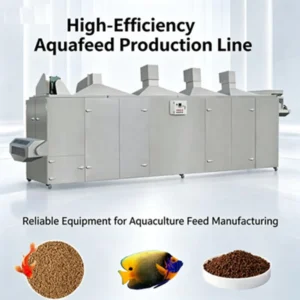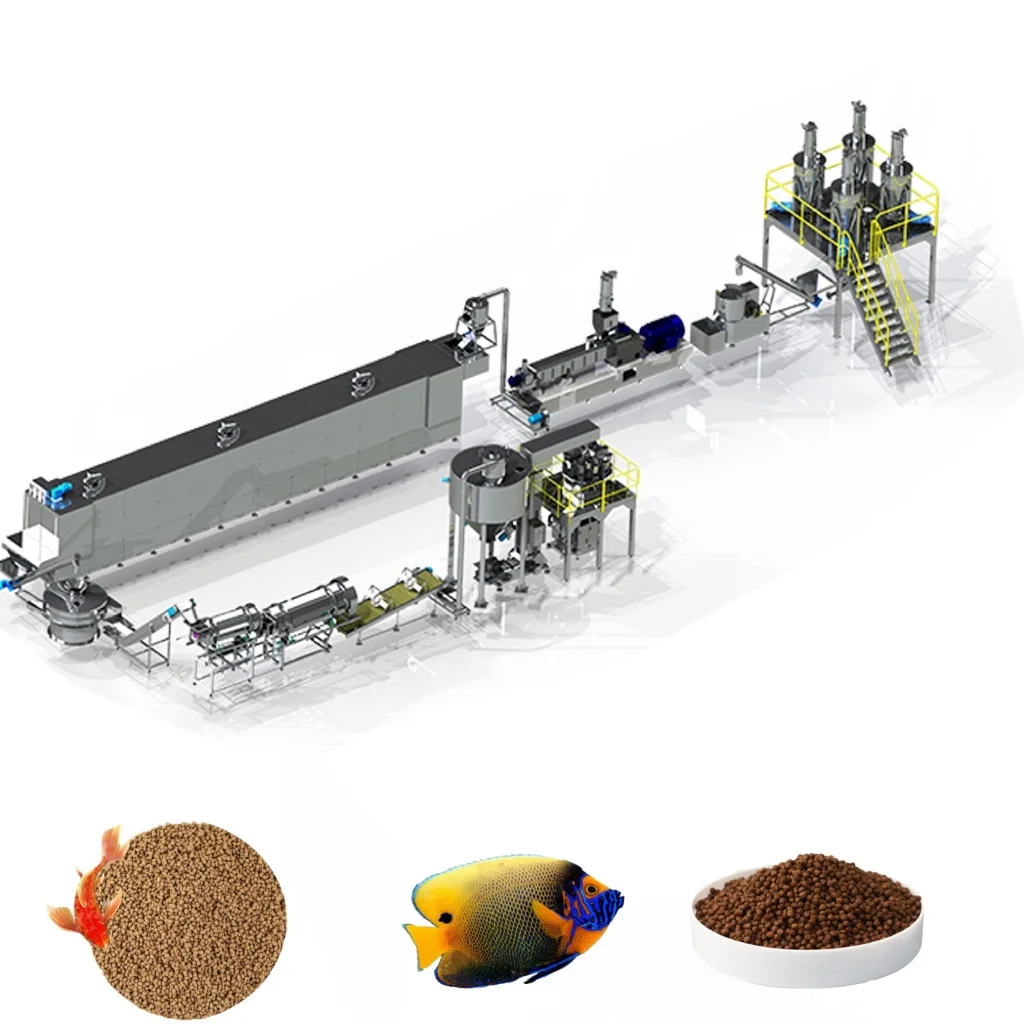
Screw Geometry as the Density Lever — Floating or sinking behavior in aquatic pellets is decided inside the barrel, not in the dryer, and this twin-screw extrusion fish feed production line is specified to the buyer’s formulation rather than copied from a generic build.
Technical Specifications
| Parameter | Value |
|---|---|
| Product Type | Automatic Fish Feed Extrusion Production Line |
| Operation Mode | Full-Automatic |
| Contact Material | Stainless Steel (food-grade contact parts) |
| Voltage | 380V (frequency and phase to be confirmed with buyer’s site supply) |
| Control System | PLC / MCC configuration (scope to be confirmed per line layout) |
| Pellet Type Capability | Floating and sinking aquatic pellets |
| Screw Configuration | Matched to raw material formulation and target pellet density |
| Die Design | Specified per pellet diameter and buoyancy requirement |
| Line Stations | Mixer, extruder, dryer, flavouring drum, cooler, packing (configuration to be confirmed) |
| Output Capacity | To be confirmed based on raw material formulation, pellet size and moisture profile |
| Certification | CE / ISO (certificates available for verification) |
Application Suitability
| Application | Material or Output |
|---|---|
| Floating pellets for surface-feeding species | Tilapia, catfish feed from corn, wheat bran, fish meal and soybean meal blends |
| Sinking pellets for bottom-feeding species | High-protein formulations with reduced starch for carp and seabass |
| Shrimp feed requiring slow-sink behavior | Fine-grind aquatic formulations demanding tight water-stability control |
| Hatchery and juvenile micro-pellets | Low-density starter feed from high-moisture raw material mixes |
| Line changeover between float and sink formats | Same base formulation, screw and die reconfiguration between runs |
Why Floating Pellets Sink: The Barrel Profile Question
Buoyancy is set by starch gelatinisation degree and internal cell structure, both governed by screw geometry and barrel temperature zones.
A twin-screw extrusion fish feed production line quoted at nominal capacity often fails the float test the moment the buyer’s actual raw material enters the hopper. The reason is rarely the dryer or the coating drum — it is almost always a screw configuration that was copied from a catalog standard instead of being matched to the buyer’s starch-to-protein ratio. I have watched feed that tested perfectly on corn-heavy lab batches sink immediately when the same line ran a soybean-meal-dominant formula the customer actually uses in production [NEED_CITE: starch gelatinisation thresholds for aquatic feed extrusion].
Shear, Residence Time and the Gelatinisation Window
The L:D ratio of the barrel directly controls how long material stays under heat and shear. Floating pellets demand a longer residence time so that starch granules fully gelatinise and trap steam in a closed-cell matrix at the die face. A twin-screw extrusion fish feed production line set up for sinking pellets typically uses a shorter effective L:D with higher shear elements, breaking cells open and releasing the gas that would otherwise keep the pellet on the surface.
Die Face Moisture and Expansion Ratio
At the moment material exits the die plate, moisture content and temperature together decide how much the pellet expands. Higher die-face moisture with a controlled pressure drop yields the low-density, closed-cell structure that keeps pellets floating for hours on the water surface. The die hole diameter, land length and taper angle are each specified to the target pellet size and the buyer’s formulation moisture range [NEED_CITE: die geometry and expansion control in aquatic feed pelleting].
Reading the Specs That Matter
Barrel zone count determines how precisely the temperature profile can be stepped along the barrel length. More zones allow a gradual ramp from preconditioning heat to peak gelatinisation temperature, then a controlled cool-down before the die — critical when switching between floating and sinking formats on the same twin-screw extrusion fish feed production line. Motor power must be matched to the highest-viscosity formulation the buyer plans to run, not just the lightest corn-based test mix. Stainless steel food-grade contact parts prevent corrosion from high-moisture aquatic formulations that would pit carbon steel barrels within months. Full-automatic PLC control holds screw speed, zone temperatures and feeder rates constant across long production runs, reducing batch-to-batch density variation that a manual panel cannot catch.
The Hidden Cost of a Generic Screw Build
When screw elements and die plates are selected from a standard catalog instead of being specified to the buyer’s raw material, the line may produce acceptable-looking pellets that fail buoyancy tests within the first week of commercial operation. Reconfiguring the screw combination on-site means unplanned downtime, scrap material and delayed market delivery [NEED_CITE: extrusion screw reconfiguration downtime and material waste]. Buyers who skip the pre-shipment trial run frequently discover that their actual soybean meal proportion — higher than the supplier assumed — collapses the cell structure and sends every pellet to the bottom.
What This Line Configuration Actually Delivers
Screw configuration and die design are specified to the buyer’s raw material formulation and target pellet density before production begins, not borrowed from a previous customer’s build. An in-house testing workshop runs trial batches on the buyer’s own raw material so that buoyancy, water stability and pellet geometry are verified before the equipment leaves the factory. Line layout calculations match throughput between the extruder, dryer and coating stations so that no single station bottlenecks the twin-screw extrusion fish feed production line. Pre-sales consultation covers barrel temperature profiling and screw element sequencing, and on-site commissioning includes operator training on screw changeover procedures for float-to-sink format switches.
Documentation & Verification
- Screw and die configuration record tied to your raw material formulation and target pellet buoyancy
- Trial run report on your raw material produced in the testing workshop before shipment
- Machine specification sheet listing barrel zone count, L:D ratio and motor power matched to line throughput
- Line layout and capacity calculation showing station-to-station throughput balance
- Electrical schematic and voltage confirmation document aligned to your site supply before dispatch
Installation, Commissioning & Support
- Foundation plan scaled to line footprint and extruder motor weight distribution
- Power supply confirmation for 380V system with dedicated circuit breaker sizing per motor rating
- Assembly sequence covering barrel section alignment, screw element stacking order and die plate seating
- First-run parameter logging of barrel zone temperatures, screw RPM and die-face moisture for your formulation
- Operator training on screw changeover steps and die replacement for float-to-sink format switching
- Wear parts list identifying screw elements, die plates and barrel liners with replacement intervals
What to Include in Your Inquiry
Provide your raw material formulation — especially the starch, protein and fat proportions — along with target pellet diameter, desired buoyancy and daily production volume. Confirm your site voltage, frequency and preferred control language so that the electrical specification is locked before production. If you have existing upstream mixers or downstream dryers, share their capacity and footprint so that the twin-screw extrusion fish feed production line integrates without throughput gaps.
Frequently Asked Questions
Q: What screw configuration and L:D ratio produce floating versus sinking pellets from the same raw material base?
A: Floating pellets generally require a longer effective L:D ratio with conveying and moderate-shear elements that preserve a closed-cell starch matrix. Sinking pellets use higher-shear kneading blocks and a shorter effective L:D to break cell walls and increase density. The exact screw element sequence is specified to your raw material’s starch-to-protein ratio after a trial run in the testing workshop.
Q: How do barrel temperature zones and moisture at the die face control pellet density and expansion?
A: Each barrel zone is set to step the material through preconditioning, gelatinisation and melt cooling. Die-face moisture, combined with the pressure drop across the die land length, determines expansion ratio at the moment the pellet exits. Together these parameters set whether the internal cell structure is open or closed, which directly controls float or sink behavior.
Q: Can the same extrusion line switch between floating and sinking feed formats, and what changeover is required?
A: Yes. Switching typically involves replacing specific screw elements, changing the die plate and adjusting barrel zone temperature setpoints. Full-automatic PLC control stores recipes for each format so that operators can recall screw speed, feeder rate and temperature profiles without manual recalculation between production runs.
Q: How is a trial run on my raw material conducted before shipment, and what does the trial report cover?
A: Your raw material is processed through the configured line in the in-house testing workshop. The trial report documents barrel temperature profile, screw speed, die-face moisture, pellet buoyancy duration, water stability and pellet geometry measurements, giving you verified performance data before the equipment is dispatched.
Q: What voltage, frequency and control language options are confirmed before commissioning at my site?
A: Voltage and frequency are confirmed during the specification stage to match your site electrical supply. Control panel language and PLC interface labels are set to your operator preference before the electrical cabinet is wired, preventing commissioning delays once the line arrives on your floor.