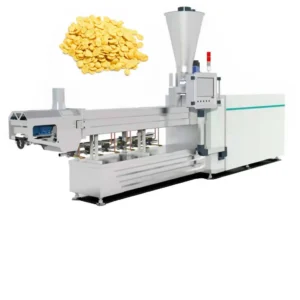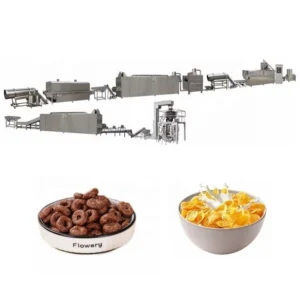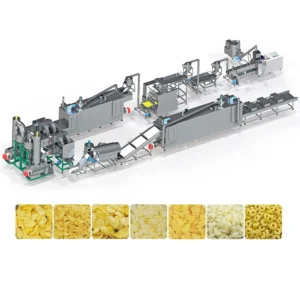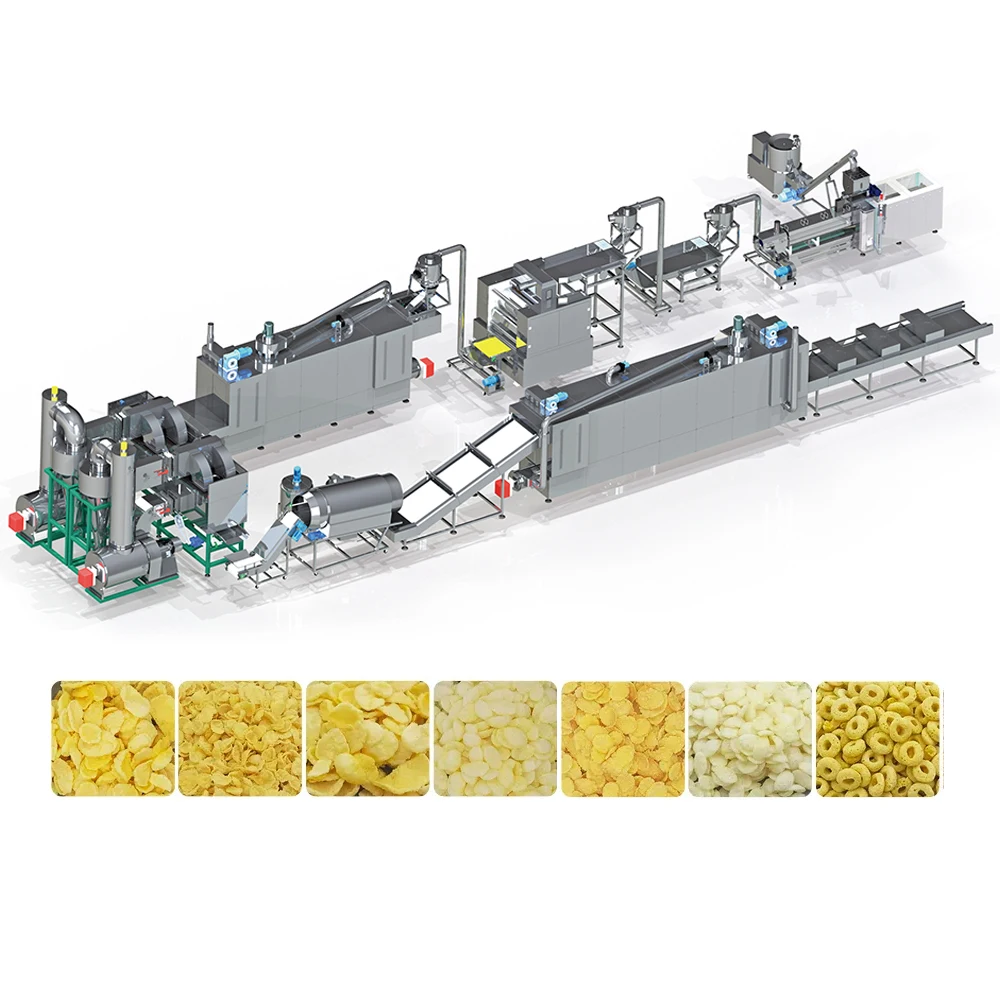
Integrated Process Design — Twin-screw extrusion parameters matched to downstream drying and pressing capacity, ensuring uniform starch gelatinization across the full corn flakes line.
Technical Specifications
| Parameter | Value |
|---|---|
| Product Type | Corn Flakes Breakfast Cereal Production Line |
| Screw Type | Twin Screw, co-rotating |
| Extruder Model | MT-65 |
| Mixer Tank Size | φ600 × 500 mm |
| Mixer Power | 4 kW |
| Mixer Load Range | 10–30 kg per batch |
| Screw Conveyor Power | 0.75 kW |
| Corn Flakes Press Roller Size | 510 × 310 × 1050 mm |
| Corn Flakes Press Power | 16.12 kW |
| High-Temperature Oven Heating | Gas-fired, both-side baking |
| High-Temperature Oven Dimensions | 4.5 × 1.4 × 1.8 m |
| Sugar Spraying System Roller | Ø600 × 2700 mm |
| Sugar Spraying System Power | 28.75 kW |
| Contact Material | Stainless steel on food-contact parts |
| Voltage Options | 3ph 380V 50Hz / 3ph 415V 60Hz / 3ph 220V 60Hz (configurable) |
| Control | Separate controller box for press machine; line control architecture to be confirmed |
| Certification | CE |
Application Suitability
| Application | Material or Output |
|---|---|
| Traditional corn flakes from maize flour | Corn or maize flour with controlled moisture for sheeted breakfast cereal |
| Multi-grain breakfast cereals | Blends of corn, rice, and oat powders extruded into pellet form before pressing |
| Sugar-coated or honey-coated cereal flakes | Corn flakes finished with syrup or honey in the sugar spraying drum |
| Fortified breakfast cereal production | Vitamin-enriched grain blends processed through twin-screw gelatinization |
| Shaped cereal snacks | Ring, ball, star, and stick formats via interchangeable extruder moulds |
Why Nominal Line Capacity Rarely Survives First Contact With Your Raw Material
A corn flakes extrusion production line turnkey rated on standard corn grits may stall or produce fractured flakes when your flour has different particle size or moisture content.
I watched this happen last year with a breakfast cereal producer who ordered a line based on catalog throughput. Their maize flour was milled finer than our trial batch, which changed how the material fed into the twin-screw barrel. The extruder ran, but the gelatinization was incomplete, and the pressing stage cracked nearly half the flakes. We had to rebuild the screw configuration and adjust moisture addition before the line held steady output [NEED_CITE: starch gelatinization behavior relative to flour particle size]. A corn flakes extrusion production line turnkey must therefore be validated on your exact raw material before the equipment leaves the factory, not after it arrives at your site.
How Screw Configuration Determines Flake Integrity
The co-rotating twin-screw extruder in this corn flakes extrusion production line turnkey uses sectional screw modules that can be rearranged along the barrel. Each section handles a different function — conveying, mixing, de-gassing, cooking, or forming. When corn flour enters the barrel, the screw profile controls residence time, shear intensity, and temperature progression. A configuration that works for coarse grits may generate insufficient shear on fine flour, leaving raw starch pockets that fracture during pressing. We adjust the screw arrangement and die geometry to the specific raw material behavior observed during in-house trial runs, matching the gelatinization degree your target flake density requires.
Matching Dryer and Oven Capacity to Extruder Output
The bottleneck on a corn flakes line is rarely the extruder itself — it is more often the dryer or oven downstream. If the high-temperature oven cannot remove moisture at the rate the extruder delivers pellets, material backs up and flake texture degrades. The gas-fired, both-side baking system in this line is sized to handle continuous throughput from the MT-65 extruder without creating a queue [NEED_CITE: thermal load calculation for breakfast cereal drying stages]. The vibrating spreader between the elevator and second dryer distributes pellets into a uniform layer, which prevents uneven drying that leads to mixed crispness across the batch.
Reading the Parameter Sheet Against Your Production Target
The 16.12 kW corn flakes press machine uses a 510 × 310 × 1050 mm roller set with an adjustable gap, which lets you control flake thickness directly. Thinner flakes toast faster and crisp more completely, but require precise moisture control upstream — too wet and they stick to the roller, too dry and they shatter. The integrated cooling system on the press prevents roller heat buildup that could soften flakes during continuous runs. Mixer load range of 10–30 kg per batch sets the batching rhythm; if your target output demands faster cycling, the mixer becomes the pacing station rather than the extruder. Voltage configurability across 380V, 415V, and 220V three-phase supplies means the motor specifications can be locked to your local grid before production begins, avoiding commissioning delays from mismatched frequency or phase [NEED_CITE: industrial voltage and frequency standards by region].
What Happens When Stations Are Sourced Separately
Buyers who assemble a corn flakes line from different vendors often discover at commissioning that the extruder output overwhelms the dryer, or the coating drum cannot keep pace with the cooling conveyor. The sugar spraying system here uses a Ø600 × 2700 mm roller with 28.75 kW drive, sized to coat flakes at the rate the upstream stations deliver them. When coating capacity falls short, syrup pooling causes clumping and uneven sweetness — a defect that reaches the packaging station before operators notice the pattern [NEED_CITE: coating uniformity defects in breakfast cereal finishing]. Sourcing the full line from one supplier means throughput at every station is calculated together, and any mismatch is caught on paper before metal is cut.
Why Procurement Decisions Made Here Reduce Commissioning Risk
Every station from the flour mixer through the cooling conveyor is specified as a matched set, so throughput calculations reflect actual inter-station flow rather than individual machine ratings. Screw configuration and die design are selected against your raw material sample, not copied from a generic build. An in-house testing workshop runs your corn flour through the extruder before shipment, producing a trial report that documents achievable output and flake quality on your specific material. Electrical schematics are drawn with your confirmed voltage, frequency, and control language, so the panel matches your factory supply on day one. Pre-sales consultation covers line layout, utility planning, and phased installation scheduling, continuing through commissioning and operator training at your site.
Documentation & Verification
- Line layout showing throughput matching across all 11 stations for your target output
- Screw and die configuration record tied to your raw material and target flake density
- Trial run report from in-house testing workshop using your corn flour sample
- Electrical schematic confirming voltage, frequency, and control language for your facility
- CE declaration of conformity covering the complete production line
- Wear parts list with screw, die, and roller replacement specifications
Installation, Commissioning & Support
- Foundation plan accounts for the 4.5 m oven length and press machine vibration isolation
- Dedicated electrical circuits specified for the 28.75 kW sugar spraying system and 16.12 kW press
- Equipment ships in modular sections; on-site assembly sequence follows the 11-station flow
- First-run parameter setting covers screw speed, barrel temperature zones, and roller gap calibration
- Operator training includes moisture adjustment, screw module changes, and press roller maintenance
- Spare screw segments, dies, and press roller shells stocked with documented replacement procedures
What We Need to Configure Your Line
Send your corn flour or grain blend sample along with the target flake thickness and coating type you plan to produce. Confirm your factory voltage, phase, and frequency so motor and control specifications can be finalized before fabrication. If you have existing upstream batching or downstream packaging equipment, share the interface dimensions and throughput rates so the line endpoints can be matched.
Frequently Asked Questions
Q: How is line capacity verified on my specific raw material before shipment?
A: Your corn flour sample runs through the extruder in our testing workshop. We document actual throughput, gelatinization degree, and flake quality achieved under controlled conditions. The trial report becomes part of your shipment documentation, so you know what the line delivers on your material before it leaves our floor.
Q: How do you match screw configuration to my target flake thickness?
A: Screw modules are rearranged based on your flour particle size and moisture content to control shear, residence time, and gelatinization. Die geometry is then selected to produce pellets that press into your specified flake thickness without cracking or sticking to the roller.
Q: What voltage and control options are confirmed before production?
A: We confirm your three-phase voltage, frequency, and preferred control language during the specification stage. The electrical schematic is drawn to match your facility supply, and the press machine controller is configured accordingly before assembly.
Q: Which spare wear parts should I order with the line?
A: Screw segments, extruder dies, and press roller shells experience the most wear during continuous corn flakes production. We supply a wear parts list with replacement specifications and lead times so you can plan your first reorder before the initial set reaches end of service life.