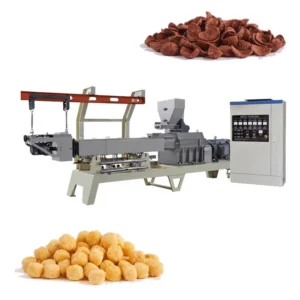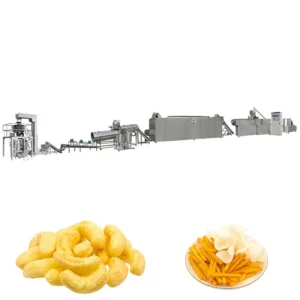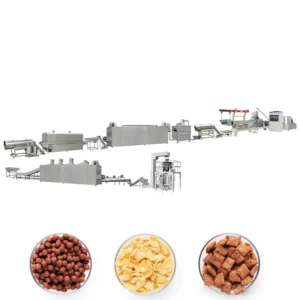
Integrated screw and die engineering — every barrel zone and roller gap on this line is matched to your grain formulation before the first test run, not borrowed from a generic build.
Technical Specifications
| Parameter | Value |
|---|---|
| Model | MT-65 |
| Product Type | Corn Flakes Breakfast Cereal Production Line |
| Screw Type | Twin-screw, co-rotating, sectional modules |
| Mixer Output | 10–30 kg/load (basis to be confirmed with raw material and moisture) |
| Mixer Power | 4 kW |
| Mixer Tank Size | φ600 × 500 mm |
| Mixer Dimension | 1000 × 800 × 1200 mm |
| Screw Conveyor Power | 0.75 kW |
| Screw Conveyor Dimension | 2700 × 500 × 2400 mm |
| Corn Flakes Press Machine Power | 16.12 kW |
| Corn Flakes Press Machine Size | 1550 × 1300 × 2000 mm |
| Press Machine Roller | 510 × 310 × 1050 mm |
| High-temperature Oven Size | 4.5 × 1.4 × 1.8 m |
| High-temperature Oven Power | 3.75 kW |
| Oven Heating Method | Gas-fired, dual-side baking |
| Sugar Spraying System Total Power | 28.75 kW |
| Sugar Spraying System Dimension | 4000 × 1900 × 1880 mm |
| Sugar Spraying Roller Size | Ø600 × 2700 mm |
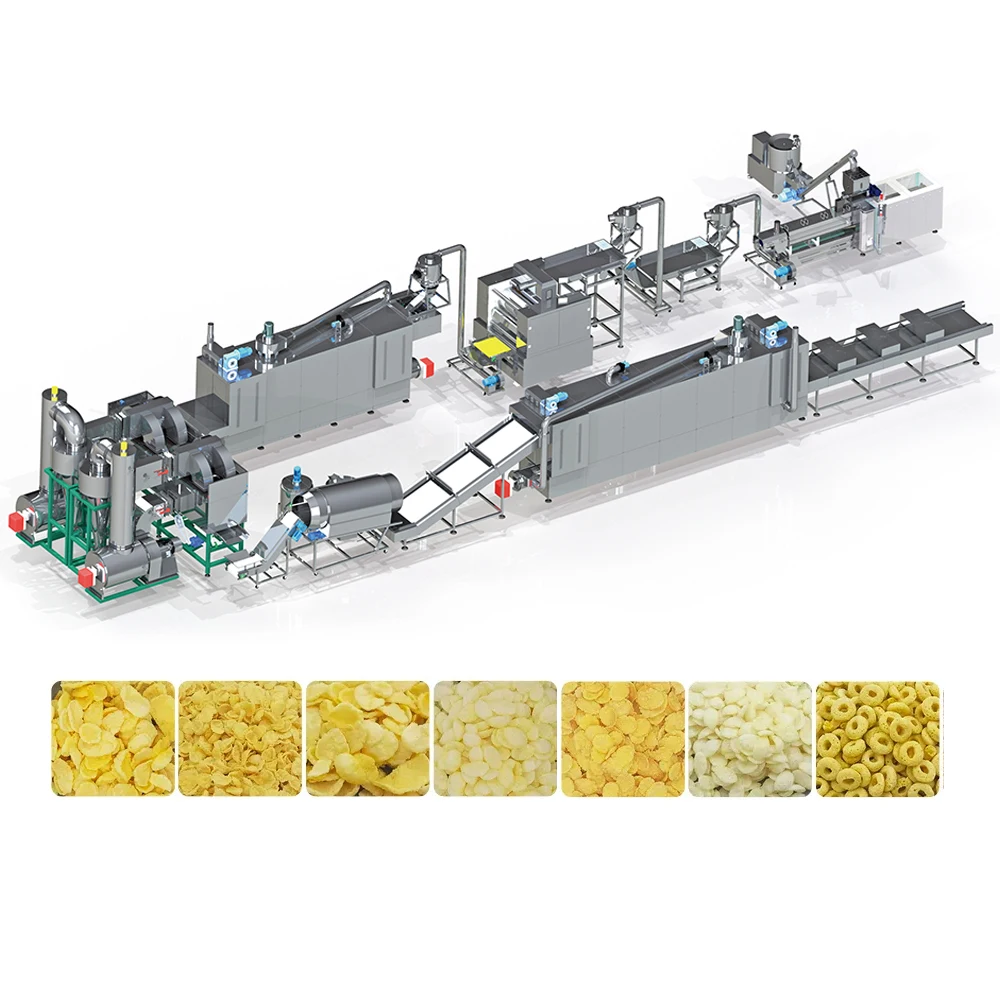
| Line Stations | Flour Mixer → Screw Elevator → Double-screw Extruder → Elevator → Dryer → Elevator → Coating Line → Vibrating Spreader → Elevator → Dryer → Cooling Conveyor |
| Material Contact Parts | Stainless steel |
| Voltage & Frequency | Customizable (3ph 380V/415V/220V at 50Hz or 60Hz) |
| Control System | Separate controller box for press machine (source value — verify against manufacturer catalog) |
| Standards | CE |
Application Suitability
| Application | Material or Output |
|---|---|
| Corn flakes for retail breakfast cereal | Corn grits or corn flour with vitamin fortification |
| Multi-grain flakes | Blends of rice, oat, and corn powders |
| Sugar-coated cereal snacks | Extruded rings, balls, stars, sticks with sugar or honey coating |
| Institutional breakfast cereal supply | Fortified grain formulations for nutrition programmes |
Why Screw Geometry Decides Whether Your Flakes Hold Together
A line rated at a nominal throughput that cannot sustain it on the buyer’s actual grain blend is one of the most frequent failures in breakfast cereal projects. The corn flakes extrusion line specifications screw configuration must be locked to your raw material before the machine is built, not after it arrives.
I once configured a corn flakes line for a customer who mixed standard maize flour with millet and sorghum. The initial trial used plain corn — everything expanded correctly, the flakes pressed flat, toasted evenly. When the customer ran his own blend on site, the starch gelatinisation curve shifted, the dough was too dry inside the barrel, and the flakes came out brittle and shattered during coating. The press roller caught fragments instead of sheeting them. We rebuilt the screw module sequence and adjusted the moisture addition point, but that two-week setback cost him an entire production season launch. [NEED_CITE: starch gelatinisation behaviour in multi-grain extrusion]
That is the reason every grain formulation needs its own screw and die configuration record, written before steel is cut.
Barrel Temperature Profile and Starch Behaviour
The MT-65 barrel is divided into heating zones, each set independently. Corn starch gelatinises at a different temperature window than rice or oat starch, and multi-grain blends shift that window further. The corn flakes extrusion line specifications screw configuration determines how long the dough stays at peak gelatinisation temperature and how much shear it receives before exiting the die. Too short a residence time and the centre of the pellet remains raw; too long and the surface degrades before flaking.
Moisture Control at Every Transfer Point
Moisture enters the process at the mixer and leaves it in the dryer and oven, but the critical control point is between extrusion and pressing. If the extruded pellet cools unevenly before reaching the press machine roller, some pieces arrive too dry and crack under pressure while others remain too plastic and stick to the roller surface. The elevator and dryer stages between the extruder and the press must therefore be tuned as one continuous moisture-management step, not as isolated stations. [NEED_CITE: moisture migration in extruded cereal pellets before flaking]
What the Press Roller Gap Actually Controls
The press machine on this line carries a 510 × 310 × 1050 mm roller set with adjustable gap. That gap, combined with pellet moisture and temperature at the moment of pressing, sets the final flake thickness and surface density. A thinner flake toasts faster in the gas-fired oven but is more fragile during sugar coating and packing. A thicker flake survives handling better but may retain a hard centre after toasting. The 16.12 kW drive and separate controller box allow the operator to adjust roller speed and gap independently of the extruder output rate, which is necessary when switching between corn-dominant and multi-grain formulations.
The Gas-Fired Oven and Dual-Side Baking
The 4.5 m long oven at 3.75 kW uses gas-fired dual-side heating. In corn flake production, single-side baking tends to curl the flake because one surface dries and contracts before the other. Dual-side exposure reduces curl and keeps the flakes flat enough to pass through the sugar spraying drum without jamming. The Ø600 × 2700 mm coating roller in the spraying station then distributes syrup across a bed of uniformly flat flakes rather than a mixed pile of curled and flat pieces.
Throughput Matching Across the Full Line
The station sequence — mixer, extruder, elevator, dryer, press, coating, vibrating spreader, second dryer, cooling conveyor — only works if each stage can handle the volume the previous stage delivers. A mixer loading 10–30 kg per batch feeds the extruder at intervals; if the dryer or oven cannot clear that batch before the next one arrives, pellets accumulate and cool past the pressing window. The sugar spraying system at 28.75 kW total power and the cooling conveyor at the end must also clear material at the same rhythm. Capacity calculations should confirm this matching against your specific grain blend and target flake thickness. [NEED_CITE: throughput balancing in breakfast cereal production lines]
The Hidden Cost of Generic Screw Builds
When a supplier copies a screw module arrangement from a standard catalogue rather than specifying it to your grain blend, the extruder may run — but the downstream consequences are expensive. Brittle flakes break in the coating drum, producing fines that clog the vibrating spreader. Uneven expansion causes some flakes to toast properly while others burn or remain doughy. The operator ends up slowing the entire line to find a compromise speed, which means the actual throughput never reaches what was quoted. [NEED_CITE: extrusion screw configuration impact on downstream yield]
Why Source the Line Here
Complete station matching from batching to cooling is designed under one supplier, so the dryer, oven, and coating drum are sized to the extruder output rather than sourced separately and hoped to fit.
Screw configuration and die design are specified to the buyer’s raw material and target flake density, documented in a configuration record that travels with the machine.
An in-house testing workshop runs trial production on the customer’s actual grain blend before shipment, so starch behaviour and flake integrity are confirmed before the line leaves the factory.
Twin-screw expertise extends across corn flakes, multi-grain cereals, puffed snacks, and fortified breakfast products, so the same engineering team handles formulation changes without handing the project to a different department.
Pre-sales engineering covers line layout, utility planning, voltage confirmation, and control language — all locked before production begins rather than negotiated during commissioning.
Documentation & Verification
- Screw and die configuration record matched to your grain formulation and target flake density
- Line layout and capacity calculation showing throughput at every station from mixer to cooling conveyor
- Trial run report on your actual raw material conducted in the testing workshop before dispatch
- Electrical schematic with confirmed voltage, frequency, and control language for your facility
- CE declaration of conformity and ISO certificate included with customs documentation
- Operation and maintenance manual with wear parts list for screw modules, die inserts, and press roller
Installation, Commissioning & Support
- Foundation plan accounts for the 4.5 m oven and 4 m coating system footprint plus elevator clearances
- Separate electrical circuits required for the 28.75 kW sugar spraying system and 16.12 kW press machine
- Line arrives in sectional modules; reassembly sequence documented in the installation manual
- First commissioning run includes barrel temperature profiling and press roller gap calibration on your grain blend
- Operator training covers screw module changes for switching between corn-dominant and multi-grain recipes
- Wear parts inventory includes replacement screw sections, die plates, and press roller bearings
What We Need to Configure Your Line
Share the grain formulation you intend to run — corn percentage, any secondary grains, and whether you add vitamin premix — along with your target flake thickness and daily production volume. Confirm the voltage and frequency at your facility and the language your operators need on the control interface. If you can send a sample of your raw material, we will run a trial in the testing workshop and include the results with the proposal.
Frequently Asked Questions
Q: How is screw configuration and die design determined for my specific grain formulation?
A: We review your grain blend ratios, target flake thickness, and nutritional additives, then select the screw module sequence and die geometry to match the starch gelatinisation behaviour of that blend. A trial run on your raw material in our testing workshop confirms expansion, texture, and pressing performance before the configuration is finalised.
Q: What voltage and frequency options are available, and how is the control language confirmed?
A: The line supports 3-phase supply at 380V, 415V, or 220V, at either 50Hz or 60Hz. Voltage and frequency are confirmed before production. Control system language is agreed at the same stage so that the HMI, alarms, and manual are all in your operators’ language when the line arrives.
Q: How is throughput matched between the extruder, press machine, and coating line?
A: Each station’s capacity is calculated against the extruder batch cycle and the moisture removal rate of the dryers. The press machine roller speed, oven belt speed, and sugar spraying drum rotation are all set so that material flows continuously without accumulating between stages.
Q: Can I send my raw material for a trial run before the line ships?
A: Yes. Our in-house testing workshop runs your actual grain blend through the extruder and press to verify flake density, expansion, and coating adhesion. The trial report is included in your documentation package and forms the baseline for screw and die configuration.
Q: What parameters differ when producing corn flakes versus other cereal formats like rings or balls?
A: Corn flakes require a specific barrel temperature profile that achieves partial gelatinisation — enough for the pellet to hold shape through the press but not full expansion at the die. Rings and balls need higher expansion at the die and skip the press stage entirely, so the screw module sequence, die plate, and downstream drying times are all reconfigured.