Screw Profile Matched to Formulation — Trial runs on your specific raw material confirm pellet density and expansion before the line leaves the factory.
Technical Specifications
| Parameter | Value |
|---|---|
| Product Type | Twin Screw Fish Feed Extrusion Line |
| Output Capacity | 1.0–1.5 t/h (basis not stated in source — confirm raw material formulation, moisture content, and pellet size) |
| Screw Type | Twin-screw |
| Construction Material (Product Contact) | 304 stainless steel |
| Control System | PLC / MCC (to be confirmed based on plant preference) |
| Voltage & Frequency | Configurable to destination market (to be confirmed) |
| Target Species | Trout, salmon, catfish (floating and sinking formats) |
| Die Configuration | Specified to pellet diameter and density target (to be confirmed) |
| Steam or Water Injection | To be confirmed based on preconditioning requirements |
| Assembly State | Complete processing line (scope to be confirmed) |
Application Suitability
| Application | Material or Output |
|---|---|
| Floating feed for trout and salmon | High-protein formulations requiring controlled expansion and starch gelatinisation |
| Sinking feed for catfish | Dense pellet formulations requiring compression over expansion at the die |
| Multi-species feed milling | Lines producing different pellet sizes and densities on the same extruder platform |
| Marine species grow-out feed | Formulations with fish meal and oil content requiring matched drying and coating capacity |
Why Pellet Density Drifts When the Screw Profile Is Copied
Extrusion parameters must be dialed to the actual raw material, not transplanted from a generic build.
A floating feed pellet that sinks on arrival destroys credibility with the end farmer. The issue is rarely the extruder itself but the screw configuration and die geometry that were carried over from a different formulation. I have seen lines where a manufacturer swapped to a higher-fat fish meal blend and suddenly half the output dropped below the waterline, because the shear profile and barrel temperature zones were set for a starch-heavy corn base. The twin screw fish feed extrusion line only holds specification when the screw elements, die land length, and moisture preconditioning are all specified against the buyer’s exact recipe. [NEED_CITE: starch gelatinisation temperature ranges in aquaculture feed processing]
Screw Element Sequencing and Shear Control
The arrangement of conveying, kneading, and reverse-screw elements inside the barrel determines how much mechanical energy transfers into the material. For floating feed, the twin screw fish feed extrusion line needs a longer high-shear section to achieve full starch gelatinisation and trap air pockets during expansion at the die. For sinking feed targeting catfish, the screw profile shifts toward gentler mixing with higher compression, pushing density above the waterline threshold. This is not a matter of swapping one element — the entire sequence from feed inlet to die face must be reconfigured when switching between floating and sinking formats.
Barrel Temperature Zones and Moisture Balance
Each barrel section can be heated or cooled independently, creating a temperature gradient that controls viscosity as the dough moves toward the die. If the mid-barrel zone runs too hot on a high-fat trout formulation, the fat separates before the pellet reaches the die face, producing a crumbly pellet with poor water stability. Getting the barrel profile right requires knowing the fat content, protein source, and starch level of the incoming mix, which is why preconditioner steam injection and barrel zone settings are tuned together rather than in isolation. [NEED_CITE: barrel temperature profiling in twin-screw extrusion for aquatic feed]
How Die Land Length Shapes Pellet Density
The die plate is not just a hole — the length of the land (the straight channel the dough passes through before exiting) directly controls back-pressure and expansion ratio. A short land lets the pellet expand aggressively at exit, locking in buoyancy for floating feed. A longer land holds pressure higher, compressing the pellet into a denser form that sinks. Die diameter, number of holes, and land length are all specified to the target pellet size and species. A trout farm expecting 3mm pellets and a catfish operation needing 6mm sinking pellets require entirely different die plates on the same extruder.
What Happens When Line Stations Are Mismatched
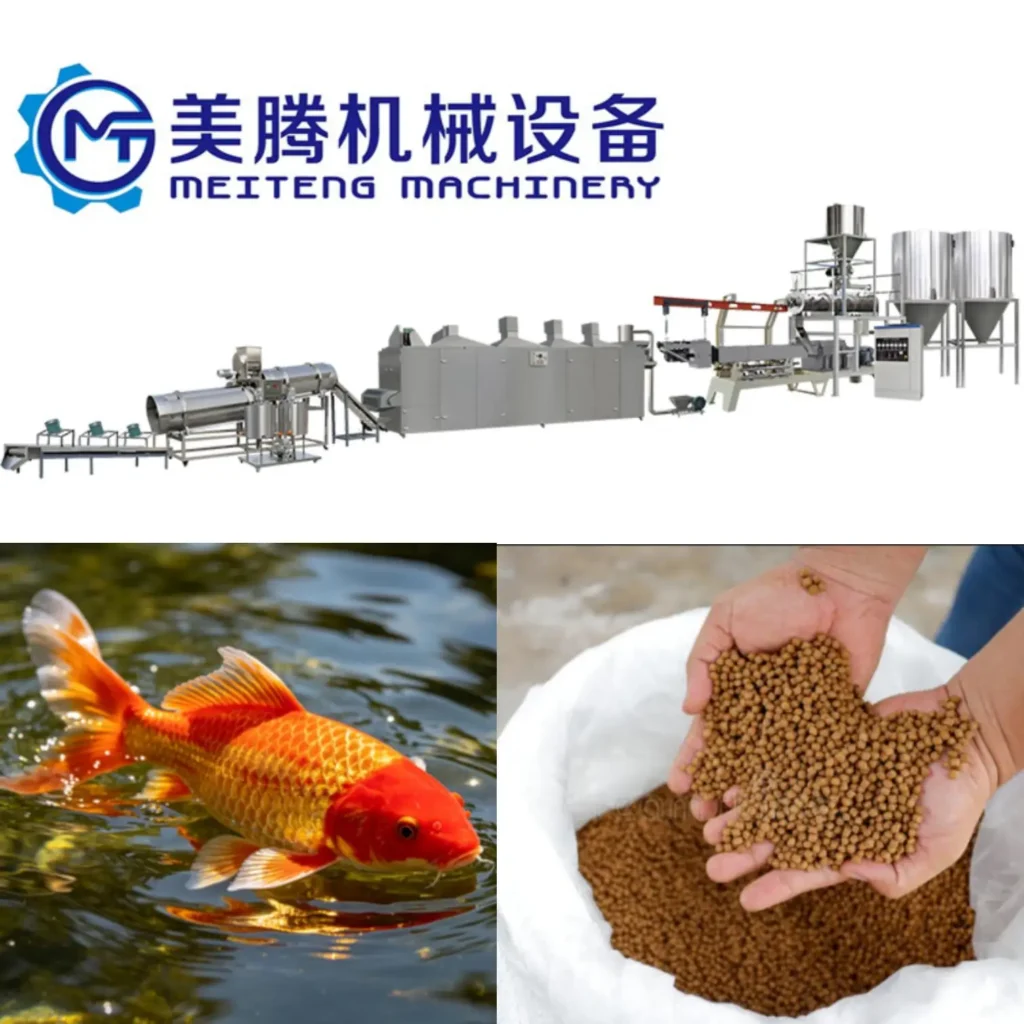
An extruder producing 1.5 tonnes per hour is only productive if the dryer and coating drum can handle that same volume without bottlenecking. I have seen installations where the extruder was specified correctly but the dryer was undersized, forcing the operator to slow the extruder and run at a fraction of capacity just to avoid sending wet pellets to the coater. The twin screw fish feed extrusion line must have throughput matched across every station — mixer, extruder, dryer, coating drum, cooler, and packing — or the rated output is meaningless. Undersized downstream equipment also forces longer residence times in the dryer, which can over-dry the pellet surface while the core retains moisture, leading to cracking and fines generation during storage. [NEED_CITE: throughput matching across aquaculture feed processing stations]
Why This Line Is Built Around Your Recipe
The screw configuration and die geometry are specified to the buyer’s raw material and target pellet density, not pulled from a standard catalogue. The in-house testing workshop runs trial batches on the customer’s actual formulation before shipment, confirming expansion ratio, floatation percentage, and water stability. Throughput is matched across extruder, dryer, and coating stations so no single element bottlenecks the line. Electrical schematics and control language are confirmed to the destination market before production begins, avoiding commissioning delays. Pre-sales engineering covers line layout and utility planning, and support continues through on-site installation, operator training, and wear parts supply.
Documentation & Verification
- Screw and die configuration record documenting element sequence, die land length, and target pellet density for your formulation
- Trial run report on your raw material confirming expansion ratio, floatation, and water stability before dispatch
- Line layout and capacity calculation showing matched throughput across extruder, dryer, and coating stations
- Electrical schematic with voltage, frequency, and control language confirmed to your facility’s power supply
- Wear parts list specifying screw elements, die plates, and cutter blades with reorder references
Installation, Commissioning & Support
- Foundation plan accounts for extruder weight and vibration, with anchor bolt layout provided before concrete pour
- Dedicated electrical circuit sized for the main drive motor, with voltage and frequency verified to local supply
- Extruder barrel sections and screw shafts ship disassembled for container loading, with reassembly supervised on site
- First-run commissioning includes screw speed, barrel temperature, and moisture adjustment to hit pellet density targets
- Operator training covers screw element inspection, die plate changeover, and daily grease point schedules
- Wear parts stock list provided at handover, covering high-wear screw elements and die plates for initial production runs
What We Need to Move Forward
To configure the line correctly, we need your raw material formulation including protein source, fat percentage, and starch content, along with the target pellet diameter and whether floating or sinking feed is required. Confirm your facility’s voltage, frequency, and preferred control language so the electrical package matches your site. If you are adding this line to an existing plant, share the capacity of your current mixer and packing station so throughput can be balanced across the full process.
Frequently Asked Questions
Q: How is output capacity verified on the buyer’s actual raw material formulation?
A: We run trial batches in our testing workshop using the customer’s raw material or a close equivalent. The trial measures throughput, pellet density, expansion ratio, and water stability under controlled conditions. Results are documented in a report shared before shipment, so the buyer knows the line holds specification on their formulation rather than on a generic test recipe.
Q: How are screw configuration and die design matched to floating versus sinking feed targets?
A: Floating feed requires a screw profile with higher shear to fully gelatinise starch and trap air for buoyancy, paired with a short-land die for expansion. Sinking feed uses gentler mixing elements and a longer-land die to compress the pellet. Both configurations are documented in the screw and die record for future reorders.
Q: What is the scope of line stations included?
A: The complete line typically covers mixing, extrusion, drying, coating, cooling, and packing. Each station is sized to match the extruder’s throughput so no bottleneck forms downstream. The exact scope is confirmed during the line layout phase based on the buyer’s production requirements and existing equipment.
Q: Is a trial run performed on the buyer’s raw material before shipment?
A: Yes. The in-house testing workshop runs the buyer’s formulation through the extruder before the line ships. The trial confirms pellet density, expansion, and durability against the target specification. If adjustments are needed to the screw profile or die geometry, they are made and retested before factory acceptance.
Q: How are voltage, frequency, and control language confirmed?
A: The buyer provides their facility’s electrical supply details and preferred control interface language during the specification phase. The electrical schematic and PLC program are built to those parameters, avoiding delays during on-site commissioning caused by mismatched power supply or unfamiliar interface language.